Liu Yuan relocates after a famine in …
Years: 305 - 305
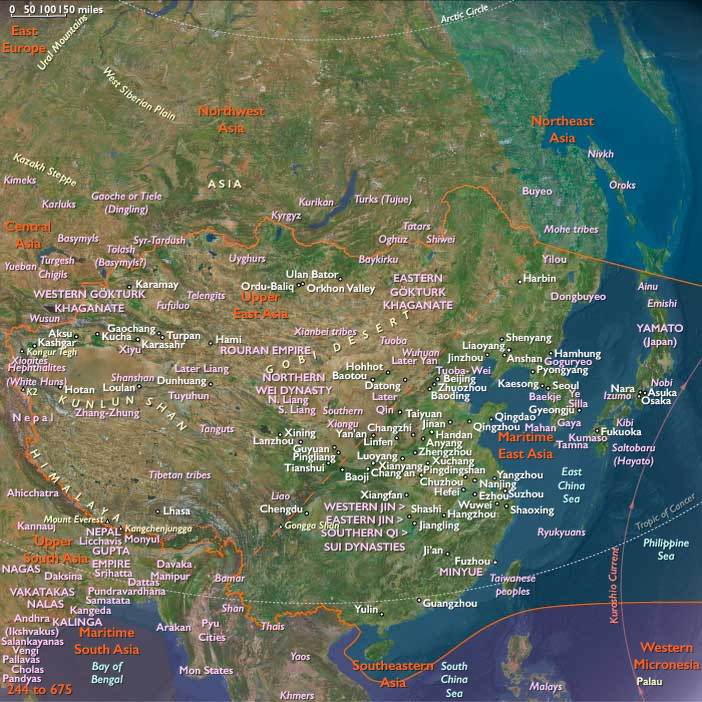
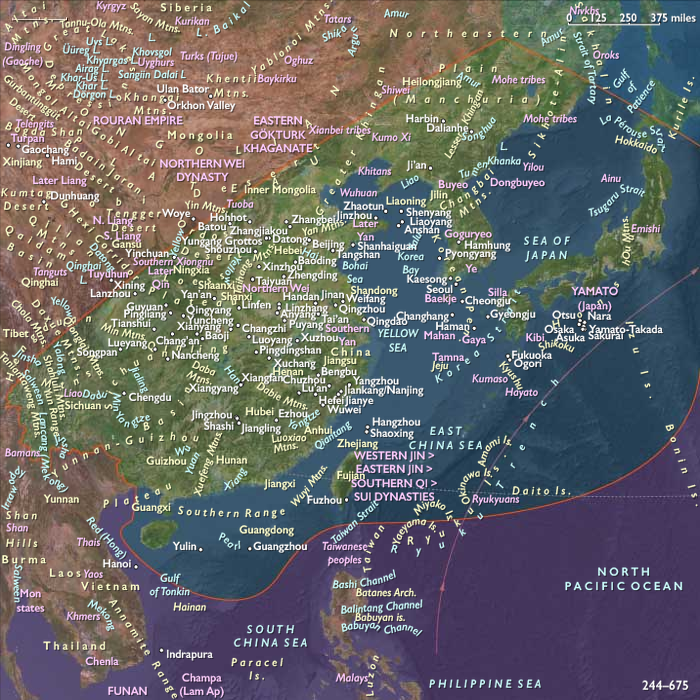
Liu Yuan relocates after a famine in 305 to Liting (in modern Changzhi, Shanxi).
Locations
People
Groups
Topics
- Six Dynasties Period in China
- Eight Princes, War of the
- Sixteen Kingdoms Period in China
- Wu Hu Uprising
Commodoties
Subjects
Regions
Subregions
Related Events
Filter results
Showing 10 events out of 60010 total
Galerius becomes Augustus of the East on Diocletian's abdication, ruling the Balkans and Anatolia.
Technically, he is subordinate to the Western ruler, Constantius, but since Galerius has arranged the appointment of two of his favorites, Maximinus (his nephew, originally called Daia) and Flavius Valerius Severus, to be Caesars in both East and West, he is in effect the supreme ruler.
Constantius's son Constantine is thus passed over.
Prostitutes, long licensed by the Roman Empire and duly taxed, suffer excommunication by the Christian church in 305, on moral grounds.
Despite the religious ban, the well-established institution will continue to flourish and provide an important source of tax revenue to the imperial state.
Diocletian, having saved the empire from disintegration by establishing strong central control and a bureaucracy, abolishing the last Roman republican institutions, has aged prematurely through illness.
Of his own volition, he decides to entrust the affairs of the empire to younger men and returns first to Nicomedia, where he abdicates on May 1, 305.
Perhaps he has decided that, after twenty years of reign, his abdication is also “fateful.”
Constantine, son of the emperor Constantius Chlorus, had been seen as a youth by his future panegyrist, Eusebius, bishop of Caesarea, passing with Diocletian through Palestine on the way to a war in Egypt.
Constantine’s experience as a member of the imperial court—a Latin-speaking institution—in the Eastern provinces will leave a lasting imprint on him.
Educated to less than the highest literary standards of the day, he will always be more at home in Latin than in Greek.
Christianity he encounters in court circles as well as in the cities of the East; and from 303, during the great persecution of the Christians that began at the court of Diocletian at Nicomedia and is enforced with particular intensity in the eastern parts of the empire, Christianity has become a major issue of public policy.
It is even possible that members of Constantine's family are Christians.
Emperor Diocletian completes the decade-long construction of his magnificent palace on the Dalmatian coast at Salona (present Split, or Spalato, in Croatia).
Both residence and fortress, the palace follows the rectangular plan of a Roman military camp, corner towers and turrets surmounting its massive walls, and broad colonnaded avenues intersecting the enclosure.
Diocletian adds Helvetia, and part of Germania Superior to Sequania, which is now called Provincia Maxima Sequanorum, Vesontio receiving the title of Metropolis civitas Vesontiensium.
Maximian’s monumental bathing complex in Rome, completed in 305 and known as the Baths of Diocletian, is the largest of all Roman baths, covering an area of over one hundred and thirty thousand square yards (one hundred and eight thousand seven hundred square meters).
An arcaded enclosure wall with alternating apsidal and rectangular rooms, originally decorated with mosaics and enclosed gardens, enormous sculptures, and a theaterlike rotunda where visitors can view athletic events, surrounds the complex’s barrel-vaulted core.
Like the Baths of Caracalla, the bathing pools in the central building consist of a “caldarium” (hot bath), “tepidarium” (warm bath), “frigidarium” (cold bath), and “natatio” (swimming pool), flanked by numerous service rooms and exercise grounds.
Neoplatonist philosopher Porphyry dies in 305, probably in Rome, leaving in addition to his important writings on the life and philosophy of his mentor Plotinus voluminous scholarly writings on philosophy, religion, philology, and science.
Among these are commentaries on Aristotle's Categories, including his influential introduction (“Isagoge”), and his fiercely critical Against the Christians.
A lecturer on Plotinus and tutor to the Syrian philosopher Iamblichus, Porphyry had written a biography of the mathematician Pythagoras, and transmitted valuable fragments of earlier thought in his On Abstinence, a case for vegetarianism.

On the same day—May 1, 305—that Diocletian abdicates at Nicomedia, Maximian abdicates, evidently reluctantly, at Mediolanum (modern Milan), which from this point is to serve as the official capital of the Western Roman Empire.
One of the earliest Christian councils, the Council of Elvira, probably held near or in the present city of Granada in 305 or 306, decrees that all priests and bishops, married or not, should abstain from sexual relations; it also forbids Christians from intermarriage and social interaction with Jews.
Galerius, refusing recognition of the imperial claim at the death of Constantius, instead offers Constantine the lesser rank of caesar.
He insists that Severus govern the West, but his protégé’s supremacy is short-lived: the new ruler becomes unpopular when he imposes higher taxes on the people of Rome and of Italy.
Constantine Joins His Father Constantius in the West (305–306 CE)
In 305 CE, following the abdication of Diocletian and Maximian, Constantius Chlorus was elevated to Augustus of the West, while Galerius became the senior emperor (Augustus) of the East. As part of the Tetrarchic system, Constantius now ruled Gaul, Britannia, and Hispania, while Galerius controlled the Balkans and the Eastern provinces.
Recognizing the political and military significance of his son, Constantius requested that Constantine be sent to join him at Gesoriacum (modern Boulogne, France). This move would prove to be pivotal in Constantine’s rise to power.
1. Constantine’s Status Under Galerius
- Constantine had been serving under Galerius in the Eastern court, gaining military and administrative experience.
- As the son of an emperor, he was a potential rival to Galerius and his faction.
- Constantine was aware that remaining too long in the East might jeopardize his future, as Galerius favored his own allies over Constantine.
2. Constantine’s Escape and Journey to the West
- Galerius was reluctant to send Constantine to Constantius, fearing that he might become a threat.
- According to historical accounts, Constantine escaped the Eastern court, possibly by secretly fleeing at night.
- He allegedly disabled or took the horses along his escape route to prevent pursuit by Galerius’ men.
- He traveled across the empire to Gaul, where he joined his father at Gesoriacum.
3. Constantine Joins His Father in Britain
- Shortly after his arrival, Constantius launched a campaign in Britain, aimed at securing Roman control over the northern frontier.
- Constantine accompanied his father on military campaigns against the Picts, further developing his leadership and battlefield experience.
4. The Death of Constantius and Constantine’s Proclamation (306 CE)
- In July 306 CE, Constantius fell ill and died at Eboracum (modern York, England).
- His troops immediately proclaimed Constantine as Augustus, despite the Tetrarchic system, which did not allow for dynastic succession.
- This move challenged the authority of Galerius, setting the stage for a new power struggle in the empire.
5. Conclusion: A Key Turning Point in Constantine’s Rise
- Constantine’s journey to the West was a defining moment that allowed him to escape Galerius’ control and establish himself as a legitimate claimant to the throne.
- His proclamation as emperor in 306 CE triggered a series of civil wars, culminating in his ultimate victory and unification of the Roman Empire in 324 CE.
- This event set the course for Constantine’s eventual conversion to Christianity and the founding of Constantinople, shaping the future of the Roman world.
By securing his place at his father’s side, Constantine positioned himself for greatness, paving the way for his eventual ascendancy as the sole ruler of Rome.
Years: 305 - 305
Locations
People
Groups
Topics
- Six Dynasties Period in China
- Eight Princes, War of the
- Sixteen Kingdoms Period in China
- Wu Hu Uprising