Liu Yong claims to be the proper …
Years: 29 - 29
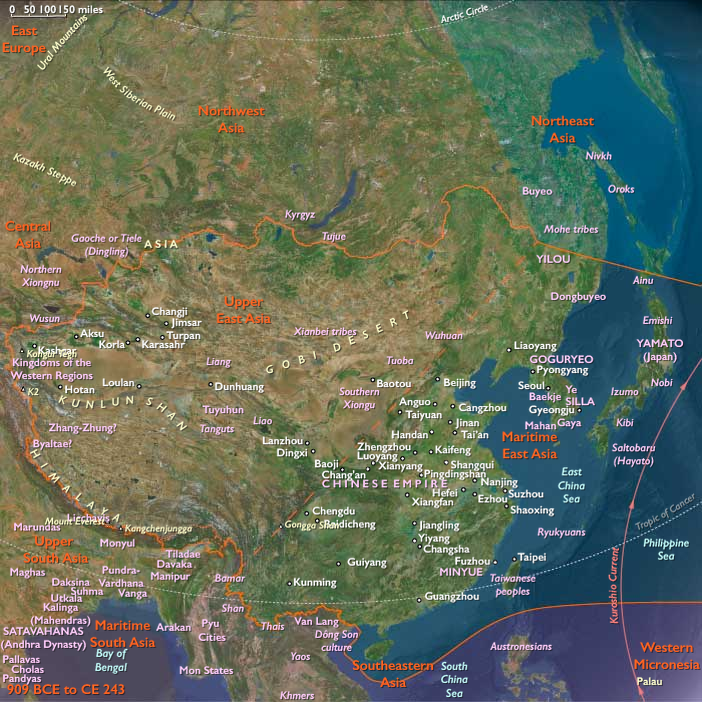
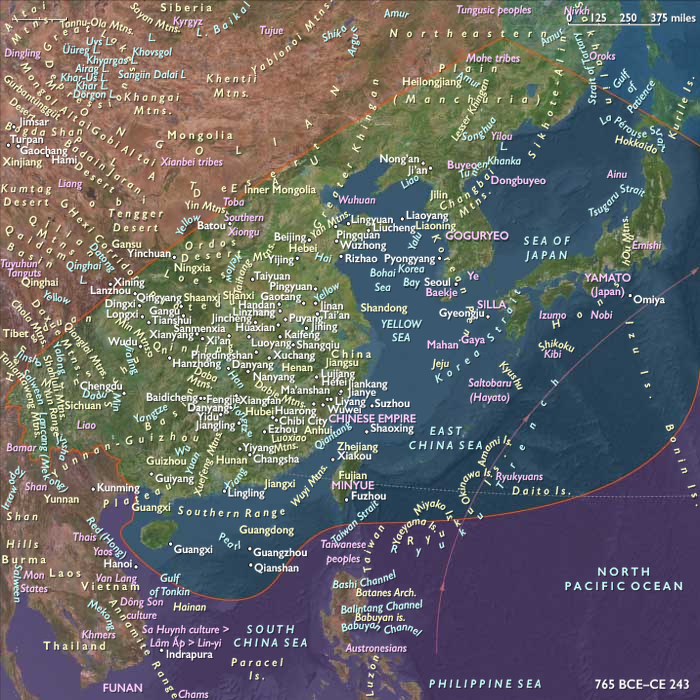
Liu Yong claims to be the proper emperor of Han, based on his lineage—as the son of Liu Li , the Prince of Liang under the reigns of Emperor Cheng, Emperor Ai, and Emperor Ping who had been forced by Wang Mang to commit suicide; he controls the modern eastern Henan and northern Jiangsu region.
Liu Yong's son and heir Liu Yu is defeated by Eastern Han forces and killed in CE 29.
Locations
People
Groups
Topics
Commodoties
Subjects
Regions
Subregions
Related Events
Filter results
Showing 10 events out of 61894 total
Peng Chong, who had by this point been aggravated by Emperor Guangwu's official Zhu Fu into rebellion (in a rare case of a succession of wrong decisions by Emperor Guangwu—mistakes that he learns from and will not repeat), claims the title of the Prince of Yan and controls the modern Beijing region.
Peng's slaves assassinate him in CE 29, leading to a collapse of his regime.
Chimei was the largest of the enemy force that Emperor Guangwu had had to face in his campaign to reunify the empire under the rule of his Eastern Han Dynasty, but there are a number of regional powers which which he still must deal.
Zhang Bu, nominally the Prince of Qi under Liu Yong, independently controls the modern Shandong region.
Seeing the futility of resistance, Zhang surrenders and is created a marquess.
Wei Xiao, nominally the commander of the Xizhou region paying allegiance to Emperor Guangwu, independently controls the modern eastern Gansu region, east of the Yellow River.
Dou Rong, nominally the governor of Liang Province paying allegiance to Emperor Guangwu, independently controls the modern western Gansu and northern Qinghai region, west of the Yellow River.
Lu Fang, who also claims the name Liu Wenbo and claims to be a descendant of Emperor Wu and the proper Han emperor, is supported by Xiongnu's Chanyu Yu; he controls the modern central and western Inner Mongolia region.
Some Russian archaeologists have identified a Han-era Chinese-style palace unearthed near Abakan (in Southern Siberia) in 1941-45 as Lu Fang's residence after he had left China for the lands of the Xiongnu.
Gongsun Shu, who claims the title emperor of his independent empire Chengjia, controls modern Sichuan and Chongqing.
(He is known also as the White Emperor (Baidi, and, according to legends, he founded the city Baidicheng which bears that title.)
Of these polities, Gongsun Shu's Chengjia is the most wealthy and powerful, but Gongsun is content to maintain his regional empire and not carry out any military expeditions outside his empire.
Instead, he sits by as Emperor Guangwu carries out his unification campaign.
Emperor Guangwu, hesitant to carry out annihilation campaigns, largely prefers first trying to persuade the regional warlords to submit to him.
Wei and Dou do in 29, and as they are assisting Eastern Han forces to the north of Chengjia, Gongsun is further discouraged from trying to expand his empire.
Jesus reportedly promises the availability to the "poor"—those who know and acknowledge their need—of a share in God's kingdom, and that those who pride themselves in their possessions and attainments will be punished on the Day of Judgment.
Jewish law forbids the eating of certain foods, but Jesus (according to the Gospels) teaches that people are defiled by their words and deeds rather than by what they eat.
Performing forbidden activities on the Sabbath when it is necessary to serve human needs, Jesus does not hesitate to eat and drink with those regarded as sinners, not only accepting invitations to eat with the ritually impure, but inviting himself to their meals.
This is a radical stance during a time when observance of purity laws at the meals eaten by family and friends is the most important means of establishing Jewish identity.
Two of the dominant themes in Jesus’ ethical teachings (summarized by Matthew in his account of the Sermon on the Mount) are the command to love one's neighbor—including one’s enemies—and the assurance that God's purpose is achieved through the suffering of the righteous.
In a departure from the commonplace notion that suffering is a sign of divine disfavor, Jesus explains to his followers that being a servant of God inevitably involves suffering.
This is another objectionable concept to those of traditional piety, and also to those who are convinced that God's people must direct action militarily and in resistance movements if Roman power is to be overthrown and an independent Jewish national state reestablished.
Jesus refuses to permit his followers to take up arms, instead counseling his questioners to pay taxes to the Roman state.
Since Judah's semi-legendary King David is taken as a symbol of fulfillment in the future, the New Testament writers will emphasize that Jesus is of the lineage of David, the founding royal house of Judah.
Jesus shatters his follower’s expectations of a conquering Messiah, however, by repeatedly insisting that he will be, in fulfillment of his messianic role, rejected by the authorities, suffer, and die.
This is a nearly impossible concept for his disciples to grasp, even though some of them—Peter, James and John—share in a visionary experience on a mountain—called the Transfiguration—intended to assure them that beyond his coming sacrificial death is a day of triumphant vindication.
He is to be raised up from the dead and exalted as the chosen instrument of God.
Agrippina the Elder has lived for the past decade on the Palatine Hill in Rome, raising her remaining children between her, Livia Drusilla and Germanicus’ mother Antonia Minor.
Agrippina has become lonely, distressed, physically ill and many of her relatives have died.
Agrippina has a hasty, uncomfortable relationship with Tiberius and possibly with Tiberius’ mother Livia.
She has become involved in politics in Tiberius’ imperial court, become an advocate for her sons to succeed Tiberius, and opposes Tiberius’ natural son and natural grandson Tiberius Gemellus for succession.
She is unwise in her complaints about Germanicus’ death to Tiberius.
Tiberius took Agrippina by her hand and quoted the Greek line: “And if you are not queen, my dear, have I then you wrong?” Agrippina has become involved in a group of Roman Senators who oppose the growing power and influence of the notorious Sejanus, the Praetorian Prefect left in charge of Rome by the voluntary withdrawal of Tiberius to the Isle of Capri.
Tiberius had begun to distrust Agrippina by 26, when Agrippina requested Tiberius to allow her to marry her brother-in-law, Roman Senator Gaius Asinius Gallus Saloninus.
However, Tiberius didn’t allow her to marry Saloninus, because of political implications the marriage could have.
Tiberius at one point invited Agrippina to a carefully staged dinner at the imperial palace, at which the emperor had offered her an apple as a test of Agrippina’s feelings towards him.
Suspected that the apple could be poisoned, she refused to taste it.
This was the last time that Tiberius invited Agrippina to his dinner table; she later stated that Tiberius tried to poison her.
The position of Sejanus is not quite that of successor; he had requested marriage in CE 25 to Tiberius's niece, Livilla, and under pressure had quickly withdrawn the request.
While Sejanus's Praetorians control the imperial post, and therefore the information that Tiberius receives from Rome and the information Rome receives from Tiberius, the presence of Livia seems to have checked his overt power for a time.
Her death in CE 29 changes all that.
Sejanus begins a series of purge trials of Senators and wealthy equestrians in the city of Rome, removing those capable of opposing his power as well as extending the imperial (and his own) treasury.
Tiberius falsely accuses Agrippina of planning to take sanctuary beside the image of Augustus or with the Roman Army abroad.
Agrippina and her sons Nero and Drusus are arrested on the orders of Tiberius and put on trial by the Roman Senate.
She is banished on Tiberius’ orders to the island of Pandataria (now called Ventotene) in the Tyrrhenian Sea off the coast of Campania, the very island where her mother had been banished.

All of eastern China is under Emperor Guangwu's rule by 30.