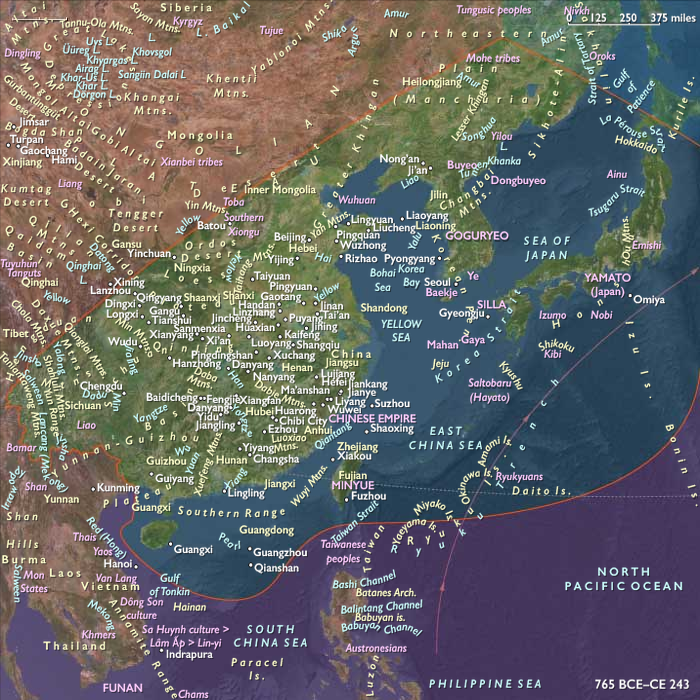
Liu Bei dies in the spring of …
Years: 223 - 223
Liu Bei dies in the spring of 223 at Baidicheng from dysentery.
He is succeeded by his crown prince Liu Shan, with chancellor Zhuge Liang and general Li Yan serving as regents.
Locations
People
Groups
- Chinese (Han) people
- Cao Wei, (Chinese) kingdom of
- Shu Han (minor Han), (Chinese) kingdom of
- Wu, Eastern, (Chinese) kingdom of
Topics
Commodoties
Subjects
Regions
Subregions
Related Events
Filter results
Showing 10 events out of 60636 total
Liu Shan treats Zhuge as a father figure, allowing him to handle all state affairs.
Zhuge Liang recommends many trusted officials, including Fei Yi, Dong Yun, Guo Youzhi and Xiang Chong into key positions.
Under Zhuge Liang's advice, Liu Shan enters into an alliance with the state of Wu, helping both states to survive against the much larger state of Wei.
During Zhuge Liang's regency, the government is largely efficient and not corrupt, allowing the relatively small state of Shu to prepare itself for military campaigns.
Liu Shan marries the late General Zhang Fei's daughter, Empress Zhang, in 223.
The southern Nanman tribes had peeled away from Shu dominance in the aftermath of Liu Bei's death.
Zhuge Liang heads south in 225 and manages, by both military victories and persuasion, to reintegrate the southern region into the empire.
For the rest of Zhuge Liang's regency, the southern Nanman people will be key contributors to Shu's campaigns against Wei.
The Cao Wei princes (unlike princes of the Han Dynasty), under regulations established by Cao Pi, are not only distanced from central politics, they also have minimal authority even in their own principalities and are restricted in many ways, particularly in the use of military.
Cao Pi, who still fears and resents Cao Zhi, soon has the latter's fief reduced in size and has a number of his associates executed.
Ding Yi, who is chief among Cao Zhi's strategists, has his whole clan wiped out as a result of assisting the latter in the past.
Cao Pi's younger brother, Cao Xiong, is also said to have committed suicide out of fears for his brother.
Legend also says Cao Pi assassinated his own brother, Cao Zhang.
Alexander Severus is young, amiable, well-meaning, and entirely under the dominion of his mother.
Julia Mamaea is a woman of many virtues, and she surrounds the young emperor with wise councilors, under the administration of the famous jurist and praetorian praefect Ulpian, who is also from Syria.
Conflicting accounts shroud the details of the fall of the Parthian Empire and subsequent rise of the Sassanid Empire in mystery.
One Babak, a descendant of a line of the priests of the goddess Anahita, was originally the ruler of a region called Kheir.
However, by the year 200, he had managed to overthrow Gocihr, and appoint himself as the new ruler of the Bazrangids.
His mother, Rodhagh, was the daughter of the provincial governor of Persis.
Babak and his eldest son Shapur managed to expand their power over all of Persis.
The subsequent events are unclear, due to the sketchy nature of the sources.
It is certain, however, that following the death of Babak, Ardashir, who at the time was the governor of Darabgird, got involved in a power struggle of his own with his elder brother Shapur.
Sources reveal that Shapur, leaving for a meeting with his brother, was killed when the roof of a building collapsed on him.
By the year 208, over the protests of his other brothers who were put to death, Ardashir had declared himself ruler of Persis.
Once Ardashir was appointed Shahenshah, he had moved his capital further to the south of Persis and founded Ardashir-Khwarrah (formerly Gur, modern day Firuzabad), constructing several great palaces and carving rock reliefs.
The city, well supported by high mountains and easily defendable through narrow passes, has become the center of Ardashir's efforts to gain more power.
The city is surrounded by a high, circular wall, probably copied from that of Darabgird, and on the north-side includes a large palace, remains of which still survive today.
After establishing his rule over Persis, Ardashir I has rapidly extended his territory, demanding fealty from the local princes of Fars, and gaining control over the neighboring provinces of Kerman, Isfahan, Susiana and Mesene.
This expansion quickly comes to the attention of Artabanus IV, the Parthian king, who initially orders the governor of Khuzestan to wage war against Ardashir in 224, but the battles are victories for Ardashir.

Artabanus, in a second attempt to destroy Ardashir, meets his opponent in battle at Hormozgan, near the modern city of Bandar Abbas, where the Parthian army is completely defeated, and Artabanus is killed.
According to one account, Ardashir and Artabanus fought in close combat on horseback.
Ardashir pretended to flee, turned around in the saddle and shot Artabanus through the heart.
This ends the four-hundred-year rule of the Arsacid Dynasty.
Following the death of the Parthian ruler, Ardashir I goes on to invade the western provinces of the now defunct Parthian Empire.
Factors that aided the rise to supremacy of the Sassanids include the Artabanus-Vologases dynastic struggle for the Parthian throne, which had probably allowed Ardashir to consolidate his authority in the south with little or no interference from the Parthians; and the geography of the Fars province, which separate it from the rest of Iran.
Ardashir, crowned in 224 at Ctesiphon as the sole ruler of Persia, takes the title Shahanshah, or "King of Kings" (the inscriptions mention Adhur-Anahid as his "Queen of Queens", but her relationship with Ardashir is not established), bringing the four hundred year-year-old Parthian Empire to an end, and beginning four centuries of Sassanid rule.
Claiming Achaemenid descent and proclaiming a revival of ancient glory, he names his dynasty after his ancestor Sasan (believed to be his grandfather) and embraces Zoroastrianism.
The division of the Han empire into three states has become firmly established, particularly after Liu Bei's death in 223.
Liu Bei's prime minister Zhuge Liang, serving as regent for Liu Shan, has reestablished the alliance with Sun, causing Cao Wei to have to defend itself on two fronts and unable to conquer either.
Exasperated, Cao makes a famous comment in 225 that "Heaven created the Yangtze to divide the north and the south."
The Wu administration is known for its efficiency early in the reign of Sun Quan, who displays a knack for listening to correct advice and for delegating authorities to the proper individuals.
For example, he correctly trusts the faithful Lu Xun and Zhuge Jin, so much so that he makes a duplicate imperial seal and leaves it with Lu Xun; whenever he corresponds with Shu's emperor Liu Shan or regent Zhuge Liang, he delivers the letter to Lu Xun first (as Lu's post is near the Shu border), and then if, in Lu's opinion, changes are needed, Lu revises the letter and then restamps it with Sun's imperial seal.
Further, Lu Xun and Zhuge Jin are authorized to coordinate their actions with Shu without prior imperial approval.
Sun Quan treats his high level officials as friends and addresses them accordingly (with style names), and in accordance they dedicate all effort to Wu's preservation.
He also knows the proper roles for officials that he trusts; for example, in 225, when selecting a chancellor, while the key officials all respect Zhang Zhao greatly and want him to be chancellor, Sun Quan declines, reasoning that while he respects Zhang greatly, a chancellor needs to handle all affairs of state, and Zhang, while capable, has such strong opinions that he will surely be in conflict with Sun Quan and other officials at all times.
He also repeatedly promotes his official Lü Fan even though, while he was young, Lü Fan had informed on Quan to his father Sun Ce about his improper spending habits, understanding that Lü did so only out of loyalty to Sun Ce.
In 224 and 225, Cao Pi again makes attacks on Wu, but each time the Wu forces are able to repel Wei's with relative ease—so easily that Cao Pi makes the comment, "Heaven created the Yangtze to divide the north and south."
Palmyra, an important city located in an oasis two hundred and fifteen kilometers northeast of Damascus and one hundred and eighty kilometers southwest of the Euphrates at Deir ez-Zor, has long been a vital caravan stop for travelers crossing the Syrian desert and is known as the Bride of the Desert.
The earliest documented reference to the city by its Semitic name Tadmor, Tadmur or Tudmur (which means "the town that repels" in Amorite and "the indomitable town" in Aramaic) is recorded in Babylonian tablets found in Mari.
Having been made part of the Roman province of Syria during the reign of Tiberius (14–37 CE), Palmyra has steadily grown in importance as a trade route linking Persia, India, China, and the Roman Empire.
In 129, Hadrian had visited the city and was so enthralled by it that he had proclaimed it a free city and renamed it Palmyra Hadriana.
Beginning in 224, Palmyra's trade diminishes as the Sassanids occupy the mouth of the Tigris and the Euphrates.
Years: 223 - 223
Locations
People
Groups
- Chinese (Han) people
- Cao Wei, (Chinese) kingdom of
- Shu Han (minor Han), (Chinese) kingdom of
- Wu, Eastern, (Chinese) kingdom of