Little is known of Origen's activity during …
Years: 217 - 217
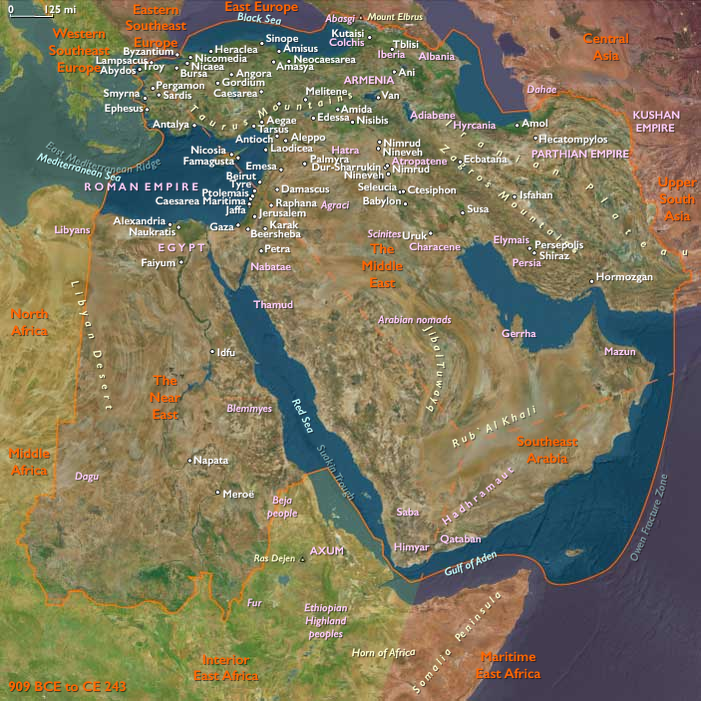
Little is known of Origen's activity during the next decade, but it is probably devoted to teaching and writing.
The latter is rendered the more easy for him by Ambrose, who provides him with more than seven stenographers to take dictation in relays, as many scribes to prepare longhand copies, and a number of girls to multiply the copies.
At the request of Ambrose, he now begins a huge commentary on the Bible, beginning with John, and continuing with Genesis, Psalms 1-25, and Lamentations, besides brief exegeses of selected texts (forming the ten books of his Stromateis), two books on the resurrection, and the work On First Principles.
Locations
People
Groups
Topics
Subjects
Regions
Subregions
Related Events
Filter results
Showing 10 events out of 60689 total
Cao Cao, who is by this point Prince of Wei, finally declares Cao Pi as his crown prince in 217.
He will remain as such until his father's death in 220.
Fa Zheng, in 217, points out the strategic necessities of seizing Hanzhong and advises Liu Bei to drive Cao Cao's force out of the area.
Liu Bei sends Zhang Fei, Ma Chao, and several subordinate generals to Wudu, while he assembles an army and advances to Yangping Pass.
Zhang Fei is forced to retreat after his aides Wu Lan and Lei Tong are defeated and killed by Cao Cao's forces.
Liu Bei, engaging Xiahou Yuan at Yangping Pass, tries to cut the enemy's supply route by sending his general Chen Shi to Mamingge, but is routed by Xiahou's subordinate, Xu Huang.
Liu Bei then presses on Zhang He at Guangshi but fails to achieve any success; at the same time, Xiahou Yuan and Zhang He are not able to hinder Liu Bei from mobilizing forces around the area.
The war turns into a stalemate, and Cao Cao decides to gather an army in Chang'an to fight Liu Bei.
Macrinus is confirmed in his new role by the Senate despite his equestrian background.
According to S.N.
Miller, this may have been due to both his background as an accomplished jurist and his deferential treatment of the senatorial class.
(Miller, S.N., "The Army and the Imperial House," The Cambridge Ancient History, Volume XII: The Imperial Crisis and Recovery (A.D. 193–324), S.A. Cook et al.
eds, Cambridge University Press, 1965, pp 50–2.)
He finds it necessary, however, to replace several provincial governors with men of his own choosing.
Caracalla's mother Julia Domna is initially left in peace, but when she starts to conspire with the military he orders her to leave Antioch.
Being at this time in an advanced stage of breast cancer (Cassius Dio) she chooses instead to starve herself to death.
In urgent matters of foreign policy, Macrinus displays a tendency towards conciliation and a reluctance to engage in military conflict.
He averts trouble in the province of Dacia by returning hostages that had been held by Caracalla, and he ends troubles in Armenia by granting that country's throne to Tiridates, whose father had also been imprisoned under Caracalla.
Less easily managed is the problem of Mesopotamia, which has been invaded by the Parthians in the wake of Caracalla's demise.
Monuments are built to revere Macrinus at a high point of his popularity.
The grand tetrastyle Capitoline Temple in Volubilis is erected to honor him in 217.
Meeting the Parthians in battle during the summer of this year, Macrinus achieves a costly draw near the town of Nisibis and as a result is forced to enter negotiations through which Rome is obliged to pay the enormous indemnity of two hundred million sesterces to the Parthian ruler Artabanus IV in return for peace.
However, Macrinus displays some financial farsightedness when he revalues the Roman currency.
He increases the silver purity of the denarius from 51.5% to 58%—the actual silver weight increasing from 1.66 grams to 1.82 grams.
Nevertheless, Macrinus' reluctance to engage in warfare, and his failure to gain victory over even a historically inferior enemy such as the Parthians causes considerable resentment among the soldiers.
This is compounded by him curtailing the privileges they had enjoyed under Caracalla and the introduction of a pay system by which recruits receive less than veterans.
After only a short while, the legions are searching for a rival emperor.
His popularity also suffered in Rome.
Not only has the new emperor failed to visit the city after taking power but a late-summer thunderstorm causes widespread fires and flooding.
Macrinus' appointee as urban prefect proves unable to repair the damage to the satisfaction of the populace and has to be replaced.
Caracalla, while traveling from Edessa to continue the war with Parthia, goes to visit a temple of Luna near the spot of the battle of Carrhae on April 8, 217, accompanied only by his personal bodyguard, which includes Macrinus.
The emperor’s escort gives him privacy to relieve himself at a roadside near Carrhae.
Events are not clear, but it is certain that Caracalla is assassinated, reportedly while urinating.
Caracalla's body is brought back from the temple by his bodyguards, along with the corpse of a fellow bodyguard.
The story as told by Macrinus is that the dead guard—Julius Martialis—had killed Caracalla with a single sword stroke.
Herodian says that Martialis' brother had been executed a few days earlier by Caracalla on an unproven charge; Cassius Dio, on the other hand, says that Martialis was resentful at not being promoted to the rank of centurion.
Macrinus, who (according to Herodian) was most probably responsible for having the emperor assassinated, has proclaimed himself emperor by April 11.
Macrinus also nominates his son Diadumenianus Caesar and successor and confers upon him the name "Antoninus", thus connecting him with the relatively stable reigns of the Antonine emperors of the second century.
The surviving members of the Severan dynasty, headed by Julia Maesa (Caracalla's aunt) and her daughters, foster this discontent.
When Macrinus came to power, he suppressed the threat against his reign by the family of his assassinated predecessor by exiling them—Julia Maesa, her two daughters, and her eldest grandson Elagabalus—to their estate near Emesa in Syria, where the Severan women plot, with Julia Maesa’s eunuch advisor and Elagabalus' tutor Gannys, to place another Severan on the imperial throne.
They use their hereditary influence over the cult of sun-deity Elagabalus (the Latinized form of El-Gabal) to proclaim Soaemias' son Elagabalus (named for his family's patron deity) as the true successor to Caracalla.
The false rumor is spread by Elagabalus, with the assistance of the Severan women, that he is Caracalla's illegitimate son and thus the child of a union between first cousins.
He is therefore due the loyalties of Roman soldiers and senators who had sworn allegiance to Caracalla.
Born around the year 203, as Varius Avitus Bassianus to the family of Sextus Varius Marcellus and Julia Soaemias Bassiana, his father had initially been a member of the equestrian class, but had later been elevated to the rank of senator.
His grandmother Julia Maesa is the widow of the Consul Julius Avitus, the sister of Julia Domna, and the sister-in-law of emperor Septimius Severus.
Her daughter Julia Soaemias is a cousin of Caracalla.
Other relatives include his aunt Julia Avita Mamaea and uncle Marcus Julius Gessius Marcianus and their son Alexander Severus.
Elagabalus's family holds hereditary rights to the priesthood of the sun god El-Gabal, of whom Elagabalus is the high priest at Emesa (modern Homs) in Syria.
Elagabalus was initially venerated at Emesa.
The name is the Latinized form of the Syrian Ilāh hag-Gabal, which derives from Ilāh ("god") and gabal ("mountain"), resulting in "the God of the Mountain" the Emesene manifestation of the deity.
The cult of the deity had spread to other parts of the Roman Empire in the second century.
For example, a dedication has been found as far away as Woerden (Netherlands).
The god is later imported and assimilated with the Roman sun god, who was known as Sol Indiges in republican times and as Sol Invictus during the second and third centuries.

Callistus, chief minister to Pope Zephyrinus, succeeds him in about 217.
A Roman by birth, Callistus was originally a slave.
His contemporary and enemy, the author of Philosophumena (probably Hippolytus of Rome), relates that Callixtus, as a young slave, had been put in charge of collected funds by his master Carpophorus, funds which were given as alms by other Christians for the care of widows and orphans; Callixtus had lost the funds and fled from Rome, but was caught near Portus.
According to the tale, Callixtus jumped overboard to avoid capture but was rescued and taken back to his master.
He was released at the request of the creditors, who hoped he might be able to recover some of the money, but was rearrested for fighting in a synagogue when he tried to borrow money or collect debts from some Jews.
Philosophumena claims that Callixtus, denounced as a Christian, had been sentenced to work in the mines of Sardinia.
He was released with other Christians at the request of Hyacinthus, a eunuch presbyter, who represented Marcia, the favorite mistress of Emperor Commodus.
At this time his health was so weakened that his fellow Christians sent him to Antium to recuperate and he was given a pension by Pope Victor I. Callixtus was the deacon to whom Pope Zephyrinus entrusted the burial chambers along the Appian Way.
In the third century, nine Bishops of Rome were interred in the Catacomb of Callixtus, in the part now called the Capella dei Papi.
These catacombs were rediscovered by the archaeologist Giovanni Battista de Rossi in 1849.
When Callixtus follows Zephyrinus as Bishop of Rome, he starts to admit into the church converts from sects or schisms who had not done penance (as we learn from Philosophoumena IX.7).
It is an old error to suppose that Tertullian attacked this is his 'de pudicitia' (’of Modesty), but Tertullian is not referring to the reception of converts and was probably writing ten years earlier; and the bishop he criticizes is much more likely to be the bishop of Carthage than the bishop of Rome.
Hippolytus has also accused Callixtus of the heresy of Sabellianism, but since Callixtus had excommunicated Sabellius, the charge was clearly false.
Macrinus' short reign, while important for its historical "firsts", is cut short due to the inability of this otherwise accomplished man to control or satisfy the soldiery.
After Julia Maesa displays her wealth to the Legio III Gallica at Raphana, they swear allegiance to Elagabalus.
At sunrise on May 16, 218, Publius Valerius Comazon Eutychianus, commander of the legion, declares him emperor.
To strengthen his legitimacy through further propaganda, Elagabalus assumes Caracalla's names, Marcus Aurelius Antoninus.
In response, Macrinus dispatches his Praetorian prefect Ulpius Julianus to the region with a contingent of troops he considers strong enough to crush the rebellion.
However, this force soon joins the faction of Elagabalus when, during the battle, they turn on their own commanders.
The officers are killed and Julianus' head is sent back to the emperor.
Macrinus now sends letters to the Senate denouncing Elagabalus as the False Antoninus and claiming he is insane.
Both consuls and other high ranking members of Rome's leadership condemn him, and the Senate subsequently declares war on both Elagabalus and Julia Maesa.
A force under Bassianus’s tutor Gannys marches on Antioch and engages a force under Macrinus Macrinus and his son, who, weakened by the desertion of the Second Legion due to bribes and promises circulated by Julia Maesa, are defeated on June 8, 218 at the Battle of Antioch.
Macrinus flees toward Italy, disguised as a courier, but is later intercepted near Chalcedon and executed in Cappadocia.
His son Diadumenianus, sent for safety to the Parthian court, is captured at Zeugma and also put to death.
The demise of Macrinus has reinforced the notion of the soldiers as the true brokers of power in the third-century empire and highlighted the importance of maintaining the support of this vital faction.
Elagabalus declares the date of the victory at Antioch to be the beginning of his reign and assumes the imperial titles without prior senatorial approval, which violates tradition but is a common practice among third-century emperors nonetheless.
Letters of reconciliation are dispatched to Rome extending amnesty to the Senate and recognizing the laws, while also condemning the administration of Macrinus and his son.
The senators respond by acknowledging Elagabalus as emperor and accepting his claim to be the son of Caracalla.
Caracalla and Julia Domna are both deified by the Senate, both Julia Maesa and Julia Soaemias are elevated to the rank of Augustae, and the memory of Macrinus and Diadumenianus is condemned and vilified by the Senate.
The former commander of the Third Legion, Comazon, is appointed to be commander of the Praetorian Guard.