
The Mysians, an aboriginal people of the …
Years: 765BCE - 622BCE
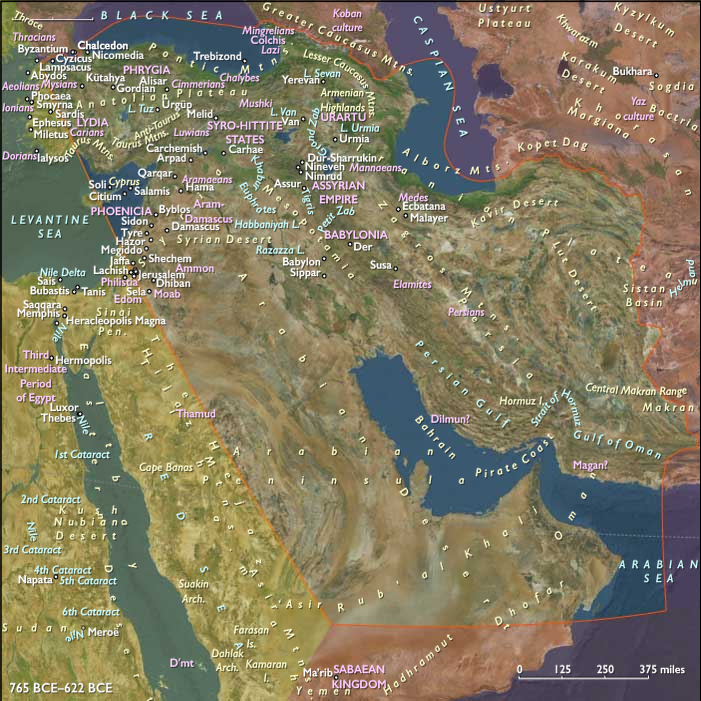
Mysia, their homeland district in northwest Anatolia, adjoins the Sea of Marmara on the north and the Aegean Sea on the west.
Homer mentions the Mysians (for whom the region is named) as primitive allies of the Trojans, but historically there is no record of their action as an independent nation.
Herodotus recorded the tradition that Mysians (along with Teucrians) invaded Europe, conquering "all of Thrace" and invading Greece as far as Elis in early times (7.20).
He also wrote that they were brethren of the Carians and Lydians (Herod. 1.171), and that the Mysians were "Lydian colonists" (7.74).
This identification may be supported by the fact that only Mysians, Carians, and Lydians were allowed to worship at the temple of Carian Zeus in the country of the Mylasians (1.171), based on the tradition that the eponymous figures Car (Carians), Lydus (Lydians), and Mysus (Mysians) were brothers (1.171).
Little is known about the Mysian language.
A short inscription which may be in Mysian and which dates from between the fifth and third centuries BCE will be found in Uyuçik, near Kütahya; it seems to include Indo-European words, but it has not been deciphered.
If Herodotus was right, the Mysian language would be a language of the Anatolian group, akin to Carian and Lydian.
A passage in Athenaeus, however, suggests that Mysian was akin to the barely attested Paionian language of Paionia, north of Macedon.
Locations
Groups
Topics
Commodoties
Subjects
- Origins
- Commerce
- Language
- Environment
- Labor and Service
- Conflict
- Faith
- Government
- Technology
- Movements
- Linguistics
Regions
Subregions
Related Events
Showing 10 events out of 34 total
Years: 765BCE - 622BCE
Locations
Groups
Topics
Commodoties
Subjects
- Origins
- Commerce
- Language
- Environment
- Labor and Service
- Conflict
- Faith
- Government
- Technology
- Movements
- Linguistics
Regions
Subregions