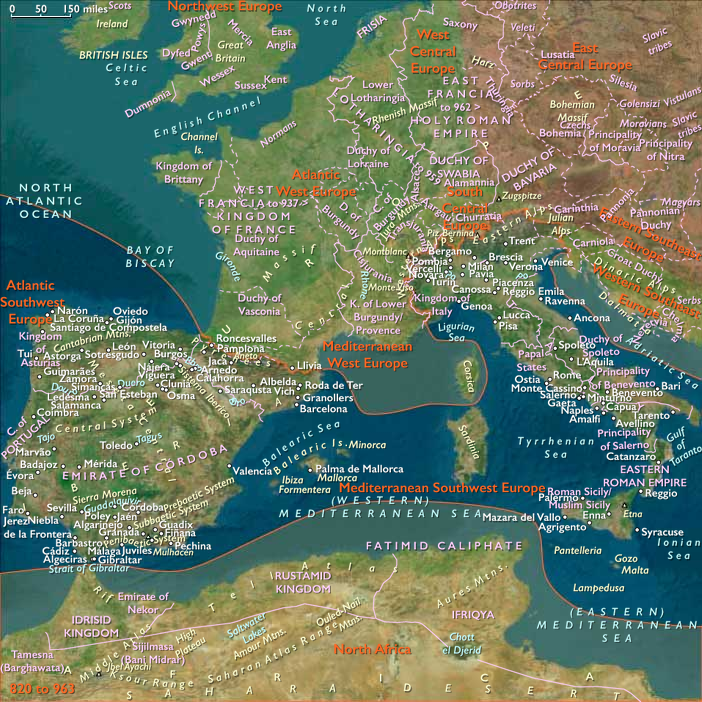
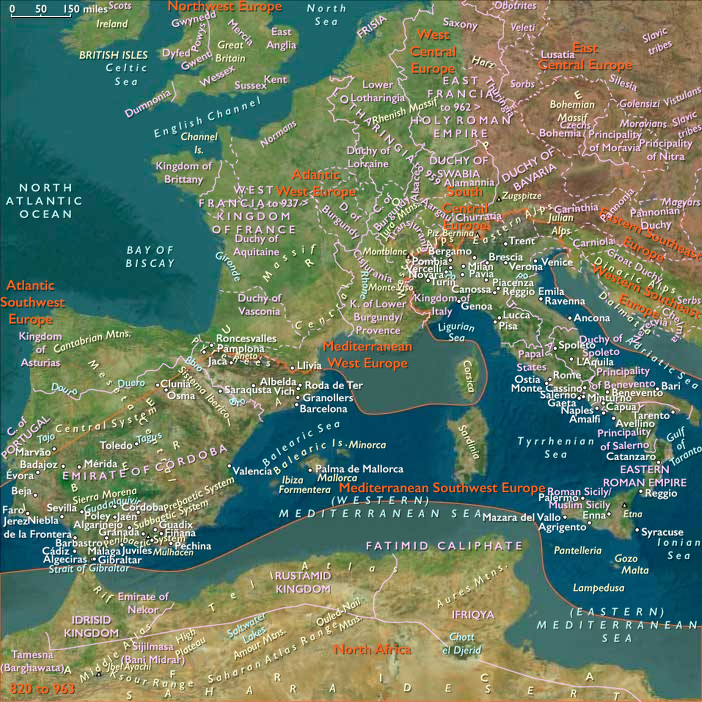
Little is known about John IX before …
Years: 898 - 898
January
Little is known about John IX before he became Pope.
Born in Tivoli in an unknown year, he had been ordained as a Benedictine priest by Pope Formosus.
With the support of the powerful House of Spoleto he is elected Pontiff in early 898 following the sudden death of Pope Theodore II.
Locations
People
- Adalbert II
- Arnulf of Carinthia
- Berengar I of Italy
- Guy IV of Spoleto
- Lambert II of Spoleto
- Pope John IX
Groups
- Franks
- Christianity, Chalcedonian
- Papal States (Republic of St. Peter)
- Italy, Carolingian Kingdom of
- Spoleto, Duchy of
- Moravia, Great, Kingdom of
- Francia Occidentalis (West Francia, or France), Kingdom of
- Francia Orientalis (East Francia), Kingdom of
Commodoties
Subjects
Regions
Subregions
Related Events
Filter results
Showing 10 events out of 53585 total
Emperor Zhaozong makes peace with Li Maozhen in spring 898, restoring the titles that he had previously stripped from Li Maozhen.
With Zhu Quanzhong urging the emperor to move the capital to the eastern capital Luoyang, Han and Li Maozhen become apprehensive that he will launch an army to seize the emperor, and therefore repair the palaces and governmental offices at Chang'an (which Li Maozhen's army had destroyed).
In fall 898, Emperor Zhaozong returns to Chang'an, but with no army around him now other than the eunuch-controlled Shence Armies.
Al-Hadi subjugates Najran, establishing a firm base among the tribal groups of northern Yemen.
Yahya takes great care to collect taxes according to the religious scriptures, at the same time avoiding abuses and arbitrary tax harvesting.
The Ascension of Charles the Simple as King of West Francia (898)
After renouncing his claim to the throne of West Francia in 897 due to the prolonged civil war against King Odo, Charles the Simple ultimately gains full recognition as King following Odo’s death on January 1, 898.
Charles' Claim and Odo’s Reign (888–898)
- Charles, the youngest son of Louis the Stammerer, was a legitimate Carolingian heir, but he was too youngto be considered for the throne after Charles the Fat’s deposition in 887.
- Instead, the West Frankish nobility elected Odo, Count of Paris, in 888, primarily because of his successful defense of Paris against the Vikings in 885–886.
- Despite Odo’s reign, a faction of nobles remained loyal to the Carolingian dynasty, leading to civil war between Odo and Charles in the early 890s.
- By 897, Charles had renounced his claim, possibly in a political agreement to avoid further conflict.
The Death of Odo and Charles' Recognition (898)
- When Odo dies on January 1, 898, Charles becomes the natural successor as the last Carolingian claimant in West Francia.
- He is generally recognized as King Charles III, also known as Charles the Simple, restoring the Carolingian line to the West Frankish throne.
Significance of Charles III’s Accession
- His rule marks the restoration of Carolingian legitimacy, though royal power remains weak and fragmented.
- He inherits a kingdom in crisis, still beset by Viking incursions, powerful feudal lords, and decentralization.
- His reign will be defined by both political struggles and key territorial agreements, including the Treaty of Saint-Clair-sur-Epte (911), which grants Normandy to the Viking leader Rollo in exchange for military protection.
The Beginning of a Fragile Carolingian Revival
While Charles III's ascension in 898 represents a temporary revival of Carolingian rule, his reign is ultimately marked by feudal rivalries, Norman settlements, and a weakening monarchy, which will lead to the eventual rise of the Capetian dynasty in 987.
Lambert in February 898 convenes a diet at Ravenna.
Seventy bishops meet and confirm the pact of 891, the invalidity of Arnulf's coronation, and the validity of Lambert's imperial title.
They legitimize the election of John IX.
They also solve the Formosan question and confirm his rehabilitation.
Most significantly for Lambert, however, they reaffirm the Constitutio Romana of Lothair I (824), which requires the imperial presence at papal elections.
Trier, as the important Roman provincial capital of Augusta Treverorum, had been the seat of a bishop since Roman times.
The bishops of Trier were already virtually independent territorial magnates in Merovingian times.
Charlemagne in 772 had granted Bishop Wiomad complete immunity from the jurisdiction of the ruling count for all the churches and monasteries, as well as villages and castles that belonged to the Church of St. Peter at Trier.
Later during the reign of Charlemagne, Trier had been raised to archiepiscopal status.
Louis the Pious in 816 had confirmed to Archbishop Hetto the privileges of protection and immunity granted by his father.
At the partition of the Carolingian empire at Verdun in 843, Trier had fallen to Lothair; at the partition of Lotharingia at Mersen in 870, it had fallen to the East Frankish kingdom, which has developed into Germany.
Archbishop Ratbod receives in 898 complete immunity from all taxes for the entire Episcopal territory, granted by Zwentibold, the natural son of Emperor Arnulf of Carinthia, who reigns briefly as King of Lotharingia and, under great pressure from his independent nobles, desperately needs a powerful ally.
The gift cements the position of the archbishops as territorial lords in their own right.
Lambert hereafter governs with the church and continues the policy of his father of renovatio regni Francorum: renewal of the Frankish kingdom.
He is able to issue capitularies in the Frankish fashion as his father had done.
In fact, he is the last ruler to do so.
In 898, he legislates against the exploitation of the services owed by arimanni (a warrior class of freemen in Lombard and later Frankish Italy, typically small or medium landowners with a few tenants, or none, beneath them) to create benefices for vassals.
The Lex Romana Utinensis is composed at his court.
However, Lambert still has Berengar of Friuli and the rebellious Adalbert of Tuscany to face.
In 898, the latter marches on Pavia.
The emperor, who had been hunting near Marengo, south of Milan, is given word and surprises and defeats his rival at Borgo San Donnino, taking him prisoner to Pavia.
On his return to Marengo however, he is killed, either by assassination (by Hugh, son of Maginulf), a theory about which Liutprand, our primary source, is reserved, or by falling from his horse.
He is buried in Piacenza.
Liutprand remembers him as an elegans iuvenis and vir severus: "an elegant youth and a stern man".
He is succeeded in Spoleto by Guy IV while the regnum Italicum and the imperium Romanum are thrown into chaos, contested by multiple candidates.
Within days, Berengar has taken Pavia.
Pope John, with a view to diminish the violence of faction in Rome, holds several synods in Rome and elsewhere in 898.
They not only confirm the judgment of Pope Theodore II in granting Christian burial to Pope Formosus, but also at a council held at Ravenna decree that the records of the synod held by Pope Stephen VI which had condemned him should be burned.
Re-ordinations are forbidden, and those of the clergy who had been degraded by Stephen are restored to the ranks from which he had deposed them.
The Slavs of Moravia, to keep their independence, which is threatened by the Germans appeal to John to let them have a hierarchy of their own.
Ignoring the complaints of the German hierarchy, John sanctions the consecration of a metropolitan and three bishops for the Church of the Moravians.
Finding that it is advisable to cement the ties between the empire and the papacy, John IX gives unhesitating support to Lambert in preference to Arnulf during the Synod of Rome, and also induces the council to determine that henceforth the consecration of the Popes should take place only in the presence of the imperial legates.
The sudden death of Lambert on October 15, 898, shatters the hopes which this alliance seemed to promise.
Various Shī‘ī groups organize in secret opposition to the Abbasid Caliphate.
Among them are the supporters of the proto-Isma'ili community, of whom the most prominent group are called the Mubarakiyyah.
According to the Isma'ili school of thought, Imam Jaʿfar al-Ṣadiq (702–765) designated his second son, Isma'il ibn Jafar, born in 721, as heir to the Imamate.
However, Ismā‘īl predeceased his father in 755.
Some claimed he had gone into hiding, but the proto-Isma'ili group accepted his death and therefore accordingly recognized Isma'il’s eldest son, Muḥammad ibn Isma'il (746–809), as Imām.
He remained in contact with the Mubarakiyyah group, most of whom resided in Kufah.
The split among the Mubarakiyyah came with the death of Muḥammad ibn Isma'ili in about 813 CE.
The majority of the group denied his death; they recognized him as the Mahdi.
The minority believed in his death and will eventually emerge in later times as the Faṭimid Isma'ili, the precursors to all modern groups.
The majority Isma'ili missionary movement has settled in Salamiyah (in present-day Syria) and has had great success in Khuzestan (southwestern Persia), where the Isma'ili leader al-Husayn al-Ahwazi had converted the Kūfan man Ḥamdan in 874 CE, who had taken the name Qarmaṭ after his new faith.
Qarmaṭ and his theologian brother-in-law ‘Abdān have prepares southern Iraq for the coming of the Mahdi by creating a military and religious stronghold.
Other such locations have grown up in Yemen, in Bahrain in 899 CE and in North Africa.
These attract many new Shī‘ī followers due to their activist and messianic teachings.
This new proto-Qarmaṭi movement continues to spread into Greater Iran and into Transoxiana.
A change in leadership in Salamiyah in 899 leads to a split in the movement.
The minority Isma'ilis, whose leader has taken control of the Salamiyah center, begin to proclaim their teachings—that Imam Muḥammad has died, and that the new leader in Salamiyah is in fact his descendant come out of hiding.
Qarmaṭ and his brother-in-law oppose this and openly break with the Salamiyyids; when ‘Abdān is assassinated, he goes into hiding and subsequently repents.
Qarmaṭ becomes a missionary of the new Imam, Ubayd Allah al-Mahdi Billah, who will found the Fatimid Caliphate in North Africa in 909.
Nonetheless, the dissident group retains the name Qarmaṭī.
Their greatest stronghold remains in Bahrain, which at this period includes much of eastern Arabia as well as the islands that comprise the present state.
Bahrain is under Abbasid control at the end of the ninth century, but a slave rebellion in Basra disrupts the power of Baghdad.
The Qarmaṭians seize their opportunity under their leader, Abu-Saʿid Jannabi, who captures Bahrain’s capital Hajr and al-Hasa in 899, which he makes the capital of his republic.
Once in control of the state he seeks to set up a utopian society.
The Qarmatians are alleged to oppose many of the teachings of the Prophet Muhammad, and they encourage social equality for nomads, townspeople, and peasants.

The governor in San'a, Abu'l-Atahiyah, tired of the Yu’firid faction, invites al-Hadi to rule over the city in 899, and acknowledges his status as imam.
Charles the Simple in 899 confiscates, for the profit of the church at Narbonne, all the property held by the Jews and subject to the payment of tithes (Vaissette.
iii.
63).
According to Saige ("Hist.
des Juifs du Languedoc," p. 9), this signifies that the Jews might not possess land upon which Church tithes were levied, but it did not abrogate their right to hold free land.
Years: 898 - 898
January
Locations
People
- Adalbert II
- Arnulf of Carinthia
- Berengar I of Italy
- Guy IV of Spoleto
- Lambert II of Spoleto
- Pope John IX
Groups
- Franks
- Christianity, Chalcedonian
- Papal States (Republic of St. Peter)
- Italy, Carolingian Kingdom of
- Spoleto, Duchy of
- Moravia, Great, Kingdom of
- Francia Occidentalis (West Francia, or France), Kingdom of
- Francia Orientalis (East Francia), Kingdom of