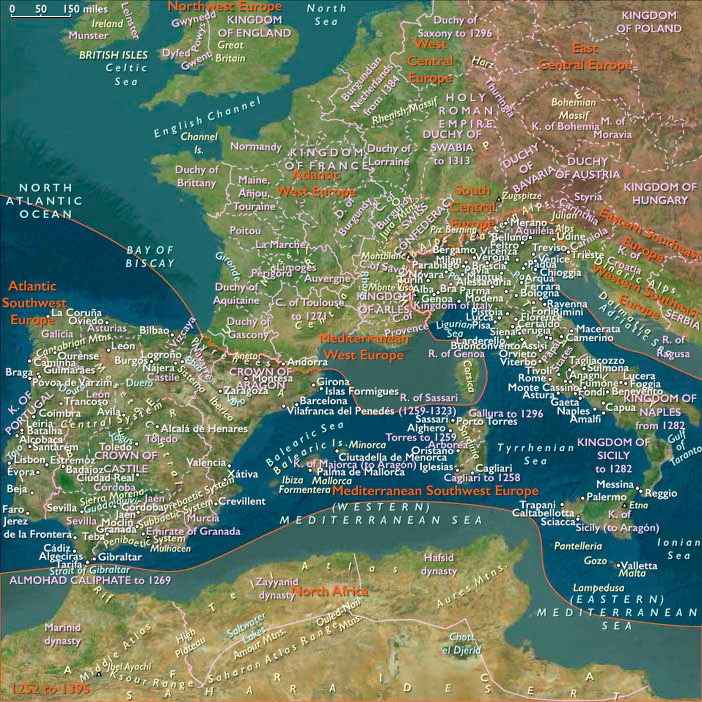
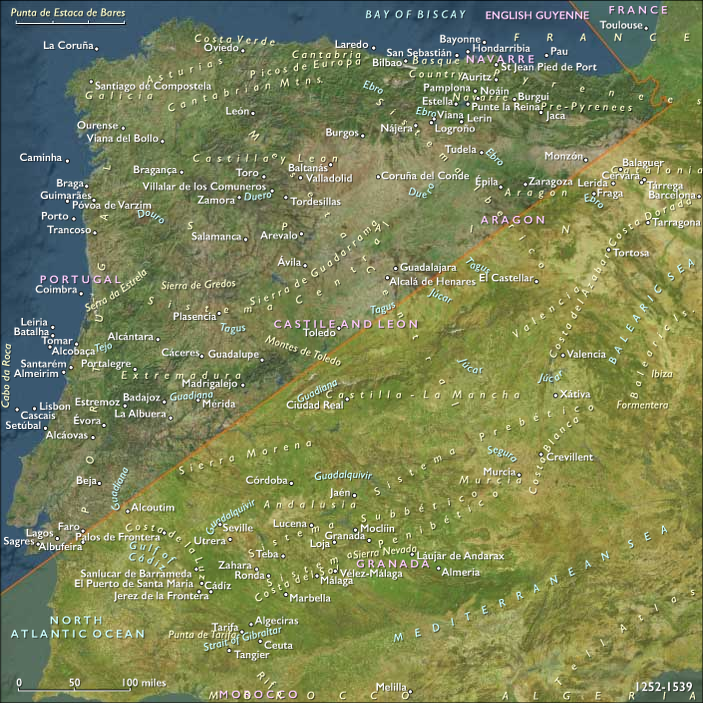
...Lisbon, …
Years: 1263 - 1263
- ...Lisbon, making it the permanent capital.
- Lisbon’s strategic location on the Tagus River, its growing population, and its flourishing trade made it the ideal political and economic center of the kingdom.
Church-Crown Conflict Resolved (1262)
- The prolonged struggle between the Portuguese Crown and the Papacy ended in 1262, when Pope Urban IV:
- Legalized Afonso III’s disputed marriage to Beatriz de Guzmán.
- Legitimized Dinis, securing his succession to the throne.
- Recognized the monarchy’s authority, ensuring a lasting balance between Church and Crown.
Full Independence Secured (1263)
- In 1263, Alfonso X of Castile formally renounced his claim to suzerainty over the Algarve, marking:
- The finalization of Portugal’s European borders, which remain unchanged to this day.
- The kingdom’s full sovereignty, ending Castilian feudal claims over Portuguese lands.
- The official recognition of Lisbon as the capital, a status it continues to hold today.
The Triumph of the Portuguese Monarchy
The Portuguese monarchy emerged victorious in this era due to:
- Defense of National Interests – The kings championed Portuguese independence, ensuring widespread support.
- Municipal and Military Order Support – Urban centers and knightly orders aligned with the Crown, weakening aristocratic opposition.
- Prestige of the Royal Armies – Victories in the Moorish and Castilian wars enhanced the king’s legitimacy and influence.
Lisbon Today: Portugal’s Economic and Political Hub
- Now Portugal’s largest city, Lisbon remains the nation’s political, economic, and cultural capital.
- It serves as the seat of the Lisbon District and the capital of the Lisbon region, the wealthiest region in Portugal.
- With a GDP per capita well above the European Union average, Lisbon continues to be the economic powerhouse of Portugal, reflecting its centuries-old importance as the center of Portuguese governance and commerce.
Thus, by the mid-13th century, Portugal had secured its borders, centralized its monarchy, and established Lisbon as its capital, laying the foundation for its future prosperity and global expansion.
Locations
People
Groups
Topics
Commodoties
Subjects
Regions
Subregions
Related Events
Filter results
Showing 10 events out of 11 total
…Dubrovnik/Ragusa—continue to regain their self-governing status, whether possessed by Hungary or its regional rival, Venice.
…the Republic of Dubrovnik (Ragusa), formerly under Serbian control, which in 1358 accepts Hungarian sovereignty.
… Dubrovnik, or Ragusa, whose riches and influence at times rival those of Venice.
The Rebublic of Ragusa in the fourteenth centur becomes the first Christian power to establish treaty relations with the Ottoman Empire, which is now advancing across the Balkans.
Dubrovnik prospers by mediating between Europe and the new Ottoman provinces in Europe, and by exporting precious metals, raw materials, agricultural goods, and slaves.
The city-state republic of Ragusa acquires the area between Ragusa and ...
…the Republic of Ragusa.
This move by the Venetians had been made in response to the threatening expansion of the late Gian Galeazzo Visconti, Duke of Milan.
Control over the northeast main land routes is also a necessity for the safety of Venetian trade.
The Republic of Ragusa had signed a treaty with the Ottoman Empire in 1458 that made it a tributary of the sultan.
Moreover, it was obliged to send an ambassador to Constantinople by November 1 of each year in order to deliver the tribute.
When the city-state passes into Ottoman protection in 1481, it pays an increased tribute of twelve thousand five hundred ducats.
For all other purposes, however, Ragusa is virtually independent.
It can enter into relations with foreign powers and make treaties with them (so long as they are not in conflict with the Porte's interests), and its ships sail under its own flag.
Ottoman vassalage also confers special rights in trade that extend within the Empire.
Ragusa handles the Adriatic trade on behalf of the Ottomans, and its merchants receive special tax exemptions and trading benefits from the Porte.
It also operates colonies that enjoy extraterritorial rights in major Ottoman cities.
Merchants from Ragusa can enter the Black Sea, which is otherwise closed to non-Ottoman shipping.
They pay less in customs duties than other foreign merchants, and the city-state enjoys diplomatic support from the Ottoman administration in trade disputes with the Venetians.
For their part, Ottomans regard Ragusa as a port of major importance, since most of the traffic between Florence and Bursa (an Ottoman port in northwestern Anatolia) is carried out via Ragusa.
Florentine cargoes leave the Italian ports of Pesaro, Fano or Ancona to reach Ragusa.
From this point on they take the land route Bosnasaray (Sarajevo)–Novibazar–Skopje–Plovdiv–Edirne.
Along with England, Spain and Genoa, Ragusa is one of the Venice's most damaging competitors in the fifteenth century on all seas, even in the Adriatic.
Thanks to its proximity to the plentiful oak forests of Gargano, it is able to bid cargoes away from the Venetians.

The spice trade no longer goes through the Mediterranean Sea after the great Portuguese explorations that open up new ocean routes.
Moreover, the discovery of America has started a crisis of Mediterranean shipping.
This is the beginning of the decline of both the Venetian and Ragusan Republics.
Charles VIII of France had granted trading rights to the Ragusans in 1497.
These rights are also granted by Louis XII in 1502.
Ragusan consuls are in France in the first decade of the sixteenth century, while their French counterparts are sent to Ragusa.
The fate of Ragusa continues to be linked to that of the Ottoman Empire.
Ragusa and Venice both lend technical assistance to the Ottoman–Egyptian–Calicut–Gujarati alliance that is defeated by the Portuguese in the Battle of Diu in the Indian Ocean.
An earthquake in Dubrovnik on April 6, 1667, is one of the two most devastating earthquakes to hit the area of modern Croatia in the last twenty-four hundred years, since records began.
The earthquake destroys almost the entire city and kills around three thousand people, one fifth of the population of the Republic of Ragusa.
The earthquake in the capital marks the beginning of the end of the Republic.
...Ragusa (modern Dubrovnik) to form the Illyrian Provinces, which he incorporates into his French Empire.
Napoleon's dominant interest in creating this political unit, whose capital is Ljubljana, is to cut off Austria's access to Italy and the Mediterranean Sea.
He also places the capable marshal Auguste Marmont in charge of the provinces.