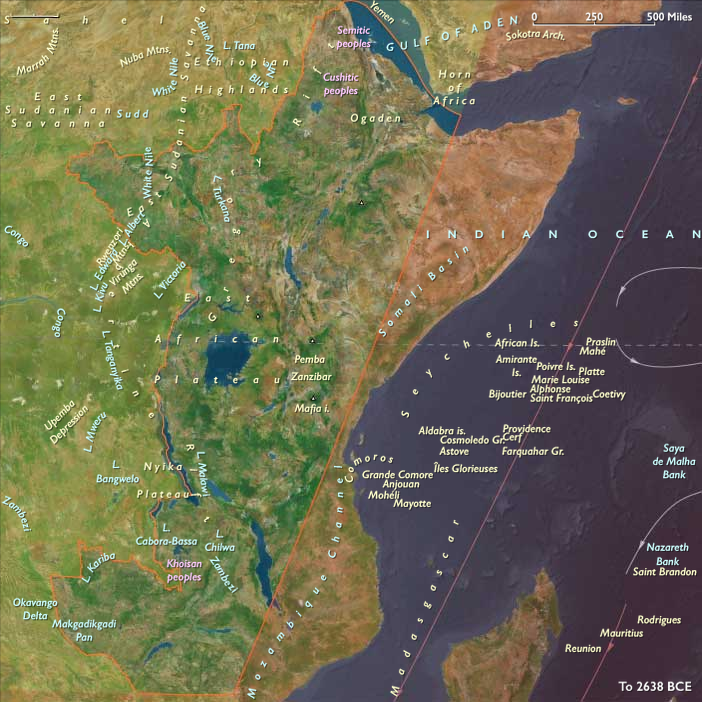
Both Cushitic- and Omotic-speaking peoples collect wild …
Years: 6093BCE - 4365BCE
Both Cushitic- and Omotic-speaking peoples collect wild grasses and other plants for thousands of years before they eventually domesticate those they most prefer.
According to linguistic and limited archaeological analyses, plow agriculture based on grain cultivation is established in the drier, grassier parts of the northern highlands by at least several millennia before the Christian era.
Indigenous grasses such as teff and eleusine are the initial domesticates in the Ethiopia region; considerably later, barley and wheat are introduced from Southwest Asia.
The corresponding domesticate in the better watered and heavily forested southern highlands is ensete, a root crop known locally as false banana.
All of these early peoples also keep domesticated animals, including cattle, sheep, goats, and donkeys.
Thus, from the late prehistoric period, agricultural patterns of livelihood are established that are to be characteristic of the region through modern times.
It is the descendants of these peoples and cultures of the Ethiopian region who at various times and places will interact with successive waves of migrants from across the Red Sea.
This interaction begins well before the modern era and will continue through contemporary times.
Related Events
Showing 10 events out of 57 total
Years: 6093BCE - 4365BCE
Subjects
Regions

Subregions