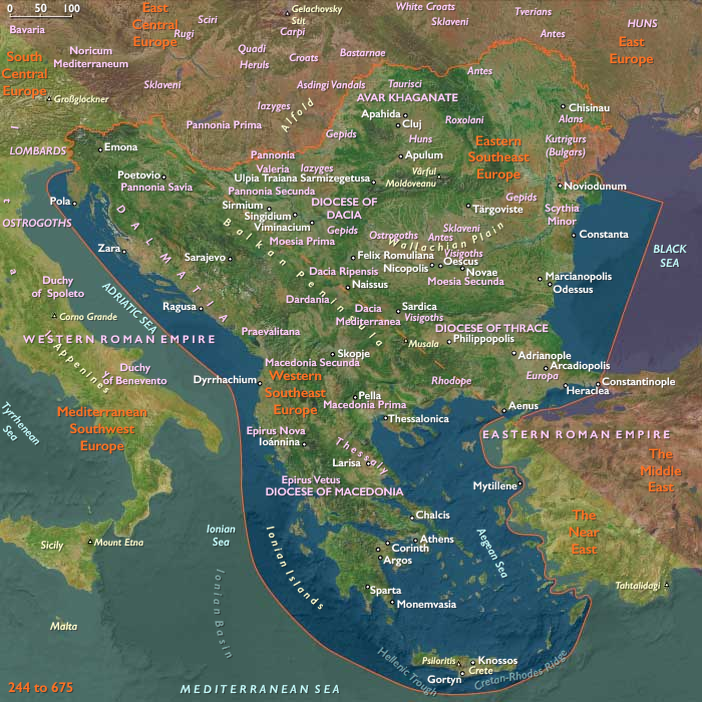
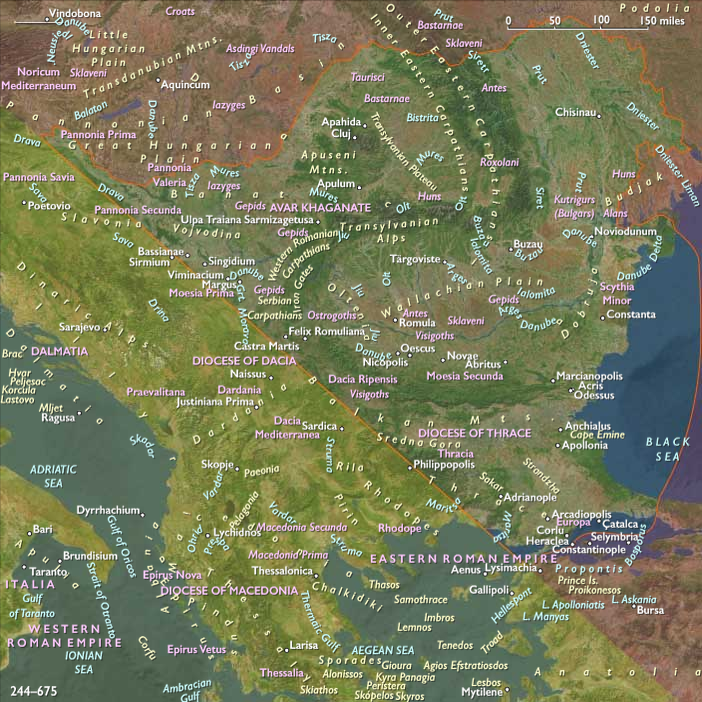
Licinius takes over Galerius' European dominions.
Years: 311 - 311
May
Licinius takes over Galerius' European dominions.
Locations
People
Groups
Topics
- Roman Age Optimum
- Late Antiquity
- Diocletianic Persecution
- Civil wars of the Tetrarchy
- Roman Civil War of 311-12
Commodoties
Subjects
Regions
Subregions
Related Events
Filter results
Showing 10 events out of 59975 total
The Han Zhao forces capture Luoyang in 311, and with it the Jin emperor Sima Chi (Emperor Huai).
The Wu Hu forces commit a massacre when entering the city, killing the Jin crown prince, a host of ministers, and over thirty thousand civilians.
They also burn down the palaces and dig up Jin mausoleums.
Maximinus succeeds his uncle, Galerius, in 311, occupying Asia Minor.
The aged Diocletian has been living in retirement in the neighborhood of Salonae, on the edge of the Adriatic, where he has had a magnificent palace built (the modern town of Split, in Yugoslavia, occupies the site of its ruins).
He has seen his Tetrarchic system fail, torn by the selfish ambitions of his successors.
He has heard of Maximian's third claim to the throne, his forced suicide, his damnatio memoriae.
In his own palace, statues and portraits of his former companion emperor are torn down and destroyed.
Deep in despair and illness, Diocletian may have committed suicide.
The death of the former emperor on December 3, 311, occurs almost unnoticed.
Galerius, a ruthless ruler, has imposed the poll tax on the urban population, maintained the persecution of the Christians that Diocletian had initiated, and managed to hold together an empire riven by civil war in the West.
In the winter of 310-311, however, he becomes incapacitated with a painful disease.
On April 30, 311—perhaps fearing that his illness is the vengeance of the Christian God—he issues an edict grudgingly granting toleration.
Shortly afterward, he dies.
Maximinus had grudgingly accepted Galerius's edict of toleration for Christians but still endeavors to organize and revitalize paganism.
Cities and provinces are encouraged to petition for expulsion of Christians from their territories, and the Acts of Pilate, an anti-Christian forgery, is taught in the schools.
In the autumn of 312, Maximinus relaxes his persecutions somewhat, and shortly before his death in the following year will grant full toleration and the restoration of the confiscated church property.
Construction had begun in 308 on the Basilica of Maxentius and Constantine (sometimes known as the Basilica Nova 'new basilica' or Basilica Maxentius).
Completed in 312 by Constantine I after his defeat of Maxentius at the Battle of the Milvian Bridge, it is the largest building in the Roman Forum.
A marvel of Roman engineering work, it is at the time of construction the largest structure to be built and thus is a unique building taking both aspects from Roman baths as well as typical Roman basilicas.
At this time, it uses the most advanced engineering techniques known including innovations taken from the Markets of Trajan and the Baths of Diocletian.
Similar to many basilicas at the time such as the Basilica Ulpia, the Basilica Maxentius features a huge open space in the central nave, but unlike other basilicas instead of having columns support the ceiling the entire building has been built using arches, a much more common appearance in Roman baths than basilicas.
Another difference from traditional basilicas is the roof of the structure.
While traditional basilicas were built with a flat roof, the Basilica Maxentius is built with a folded roof, decreasing the overall weight of the structure and decreasing the horizontal forces exerted on the outer arches.
Maxentius recovers Africa in 311, but in the following year must face the invasion of Italy by his brother-in-law Constantine at the head of a forty thousand-man army.
Constantine, scoring victories at Milan and Turin against superior numbers, wins two more victories at Brescia and Verona, and then marches south on Rome, reinforcing his army along the way.
Before the beginning of his final battle with Maxentius, Constantine reportedly sees a flaming cross in the sky.
Adopting the cross as a symbol for the fight, he supposedly vows to become a Christian if he emerges victorious.
On October 28, 312, Constantine’s forces, now about fifty thousand strong, defeat Maxentius and his seventy-five thousand-man army outside Rome at the Milvian Bridge over the Tiber River, in which Maxentius drowns while attempting to escape.
Constantine thus removes a dangerous rival and secures his share in the new government organized by Licinius.
Constantine's adherence to Christianity is closely associated with his rise to power.
He had fought the Battle of the Milvian Bridge in the name of the Christian God, having received instructions in a dream to paint the Christian monogram on his troops' shields.
This, at least, is the account given by the Christian apologist Lucius Caecilius Firmianus Lactantius; a somewhat different version, offered by Eusebius of Caesarea, tells of a vision seen by Constantine during the campaign against Maxentius, in which the Christian sign appeared in the sky with the legend “In this sign, conquer.” Despite the Emperor's own authority for the account, given late in life to Eusebius, it is in general more problematic than the other; but a religious experience on the march from Gaul is suggested also by a pagan orator, who in a speech of 310 referred to a vision of Apollo received by Constantine at a shrine in Gaul.
The southern Manchurian-based Korean kingdom Goguryeo extends its reach into the Liaodong peninsula, and Micheon of Goguryeo destroys the last Chinese prefecture, at Lelang, in 313, ending more than four hundred years of Chinese colonial presence.
The Three Kingdoms—Goguryeo, Baekje, and Silla—now dominate the Korean Peninsula.
Maximinus, angling for control of the entire Roman East, crosses the Bosporus with an army in 313 and attacks Licinius’ dominions in Thrace but, defeated at Tzurulum, east of Adrianople, is forced to retreat into Asia Minor, where he soon dies of disease.
Constantine goes far beyond the joint policy agreed upon at Mediolanum, however.
He has seemingly lived until now as a tolerant pagan, uncommitted to any one deity, but now begins gradually to adopt the Christian God as his protector.
By 313, he has already donated to the Bishop of Rome the imperial property of the Lateran, where a new cathedral, the Basilica Constantiniana (now S. Giovanni in Laterano), will soon rise.
The Church of St. Sebastian is also probably begun at this time.
Throughout his life, Constantine will ascribe his success to his conversion to Christianity and the support of the Christian God.
The triumphal arch erected in his honor at Rome after the defeat of Maxentius ascribes the victory to the “inspiration of the Divinity” as well as to Constantine's own genius.
A statue set up at the same time shows Constantine himself holding aloft a cross and the legend “By this saving sign I have delivered your city from the tyrant and restored liberty to the Senate and people of Rome.” The three-centuries long career of the privileged, politically influential Praetorian Guard ends when Constantine disbands it in 313.
A colossal head of Constantine, executed around 313, features blocklike facial planes and bulging eyes, whose off-center pupils gaze heavenward; the hair is a schematic cap.
Miltiades, pope from 311, had become the first pope after the edicts of toleration by the Roman emperors Galerius (ending the persecution of Christians), Maxentius (restoring church property to Miltiades), and Constantine (favoring Christianity).
Concurrently, however, dissension within the church has been caused by the Donatists, North African schismatics who contest the election of Caecilian as bishop of Carthage, championing the election and ordination of their bishop, the theologian Donatus.
At the Lateran Council of 313, Miltiades supports Caecilian and condemns the Donatists, who refuse to submit.
Constantine then orders the Council of Arles (Arelate), the first representative meeting of Christian bishops in the Western Roman Empire, but Miltiades dies before the council convenes.
(The modern Roman Catholic Church considers him a martyr because of earlier sufferings under the Roman emperor Maximian.)

Years: 311 - 311
May
Locations
People
Groups
Topics
- Roman Age Optimum
- Late Antiquity
- Diocletianic Persecution
- Civil wars of the Tetrarchy
- Roman Civil War of 311-12