Leopold V of Austria, soon after succeeding …
Years: 1179 - 1179
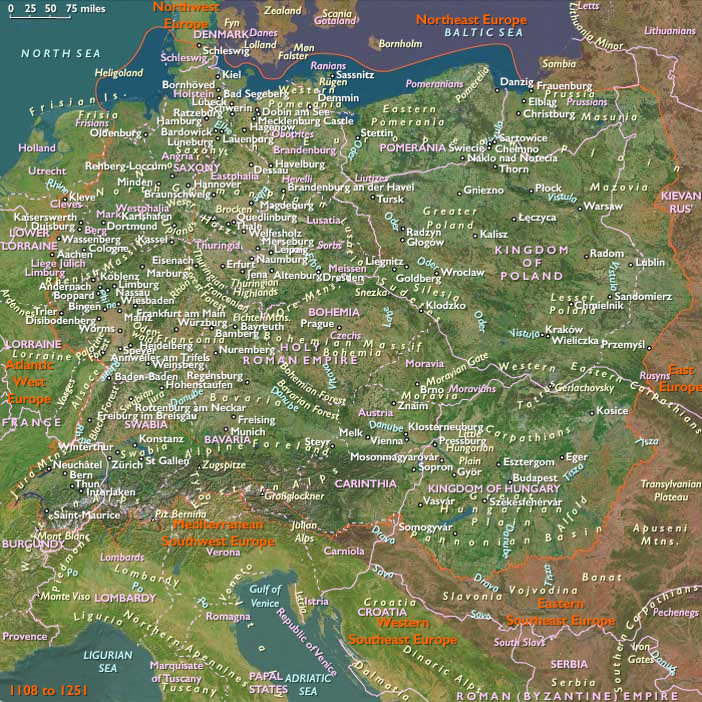
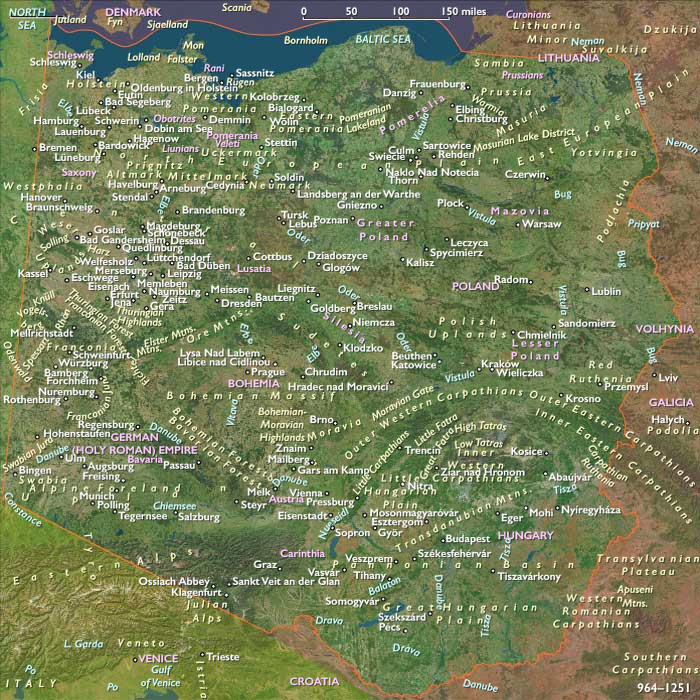
Leopold V of Austria, soon after succeeding his father as Duke of Austria upon the latter’s death on January 13, 1177, had lent his support to Frederick of Bohemia in his struggle against Soběslav II, who had campaigned in the Austrian duchy.
Leopold reaches a peace agreement with Bohemia in 1179.
Locations
People
Groups
Topics
Commodoties
Subjects
Regions
Subregions
Related Events
Filter results
Showing 10 events out of 48207 total
Earl Erling Skakke's position is compromised and he falls at the Battle of Kalvskinnet outside Nidaros in 1179.
The battle changes the tide of the civil wars.
Frederick of Bohemia is the son of King Vladislaus II of Bohemia, who had abdicated in 1172 in his favor.
However, he could not hold on to his principality, because neither the national diet nor the emperor,Frederick I, had approved his accession, and was deposed in September the year following by the emperor at the Diet of Hermsdorf.
The Emperor, godfather and namesake of Frederick, had nominated Oldřich, son of Soběslav I, but he had renounced the throne in favor of his elder brother Soběslav II, who had been imprisoned since 1161.
Soběslav II was sympathetic to the peasantry, but antagonistic to both nobles and emperor.
Sobeslav had granted a charter to the town of Prague, entered into a fight conflict with Henry II, Duke of Austria, in 1175.
In summer 1176, an army led by Duke Conrad Otto of Znojmo had devastated the country to the north of the Danube.
Churches and monasteries were attacked and Pope Alexander III had excommunicated the duke.
the emperor had intervened in 1177 and recognized Frederick as duke.
In alliance with the emperor, Frederick had defeated Soběslav at the battles of Lodenice and Prague.
The emperor had recognized Frederick as an imperial prince, but he had also raised the bishop of Prague, Henry Bretislaus, to princely status, making him a direct vassal of the emperor.
He had also appointed Conrad Otto margrave over Moravia, thus dividing the duchy into three parts dependent on him.
Soběslav will die in "some part of a foreign land" on January 29, 1180, without heirs from his union with Elisabeth (d. 1209), daughter of Mieszko III of Poland.

Saladin, after taking Hama from the Zengids in 1175, grants the city to his nephew, al-Muzaffar Umar, four years later, putting it under the rule of his Ayyubid family; this ushers in an era of stability and prosperity in the city.
Manuel has continued to meet the Seljuqs in smaller battles with some success, and concludes a probably advantageous peace with Kilij Arslan in 1179.
However, like Manzikert, Myriokephalon is a pivotal event and following it the balance between the two powers in Anatolia had gradually begun to shift, for Manuel will never again launch a strategically offensive campaign against the Turks and remains on the defensive.
Muhammad destroys the Ghaznavid garrison in Peshawar in 1179.
The two hundred and ninety-one bishops attending the third Lateran Council, convoked in 1179 by Pope Alexander III, study the Peace of Venice, by which Frederick Barbarossa had agreed in 1177 to withdraw support from his antipope and to restore the church property he had seized, leaving Italy in the hands of local rulers and the Pope.
The council establishes a two-thirds majority of the College of Cardinals as a requirement for papal election and stipulates that candidates for bishop must be thirty years old and of legitimate birth.
The council reaffirms the prescription of imprisonment and confiscation of property as punishment for heresy, and, like the Second Lateran council, threatens to excommunicate princes who fail to punish heretics.
The council officially ends the eighteen-year schism of the antipope Callixtus III and his predecessors, and also limits papal electors to members of the Sacred College of Cardinals.
Henceforth, it will be by virtue of the Cardinals’ decision that each new pope inherits his official titles, ancient and modern, secular and sacred: bishop of Rome, vicar of Jesus Christ, successor of the prince of the apostles, supreme pontiff of the universal Church, patriarch of the West, primate of Italy, archbishop and metropolitan of the Roman province, sovereign of the state of Vatican City, servant of the servants of God.
The heretical Cathari (or Albigenses) are condemned, and Christians are authorized to take up arms against vagabond robbers.
The Council also adopts a new canon: Jews are prohibited from having Christian servants, the testimony of Christians is to be accepted against Jews in suits, and Jews who convert are permitted to keep their possessions.
The council also attacks the practice of usury, essentially a Jewish business.
The Recognition of Portugal’s Independence: Papal Approval and Sovereignty (1179)
For four decades, Afonso I of Portugal had claimed the royal title, but full independence from León required more than military victories. The County of Portugal still needed diplomatic recognition from neighboring Christian realms and, most importantly, from the Roman Catholic Church and the papacy.
Marriage Alliances and Diplomatic Maneuvers
To strengthen his position, Afonso I wed Mafalda of Savoy, daughter of Amadeus III, Count of Savoy, securing ties with powerful European noble houses. He also dispatched ambassadors to Rome, negotiating directly with the pope to seek formal recognition of Portugal as a kingdom.
Renouncing León’s Suzerainty and Becoming a Papal Vassal
Afonso successfully renounced his vassalage to his cousin, Alfonso VIII of León, instead pledging fealty to the papacy, following the precedent set by the kings of Sicily and Aragon. This strategic move placed Portugal under the direct protection of the Catholic Church, shielding it from Castilian claims.
Papal Recognition: The Bull Manifestis Probatum (1179)
In 1179, Pope Alexander III issued the papal bull Manifestis Probatum, officially recognizing Afonso I as King of Portugal and confirming Portugal’s sovereignty as an independent Christian kingdom. With this decree, Portugal not only secured its political legitimacy but also gained the Church’s blessing to continue its Reconquista against the Moors.
This marked a definitive turning point in Portugal’s history, solidifying its status as an independent monarchy and establishing its long-standing alliance with the papacy.
The Christian Alliance Against the Almohads and the Treaty of Cazola (1179)
In 1179, Alfonso VIII of Castile took the initiative to forge a united front among the Christian kingdoms of the Iberian Peninsula—Navarre, León, Portugal, and Aragon—against the powerful Almohad Caliphate, which continued to dominate Al-Andalus. Recognizing the necessity of cooperation, the Christian monarchs agreed to coordinate their expansion efforts in the ongoing Reconquista.
The Treaty of Cazola: Dividing the Reconquista (1179)
To prevent territorial disputes between the Christian realms, the Treaty of Cazola was signed in 1179, establishing clear zones of expansion for each kingdom:
- Castile was granted the right to expand southward into La Mancha and the Guadalquivir Valley.
- Aragon was assigned the eastern territories, including Valencia and lands towards the Mediterranean.
- Portugal would continue its expansion southward along the Atlantic coast, consolidating its hold over Alentejo and the Algarve.
- León was to extend its influence into western Extremadura.
This treaty formalized territorial ambitions, reducing the risk of conflict among the Christian kingdoms and allowing them to focus on their common enemy, the Almohads. The agreement also reflected the growing diplomatic maturity of the Iberian Christian states, balancing their competing interests while pursuing a unified military strategy against Muslim rule.
Richard’s Suppression of the Gascon Revolt and the Siege of Taillebourg (1179 CE)
By 1179, Richard the Lionheart, having failed to overthrow his father Henry II, turned his attention to quelling internal revolts in Aquitaine, particularly in Gascony, where nobles had risen against his harsh rule. The increasing cruelty of his reign had alienated many lords, leading to a major rebellion. Seeking to dethrone Richard, the rebels allied with his brothers, Henry the Young King and Geoffrey of Brittany, in an attempt to divide and weaken Angevin rule in the region.
The Turning Point: The Siege of Taillebourg (Spring 1179)
The decisive moment in Richard’s campaign to crush the revolt came in the Charente Valley, where the rebels had taken refuge in Taillebourg, a fortress of strategic importance.
Fortress Defenses
- Taillebourg was considered impregnable, surrounded on three sides by cliffs and on the fourth by a well-fortified town with a three-layered wall.
- The garrison, confident in their defensive position, believed they could withstand any siege.
Richard’s Strategy and Victory
-
Isolating the Fortress –
- Instead of launching a direct assault, Richard first destroyed and looted the surrounding farms and lands, cutting off the defenders' supply lines and reinforcements.
- This starved the fortress and put psychological pressure on the defenders.
-
Luring the Garrison into Open Battle –
- The desperate garrison sallied out to attack Richard’s forces, attempting to break the siege.
- Richard defeated them in open battle, forcing them to retreat back inside.
-
Storming the Castle –
- As the defenders rushed back through the gates, Richard’s forces followed them inside, taking advantage of the open entry point.
- Within two days, he had seized control of Taillebourg, crushing the rebellion’s strongest defensive position.
Consequences of Richard’s Victory
-
Deterred Further Rebellion –
- The fall of Taillebourg shattered the morale of rebellious barons, forcing many lords to declare loyalty to Richard.
- It cemented his authority in Gascony and weakened his brothers' influence in the region.
-
Enhanced Military Reputation –
- The campaign demonstrated Richard’s strategic brilliance, particularly his ability to outmaneuver well-defended opponents.
- His methodical siege tactics and decisive battlefield leadership earned him widespread recognition as a formidable military commander.
This victory at Taillebourg in 1179 marked a crucial moment in Richard’s early military career, foreshadowing his later successes in warfare and his legendary status as one of the greatest generals of the medieval period.
A trilogy of works recorded between 1152 and 1170 details the prophetic and apocalyptic revelations of Hildegard of Bingen.
The abbess, who conducts extensive correspondence with the contemporary rulers of European nations and the church, gains renown for her lives of saints as well as treatises on medicine and natural history, but her music secures her lasting fame.
She composes for her large body of lyric and dramatic poetry unusual monophonic, melismatic chants, in a range that—as she notes—is suited to the voices of women.
Hildegard dies at the age of eighty-one on September 17, 1179.