
Filters:
The Rangers have been trailing the Comanche …
Years: 1840 - 1840
August
The Rangers have been trailing the Comanche war party for some time, unable to engage them because of their sheer numbers, but the three days of looting at Linnville have given the militia and Ranger companies a chance to gather.
Volunteers from Gonzales, Texas under Mathew Caldwell and from Bastrop under Ed Burleson, with all the ranger companies of east and central Texas, move to intercept the Indians.
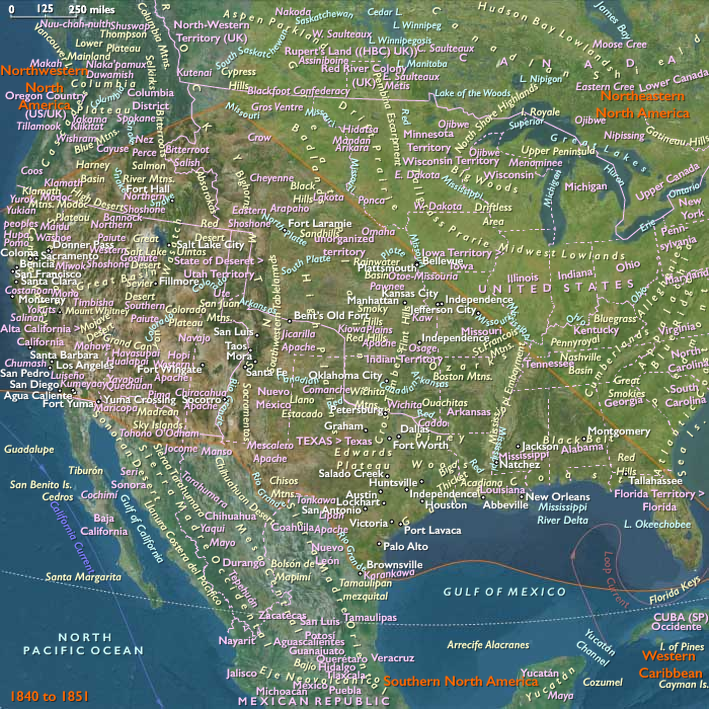
They make contact at Plum Creek, near the city of Lockhart, Texas, on August 12, 1840.
The Comanches, who normally fare about as a fast and deadly light cavalry, are detained considerably by the captive, slower pack mules.
The normal Comanche tactic is to ride as fast as possible away from the scene of a victory, but on this occasion they had slowed to a gentler pace acceptable to the heavily laden pack mules
Thus, the militia and rangers catch the raiders, which normally they find impossible.
The battle of Plum Creek is really a running gun battle, where the Texans attempt to kill the raiders and recover loot, and the Comanches simply attempt to get away.
Although only a dozen bodies are recovered, the Texans report killing eighty Comanches, and the war party losses are probably higher than normal, but greed saves the Comanches in turn; when the militia discover the stolen bullion, they abandon the fight, divide their loot, and go home.
Tonkawas had fought alongside the Texas Rangers against the Comanche will do so again at the Battle of Plum Creek and again in 1858 at the Battle of Little Robe Creek.
The Tonkawa will often visit the capital city of Austin during the days of the Republic of Texas and during early statehood.
Volunteers from Gonzales, Texas under Mathew Caldwell and from Bastrop under Ed Burleson, with all the ranger companies of east and central Texas, move to intercept the Indians.
They make contact at Plum Creek, near the city of Lockhart, Texas, on August 12, 1840.
The Comanches, who normally fare about as a fast and deadly light cavalry, are detained considerably by the captive, slower pack mules.
The normal Comanche tactic is to ride as fast as possible away from the scene of a victory, but on this occasion they had slowed to a gentler pace acceptable to the heavily laden pack mules
Thus, the militia and rangers catch the raiders, which normally they find impossible.
The battle of Plum Creek is really a running gun battle, where the Texans attempt to kill the raiders and recover loot, and the Comanches simply attempt to get away.
Although only a dozen bodies are recovered, the Texans report killing eighty Comanches, and the war party losses are probably higher than normal, but greed saves the Comanches in turn; when the militia discover the stolen bullion, they abandon the fight, divide their loot, and go home.
Tonkawas had fought alongside the Texas Rangers against the Comanche will do so again at the Battle of Plum Creek and again in 1858 at the Battle of Little Robe Creek.
The Tonkawa will often visit the capital city of Austin during the days of the Republic of Texas and during early statehood.
Locations
People
Groups
- Tonkawa (Amerind tribe)
- Comanche (Amerind tribe)
- United States of America (US, USA) (Washington DC)
- Texas, Republic of
Topics
- Indian Wars in Upper North America
- Comanche Wars
- Texas–Indian wars
- Great Raid of 1840
- Plum Creek, Battle of
Subjects
Regions

Subregions
Years: 1840 - 1840
August
Locations
People
Groups
- Tonkawa (Amerind tribe)
- Comanche (Amerind tribe)
- United States of America (US, USA) (Washington DC)
- Texas, Republic of
Topics
- Indian Wars in Upper North America
- Comanche Wars
- Texas–Indian wars
- Great Raid of 1840
- Plum Creek, Battle of
Subjects
Regions
Subregions