
Leaders in Albany, New York, do not …
Years: 1690 - 1690
May
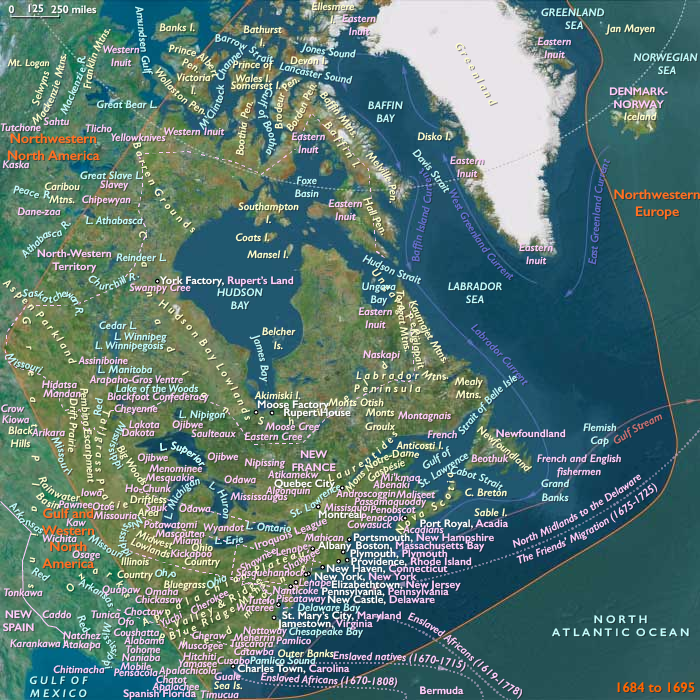
Leaders in Albany, New York, do not recognize Leisler until 1690, when they need his militia to protect them from a feared attack by the French and their native allies.
Locations
People
Groups
- New France (French Colony)
- France, (Bourbon) Kingdom of
- New York, Province of (English Colony)
- England, (Orange and Stewart) Kingdom of
Topics
- Colonization of the Americas, English
- Beaver Wars, or French and Iroquois Wars
- King William's War
- Leisler's Rebellion
Subjects
Regions

Subregions
Related Events
Filter results
Showing 10 events out of 29283 total
The major German Princes also associate themselves with the coalition, proving themselves willing to cooperate in the war against Louis and accepting of Leopold as their leader (although they have no intention of sacrificing their own independence).
Since the Swedes are part of the coalition, Frederick of Brandenburg has put aside his differences with them over Pomerania, and the Emperor himself acts for the Empire rather than just his own dynastic and hereditary lands in Austria.
Ottoman conquest has not meant the end of armed resistance on the part of the Slavic peoples.
Poor harvests and a rapacious nobility have frequently brought on local revolts by the reaya; in addition, individuals accused of crimes or protesting injustice would characteristically head for the hills or forests to live the life of the haiduk, or outlaw.
Both of these forms of resistance had increased from the seventeenth century, when the territorial expansion of the Ottoman Empire is reversed and Ottoman warriors withdrawing toward the core of the empire find themselves in growing competition with one another for inelastic resources.
Christian forces have attempted to push the Turks from the Balkans from 1684 to 1689, inciting the Serbs to rebel against their Turkish overlords.
Armed uprisings by the peasantry are particularly common in northern areas such as the Morava River valley, where imperial control is weakest and the Janissaries least disciplined.
The greatest of these revolts takes place in 1690, when Serbs rise in support of the Austrian invasion.
The Habsburg forces, unable to sustain their advance, retreat back across the Sava, leaving the the Serbs south of the Sava River seriously exposed to Turkish reprisals.
Fearing these, the Serbian patriarch Arsenije III Carnojevic of Pec, a town in the south of present-day Serbia, leads a great migration of sixty thousand to seventy thousand families from “Old Serbia” and southern Bosnia across the Danube and Sava to ...
...Austrian-ruled southern Hungary with as many as thirty-six thousand families.
Arsenije is soon upset by news that Catholic clergy is forcing the newly arrived Serbs to convert.
Upon reporting this to the Emperor, he is granted the Diploma of Protection for the Serbs and their religion on December 11, 1690.
Leopold also promises these Serbs the right to elect their own voivode, or military governor, and incorporates much of the region where they settle, later known as Vojvodina, into the military border.
The refugees establish new monasteries that become cultural centers in the Austrian Militärgrenze, or Military Frontier. (The Slavic name for the region, Vojna Krajina, will be used three hundrerd years later in the title given to the areas of Croatia that local Serb majorities attempted to claim for Serbia following the secession of Croatia from Yugoslavia.)
The British East India Company, consolidating its trade business in Bengal in 1690, acquires coastal enclaves on the east bank of the Hooghly River.
At this time Kolkata, under direct rule of the Nawab of Bengal Siraj-Ud-Daulah, comprises three villages: Kalikata, Govindapur and Sutanuti.
Charnock, threatened in Hooghly by the Mughal (Mogul) viceroy in Bengal, in 1690 moves his operations twenty-seven miles south to Sutanati, the site of what is now Calcutta.
The later selection of Calcutta as the capital of British India is largely the result of his persistence.
Constructing Fort William, the English authorities finally conclude peace with the Mughal Empire in 1690, when they agree to pay fees to continue their trade in Bengal.
Frequently at odds with Indian leaders and his superiors, Charnock has at times been accused of mismanagement, theft, brutality to Indian prisoners, and having questionable morals; he was once recommended for dismissal.
He lives with an Indian widow, whom he had rescued from her husband's funeral pyre, and has fathered several of her children.
Today the cultural capital of India and the commercial capital of Eastern India, the Kolkata metropolitan area, including suburbs, has a population exceeding fifteen million, making it the third most populous metropolitan area in India and the thirteenth most populous urban area in the world.
The city is also classified as the eighth largest urban agglomeration in the world.
The French had shown an interest in the East from the early years of the sixteenth century, but the Portuguese had checked individual efforts.
The first viable French company had been launched by the minister of finance Jean-Baptiste Colbert, with the support of Louis XIV, in 1664.
After some false starts, the French company had acquired Pondicherry, eighty-five miles (one hundred and thirty-seven kilometers) south of Madras, from a local ruler in 1674.
It obtains Chandernagore (modern Chandannagar), sixteen miles north of Calcutta, from the Mughal governor in 1690–92.
Sir John Child, whose autocratic behavior as president of Surat, where the British East India Company had established their first Indian factory (trading post) in 1612), had led in 1683 to Keigwin's unsuccessful rebellion in Bombay, had been made a baronet in 1684.
The first person to be placed in control of all the Company's trading establishments in India, he is, like Sir Josiah Child, the powerful governor of the company in London, utterly unscrupulous and has a passion for intrigue (the two Childs are stated by the Oxford Dictionary of National Biography to be unrelated).
Following orders from London, Child becomes involved in war with Aurangzeb, whose troops capture Surat and force Child to make peace.
One of the peace terms requires Child to leave India, but he dies in 1690 while the matter is still pending.
Jinji, also spelled Gingi or Gingee, an almost inaccessible fortress constructed by the Hindu rulers of the Vijayanagar Empire and located about eighty miles (one hundred and thirty kilometers) southwest of present-day Madras in the Indian state of Tamil Nadu, had been captured in 1638 from the Maratha chief Shahji by the Muslims of Bijapur.
Shahji's son, the famous Shivaji, had recaptured the fort in 1677.
Besieged by the Mughals from 1690, the fortress's chief claim to fame is that it will immobilize an army for eight years.
Fort St. David, an English stronghold near the town of Cuddalore, about one hundred miles (one hundred and sixty kilometers) south of Madras on the southeastern coast of India, is sold by the Marathas to the English East India Company in 1690.
It was named for the patron saint of Wales because the governor of Madras at this time, Elihu Yale, is Welsh.
It is purchased because of increasing political instability in southern India, which makes a second fortified trading station (besides that in Madras) desirable.
The progress of the French settlements in India is interrupted by events in Europe.
The Dutch capture Pondicherry in 1693.
Spain, with Louis XIV busy on the Rhine, joins the coalition against him.
Years: 1690 - 1690
May
Locations
People
Groups
- New France (French Colony)
- France, (Bourbon) Kingdom of
- New York, Province of (English Colony)
- England, (Orange and Stewart) Kingdom of
Topics
- Colonization of the Americas, English
- Beaver Wars, or French and Iroquois Wars
- King William's War
- Leisler's Rebellion
