
Latins move into Italy by the middle …
Years: 753BCE - 742BCE
Latins move into Italy by the middle of the eighth century BCE.
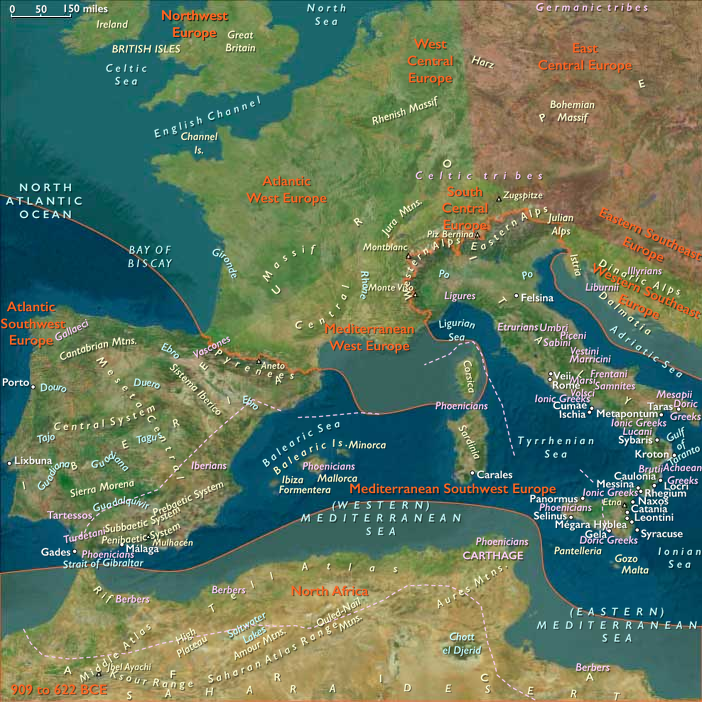
Local Latins and Sabines of the Villanovan culture are probably the actual founders of the city of Rome in the eighth century BCE, a date compatible with the Roman tradition.
According to Roman mythology, Romulus and Remus were sons of the god Mars and Rhea Silvia, a vestal virgin and the daughter of Numitor, king of Alba Longa, who had been driven from his throne by Amulius.
After birth the usurper placed the twins in a container and cast them upon the Tiber, but they floated ashore and were nursed by a bitch wolf until found and raised by the shepherd Faustulus and his wife, Acca Laurentia.
(Plutarch alleges they were also fed by a woodpecker, the bird sacred to Mars).
Upon reaching maturity, the twins restore Numitor to his throne and, on April 21, 753 (at that time the date of the vernal equinox, an event sacred to Mars), establish Rome on the Palatine Hill, one of seven proximate hills in the midst of a dozen Etruscan cities in central Italy.
Set by Varro in the first century BCE, this is the most common date used as the beginning of the Roman 'Ab urbe condita' calendar.
Rome adopts the Etruscan alphabet, which the Etruscans themselves had adopted from the Greeks.
The brothers rule jointly for a while, then quarrel, whereupon Romulus, heeding an omen indicating that he is the true founder of the city, kills Remus and becomes the first king of Rome.
(Romans will venerate Romulus as Quirinus, god of the winter solstice).
Romulus, according to Rome's early semi-legendary history, founds an asylum for fugitives on the Capitoline Hill, establishes the establishes the Senate and divides the people into tribal units.
He seeks to obtain women as wives for his male citizens.
After delegation sent to nearby regions requesting wives are refused, Romulus devises a festival of Neptune Equester and proclaims the festival among Rome's neighbors.
The citizens of nearby Caenina (the Caeninenses) attendthe festival along with many others of Rome's neighbors, including the Crustumini, and Antemnates, and many of the Sabines.
At the festival Romulus gives a signal, at which the Romans grab the virgins among the spectators for wives.
This event is known as The Rape of the Sabine Women.
(This legend, if such it be, probably developed to explain Rome’s population of Sabines, who lived in the Sabine hills northeast of Rome and maintained an antagonistic relationship with the Latin city.
Scholars believe many Roman religious practices to be Sabine in origin.
Locations
Groups
- Polytheism (“paganism”)
- Latins (Italic tribe)
- Greece, classical
- Italy, classical
- Sabines
- Etruscan civilization
Topics
Subjects
Regions
Subregions
Years: 753BCE - 742BCE
Locations
Groups
- Polytheism (“paganism”)
- Latins (Italic tribe)
- Greece, classical
- Italy, classical
- Sabines
- Etruscan civilization
Topics
Subjects
Regions
Subregions