
Lange’s Labour government embarks on a radical …
Years: 1984 - 1995
Lange’s Labour government embarks on a radical program to transform New Zealand from a social welfare state to a free-market economy.
Related Events
Filter results
Showing 10 events out of 1617 total
Australian actor Nicole Kidman (1967-), a statuesque redhead who appeared on television in films and miniseries during her adolescence, lands her first feature role in the thriller Dead Calm (1989).
The offer of a role in Days of Thunder draws her to the U.S., and her work in the film sparks the beginning of a prolific motion picture career.
(in the decade following its release, Kidman appears in a dozen films.
)
Other redhaired performers that gain attention in the movie business in Hollywood during the 80's and early 90s include Bette Midler, Susan Sarandon, Molly Ringwald, and Clare Danes
This age’s “Balkanization” of the Balkans is laid in this era, at great human and material cost.
At the era’s beginning, there are five Balkan states: Greece, Albania, Yugoslavia, Romania, and Bulgaria.
“Ethnic cleansing,” a phrase that will enter public consciousness during this era, begins with the violent Bulgarization campaign directed against ethnic Turks in Bulgaria, while Turkey hovers near the brink of war with Greece and Bulgaria, engendering cooperation between these two former enemies.
When the Soviet Union finally collapses in 1991, the Moldavian S.S.R becomes the independent state of Moldova and the second, postwar Yugoslavia begins to break apart as four of its constituent republics—Slovenia, Croatia, Macedonia, and Bosnia & Herzegovina—fight for independence from the dominant Serbian republic.
When the dust has settled and the blood has dried, only Montenegro remains in the Yugoslav federation.
At the same time, Greece, Romania, and Bulgaria shed their socialist governments—the latter two imprison or execute their former leaders—and even Albania, having increasingly walled itself off over its several decades of independence, begins to retreat from its peculiarly isolationist brand of Stalinism and let in the light of the outside world.
Northeast Asia (1984–1995 CE)
Shifts in Geopolitics, Economic Transition, and Environmental Challenges
Between 1984 and 1995, Northeast Asia—encompassing eastern Siberia (east of 130°E), northeastern China's Heilongjiang province, northern Primorsky Krai, and most of Hokkaido excluding its southwestern portion—experienced significant geopolitical shifts, economic transitions, and deepening environmental challenges.
The later stages of the Cold War saw considerable change in regional geopolitics. Under the leadership of Mikhail Gorbachev, the Soviet Union introduced policies of glasnost (openness) and perestroika (restructuring), aiming to reform and revitalize the Soviet economy and society. These changes resulted in decreased military tension and a shift toward diplomatic engagement, notably with Japan over the disputed Kuril Islands. However, despite improved diplomatic dialogue, resolution of this territorial conflict remained elusive, continuing to influence regional security dynamics.
With the collapse of the Soviet Union in 1991, Northeast Asia entered a period of profound economic transformation. The newly formed Russian Federation faced substantial economic challenges, including sharp declines in industrial output, resource extraction disruptions, and deteriorating infrastructure. Economic hardship was widespread, affecting both urban populations and indigenous communities such as the Evenki, Chukchi, Koryaks, and Itelmen, whose traditional lifestyles had already been severely disrupted by decades of industrialization and militarization.
The establishment of the Sakha Republic and the Chukotka Autonomous Okrug in 1992 marked significant administrative and political shifts. These new regional entities aimed to provide greater autonomy and self-determination for indigenous peoples, enhancing local governance and cultural preservation.
The economic restructuring process opened Northeast Asia to increased foreign investment, especially from neighboring China, Japan, and South Korea. Investment primarily targeted resource extraction industries, fisheries, and infrastructure projects, leading to intensified exploitation of regional resources. China's northeastern province of Heilongjiang expanded its industrial capacity and cross-border trade, becoming an economic focal point for Sino-Russian cooperation.
Environmental degradation continued to pose significant challenges. Persistent industrial activity, including mining and large-scale fishing, exacerbated ecological damage, resulting in severe water pollution, habitat destruction, and declining fish stocks. Increased deforestation and air pollution further threatened regional biodiversity and public health. The recognition of these environmental crises grew steadily, prompting local and international calls for more stringent conservation and sustainability measures.
Indigenous communities increasingly advocated for the protection of their traditional lands and rights, joining broader international movements supporting indigenous cultural preservation and environmental justice. These advocacy efforts gradually influenced governmental policies, leading to modest improvements in the recognition and support for indigenous peoples in Siberia and the Russian Far East.
By 1995, Northeast Asia had become a region shaped by geopolitical realignment following the Soviet collapse, economic transition and integration into global markets, and intensifying environmental and indigenous rights concerns. These interconnected dynamics continued to shape the region’s development into the subsequent era.
Northwestern North America (1984–1995 CE)
Globalization, Cultural Assertion, and Environmental Conflict
Environmental context
The late 20th century brought intensified forestry, mining, and marine resource pressures to the Northwest Coast, Plateau, and Arctic. Clearcutting reached unprecedented scales in coastal British Columbia and Southeast Alaska, while experimental salmon aquaculture emerged in sheltered inlets, sparking ecological debate. Arctic marine ecosystems faced oil and gas exploration in the Beaufort and Chukchi Seas, with concerns about spill risk in ice-covered waters. Climate variability—particularly strong El Niño events—altered North Pacific salmon migration and returns, adding uncertainty to already pressured fisheries.
In March 1989, the Exxon Valdez oil spill in Prince William Sound, Alaska, released approximately 11 million gallons of crude oil into a pristine marine ecosystem. The spill caused catastrophic mortality among seabirds, marine mammals, and fish, and its toxic legacy persisted in sediments and food webs for decades. The disaster galvanized Indigenous communities, environmental organizations, and policymakers, driving campaigns for stricter marine transportation safety, spill response capacity, and environmental protection standards.
Political and legal change
This period marked major advances in Indigenous self-determination:
-
In Canada, early modern treaty negotiations began under the BC Treaty Process (1993), building on court decisions affirming Aboriginal rights and consultation requirements.
-
In Alaska, tribal governments expanded their role in fisheries and wildlife co-management under federal and state agreements.
-
Cross-border cooperation in salmon management under the Pacific Salmon Treaty (1985) brought Indigenous voices into binational resource diplomacy.
Internationally, the end of the Cold War saw military drawdowns in Arctic radar and air bases, but sovereignty patrols and environmental monitoring increased in cooperation with circumpolar neighbors.
Economy and infrastructure
Globalization reshaped the regional economy:
-
Seafood exports expanded into Asian and European markets, with both wild and farmed salmon in play.
-
Tourism and cultural heritage industries grew rapidly, with cruise ship routes into Southeast Alaska, Haida Gwaii, and the Inside Passage.
-
Logging blockades and negotiations reshaped forestry in Clayoquot Sound and Haida Gwaii, while new mining proposals in the interior tested emerging consultation frameworks.
Arctic and Bering Strait dynamics
The Arctic entered an era of combined subsistence and cash economies, with community-led resource management integrating traditional knowledge and scientific research. Oil exploration and shipping through Arctic waters remained controversial, prompting U.S.–Canada environmental cooperation agreements. The Bering Strait continued to serve as both a cultural bridge and an international security chokepoint.
Cultural resurgence
Indigenous cultural visibility rose globally:
-
Northwest Coast art—crest poles, bentwood boxes, regalia—gained prominence in international exhibitions.
-
Language revitalization programs entered public school curricula in several regions.
-
Canoe voyaging networks revived, culminating in large intertribal gatherings such as the Paddle to Seattle (1993), reasserting maritime heritage.
Environmental and rights campaigns
The era saw some of the largest environmental–Indigenous rights coalitions in North America:
-
The Haida Nation’s logging blockades on Lyell Island (1985) contributed to the creation of Gwaii Haanas National Park Reserve and Haida Heritage Site.
-
The Tla-o-qui-aht and allies’ protests in Clayoquot Sound (1993) became one of the largest acts of civil disobedience in Canadian history.
-
Offshore oil proposals in Hecate Strait were met with coordinated Indigenous and environmentalist opposition, reinforcing marine protection agendas.
-
The Exxon Valdez oil spill became a rallying point for marine protection policy reforms and Indigenous advocacy in Alaska and beyond.
By 1995 CE
Northwestern North America emerged as a high-profile arena for Indigenous rights, environmental stewardship, and global cultural exchange. Political negotiations, environmental activism, and a resurgence in Indigenous governance reshaped the region’s trajectory toward the 21st century.
North Polynesia (1984–1995 CE)
Sustained Economic Development and Tourism Boom
From 1984 to 1995, North Polynesia, notably the Hawaiian Islands, experienced continued economic expansion driven significantly by tourism and real estate. The tourism sector flourished with increased arrivals from mainland United States, Japan, and emerging Asian markets, fueling growth in hospitality and related industries. Iconic resorts, golf courses, and luxury developments transformed landscapes, particularly on Oahu, Maui, and Kauai, reinforcing Hawaii’s reputation as a premier global destination.
Environmental Concerns and Preservation Efforts
Rapid growth prompted growing environmental concerns, notably around development impacts, shoreline erosion, and native habitat degradation. Awareness of Hawaii’s ecological vulnerability inspired movements advocating stricter environmental protection measures, marine conservation efforts, and the establishment of additional protected areas, including significant expansions in national parks, wildlife refuges, and marine sanctuaries.
Native Hawaiian Sovereignty and Cultural Movements
This period witnessed intensified political activism and cultural revival among Native Hawaiians. The 1993 Apology Resolution, passed by the U.S. Congress, officially acknowledged the illegality of the 1893 overthrow of the Hawaiian monarchy and contributed significantly to sovereignty discourse. Activists advocated for land rights, self-determination, and the restoration of indigenous cultural practices, prominently reflected in educational institutions and community programs promoting Hawaiian language and traditions.
Technological Advancements and Economic Diversification
Technological innovation and diversification of economic activities characterized this era. Advances in telecommunications, digital infrastructure, and renewable energy technologies began reshaping the region’s economy, creating new opportunities outside tourism. High-tech industries and research institutions, particularly associated with the University of Hawaii, fostered knowledge-driven economic sectors.
Military Presence and Strategic Significance
The islands maintained their strategic importance to U.S. national defense, particularly toward the conclusion of the Cold War. Military installations at Pearl Harbor, Schofield Barracks, and other sites continued to play a pivotal role in U.S. Pacific strategy. However, tensions persisted over land usage, environmental impacts, and cultural sensitivities regarding military activities, prompting ongoing local debate and activism.
Social Challenges and Housing Affordability
Rapid economic growth exacerbated social issues, notably housing affordability and income disparity. Housing prices surged, driven by demand from affluent newcomers and investors, placing increasing strain on local and indigenous populations. Efforts to address housing shortages and homelessness intensified, highlighting disparities and prompting state and local governments to implement initiatives aimed at affordable housing and community development.
Educational Reforms and Institutional Growth
Education received increased attention and resources during this era, with significant investment in public education, higher education, and vocational training programs. The University of Hawaii expanded research capabilities, while local school systems implemented culturally sensitive curricula, reflecting a growing appreciation for Native Hawaiian history and perspectives.
Natural Disasters and Resilience
The islands faced significant challenges from natural disasters. Notably, in 1992, Hurricane Iniki devastated Kauai, causing extensive damage and highlighting vulnerabilities in infrastructure and emergency preparedness. Recovery efforts sparked renewed focus on disaster resilience, better emergency planning, and improvements in infrastructure standards.
Cultural Representation and Global Recognition
North Polynesia gained global cultural recognition through media exposure, cultural festivals, international sporting events, and Hawaiian arts and entertainment. Traditional practices such as hula experienced international appreciation, showcasing Hawaiian culture worldwide and enhancing the islands' reputation for cultural richness and diversity.
Conclusion of the Era
From 1984 to 1995, North Polynesia balanced sustained economic prosperity, cultural revitalization, and emerging social and environmental challenges. Significant milestones, including the formal acknowledgment of historical injustices and increased focus on environmental and social sustainability, marked this era, setting the stage for future developments shaped by global awareness, local advocacy, and economic resilience.
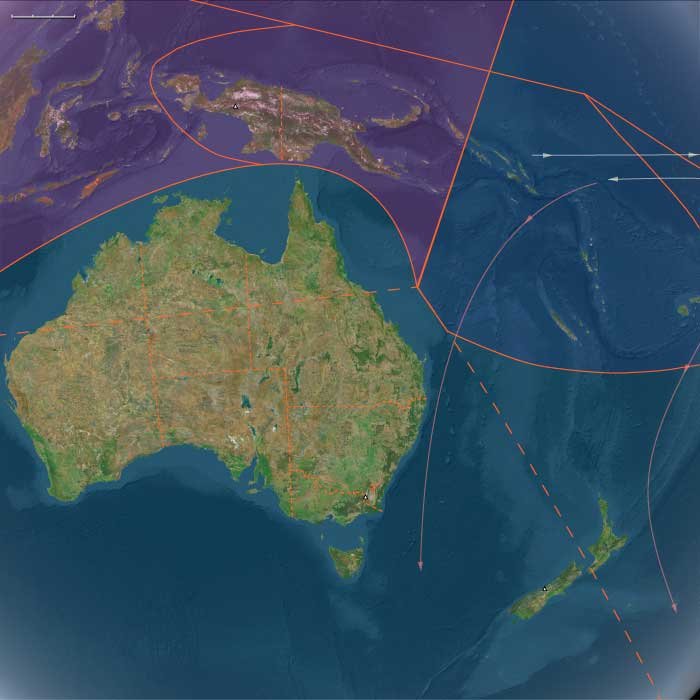
France holds French Polynesia as an Overseas Territory, as well as Wallis and Futuna Islands and New Caledonia.
New Zealand still retains sovereignty over the Tokelau Islands North of Samoa, but grants self-government to the Cook Islands (East of French Polynesia) and neighboring Niue.
France holds French Polynesia as an Overseas Territory, as well as Wallis and Futuna Islands and New Caledonia.
New Zealand still retains sovereignty over the Tokelau Islands North of Samoa, but grants self-government to the Cook Islands (East of French Polynesia) and neighboring Niue.
South Polynesia (1984 – 1995 CE)
Geographic scope: This subregion includes Norfolk Island, the Kermadec Islands, the Chatham Islands, and all of New Zealand’s North Island except for the extreme southwest.
Climate and Environmental Conditions
Overall climatic stability was punctuated by notable El Niño and La Niña episodes, which affected rainfall distribution and temperature patterns. Eastern North Island districts experienced periodic droughts, while western and northern areas occasionally endured heavy rain events and flooding. The Chatham Islands retained their cool, windy climate, the Kermadec Islands remained subtropical with occasional cyclone influence, and Norfolk Island maintained its mild, oceanic regime.
Vegetation and Landscape
North Island (excluding extreme southwest): Remaining native forests persisted mainly in upland protected reserves, rugged ranges, and isolated valleys. Lowland areas were dominated by agricultural land and exotic forestry plantations, particularly radiata pine. Alpine vegetation was confined to high volcanic summits—Ruapehu, Ngauruhoe, Tongariro, Mt Taranaki—while wetland conservation initiatives increased.
Chatham Islands: Coastal forest restoration efforts began alongside sheep grazing.
Kermadec Islands: Native evergreen forests continued to recover under pest control programs.
Norfolk Island: Native pines and hardwoods received greater protection, with replanting schemes initiated.
Political and Social Context
This period saw the consolidation of Māori political activism into lasting policy changes. In 1985, the Waitangi Tribunal was empowered to investigate historical grievances dating back to 1840, allowing for significant treaty settlement processes. High-profile settlements and the return of land and resources to Māori iwi marked a turning point in Crown–Māori relations. The period also saw landmark protests and legal actions reinforcing Treaty of Waitangi principles.
In the Chatham Islands, Moriori identity and heritage experienced renewed recognition, with cultural and historical research gaining support. Norfolk Island continued under Australian administration, negotiating the balance between local autonomy and federal oversight. The Kermadec Islands were managed primarily as a nature reserve, with access limited to research and conservation personnel.
Economic Activity
In the North Island, agriculture modernized with increased mechanization and diversification into horticulture, wine production, and high-value export crops. Dairy and sheep farming remained central, though international market fluctuations affected rural economies. Commercial fishing, especially in the 200-mile Exclusive Economic Zone, remained an important sector. Tourism grew rapidly, driven by interest in Māori cultural sites, geothermal attractions, and coastal recreation.
Cultural Developments
The Māori Renaissance gathered further momentum, with the revitalization of te reo Māori through immersion schools (kōhanga reo), broadcasting, and legislation making it an official language in 1987. Carving, weaving, performing arts, and tribal governance structures strengthened.
In the Chatham Islands, Moriori and Māori communities worked to preserve and transmit local traditions. Norfolk Island maintained its distinctive blend of Pitcairn heritage and Australian influences. The Kermadec Islands gained increasing recognition as a unique ecological site of global significance.
A century after the introduction of refrigerated cargo ships, there are 20 sheep for every New Zealander.
Lange’s Labour government embarks on a radical program to transform New Zealand from a social welfare state to a free-market economy.