
Landscape becomes a primary element in Muslim …
Years: 715 - 715
Landscape becomes a primary element in Muslim Arabic art, as, for example, in the so-called “Landscape Mosaic,” produced by mosaicists of the Eastern Roman Empire for the new Great Mosque in Damascus, the most impressive in the Islamic world at the time.
The spot where the Great Mosque now stands had been a temple of Hadad in the Aramaean era. (The Aramaean presence is attested by the discovery of a basalt orthostat depicting a sphinx, excavated in the northeast corner of mosque.)
The site was later a temple of Jupiter in the Roman era, then a Christian church dedicated to John the Baptist in the Constantinopolitan era.
Initially, the Muslim conquest of Damascus in 636 did not affect the church, as the building was shared by Muslim and Christian worshipers.
It remained a church although the Muslims built a mud brick structure against the southern wall so that they could pray.
Under the Umayyad caliph Al-Walid I, however, the church has been demolished and between 706 and 715 the current mosque built in its place.
According to legend, Al-Walid himself had initiated the demolition by driving a golden spike into the church.
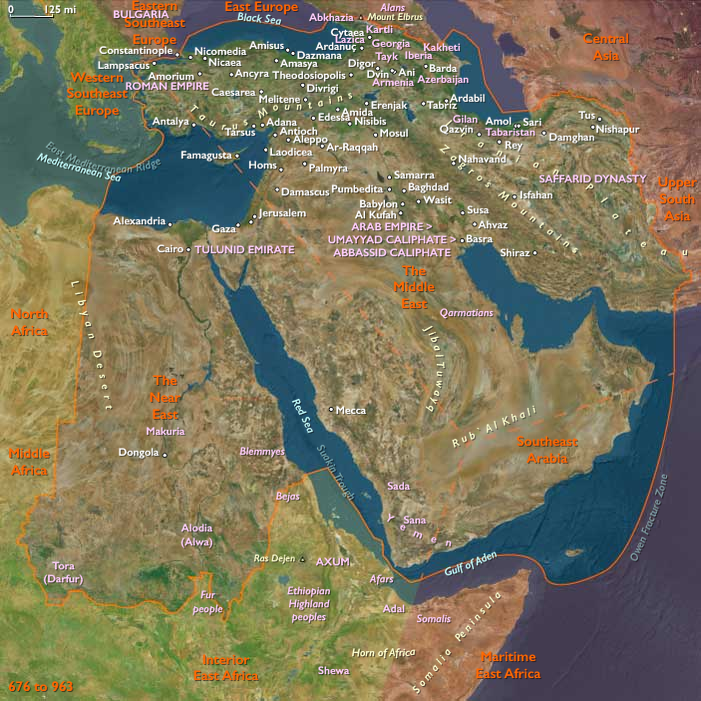
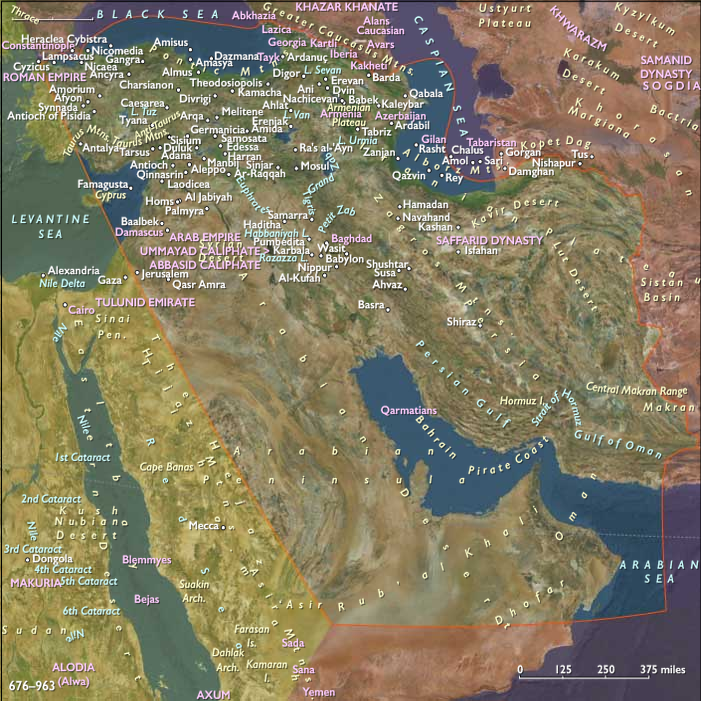
At this time, Damascus is one of the most important cities in the Middle East and will soon become the capital of the Umayyad caliphate.
The caliph had asked and obtained from the Emperor at Constantinople two hundred skilled workers to decorate the mosque, as evidenced by the partly Byzantine style of the building.
The interior walls are covered with more than an acre of fine mosaics, considered to depict the Qu'ranic paradise, or possibly the Ghouta, which tradition holds so impressed the prophet Muhammad that he declined to enter it, preferring to taste paradise in the afterlife.
The earliest surviving stone mosque, the building, one of the largest of its time, is considered one of the marvels of the world.
Locations
People
Groups
Subjects
Regions
Subregions
Years: 715 - 715
Locations
People
Groups
Subjects
Regions
Subregions