
Lahore appears as the capital of the …
Years: 1040 - 1040
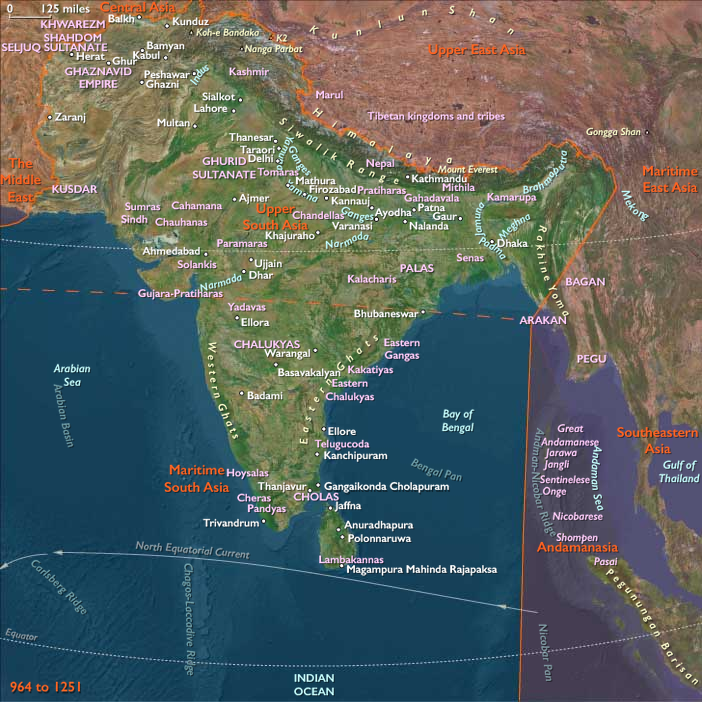
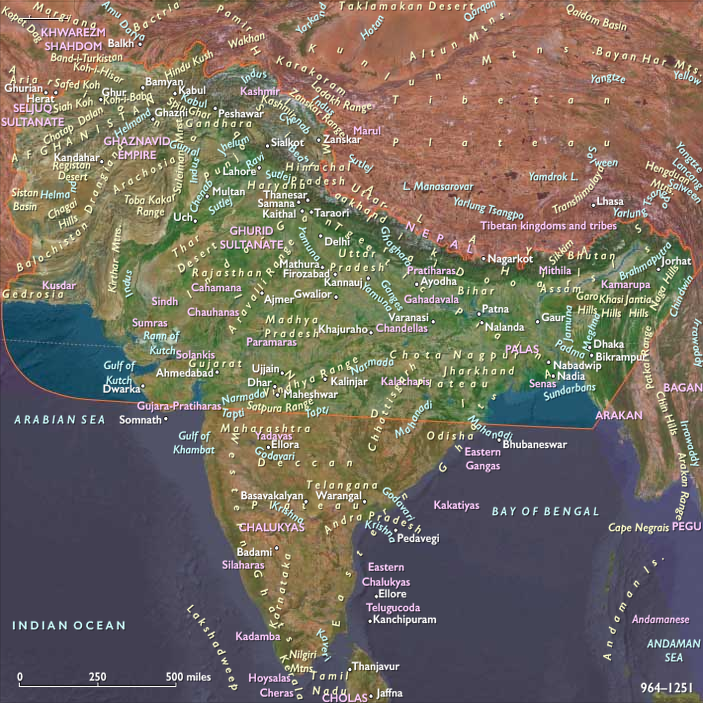
Lahore appears as the capital of the Punjab for the first time under Anandapala—the Hindu Shahi king who is referred to as the ruler of (hakim i lahur)—after leaving the earlier capital of Waihind.
Few references to Lahore remain from before its capture by Sultan Mahmud of Ghaznavi in the eleventh century.
The sultan had taken Lahore after a long siege and battle in which the city had been torched and depopulated.
In 1021, Sultan Mahmud had appointed Malik Ayaz to the throne and made Lahore the capital of the Ghaznavid Empire.
As the first Muslim governor of Lahore, Ayaz has rebuilt and repopulated the city.
He has added many important features, such as city gates and a masonry fort, built in 1037–1040 on the ruins of the previous one, which had been demolished in the fighting.
The present Lahore Fort stands on the same location.
Under Ayaz's rule, the city has become a cultural and academic center, renowned for poetry.
The tomb of Malik Ayaz can still be seen in the city’s Rang Mahal commercial area.
Locations
People
Groups
Topics
Commodoties
Subjects
Regions
Subregions
Related Events
Filter results
Showing 4 events out of 4 total
The Middle East (1984–1995): Shifting Alliances and New Confrontations
Between 1984 and 1995, the Middle East undergoes significant geopolitical shifts shaped by regional rivalries, superpower retrenchment following the Cold War, and changing internal dynamics within states. The era is defined by protracted conflict, evolving alliances, and critical peace initiatives.
The End of the Iran-Iraq War
The devastating Iran-Iraq War continues until 1988, concluding only after inflicting enormous human, economic, and environmental destruction on both sides. In August 1988, Ayatollah Ruhollah Khomeini reluctantly accepts UN Resolution 598, which mandates an immediate ceasefire. Neither country achieves its strategic objectives, leaving unresolved territorial disputes and lingering bitterness.
The conflict leaves Iraq heavily indebted, particularly to its Gulf Arab neighbors who had financed its war effort, creating tensions that quickly erupt into open hostility. Meanwhile, Iran remains politically isolated yet more resolutely committed to exporting its revolutionary ideals.
The Gulf War and its Aftermath
In August 1990, Iraqi President Saddam Hussein, seeking relief from economic pressures and claiming historical rights, invades and occupies Kuwait, prompting global condemnation. The United Nations swiftly imposes sanctions, and a U.S.-led international coalition assembles to reverse the occupation.
The Gulf War (Operation Desert Storm) begins in January 1991, resulting in the swift liberation of Kuwait and the decisive defeat of Iraqi forces. Iraq retreats, leaving catastrophic destruction behind, including widespread oil fires and environmental damage in Kuwait.
Despite Iraq's defeat, Saddam Hussein retains power, brutally suppressing Kurdish and Shi’a rebellions encouraged by the international community yet receiving limited external support. Subsequently, Iraq remains isolated, crippled by stringent international sanctions enforced under UN resolutions.
Rise of American Influence and the New Middle East Order
Following the collapse of the Soviet Union in 1991, American influence in the Middle East reaches unprecedented levels. The United States strengthens military alliances with Gulf Cooperation Council (GCC) countries, notably Saudi Arabia, Kuwait, Qatar, and the UAE, establishing permanent military bases to maintain regional stability and secure oil supplies.
However, the presence of American troops, especially in Saudi Arabia—home to Islam's holiest sites—provokes increasing resentment among local populations, fueling Islamist extremism that will later emerge violently in global politics.
Lebanon: The Taif Accord and a Fragile Peace
The protracted Lebanese Civil War, ongoing since 1975, reaches a negotiated resolution with the Taif Accord in 1989. Brokered with Saudi support, the accord redistributes political power, reducing Christian dominance, and increasing the political representation of Lebanon’s Muslim communities, especially Sunnis and Shi’as.
The accord, while ending major hostilities, institutionalizes Syrian influence, permitting a large Syrian military presence in Lebanon. Despite nominal peace, Lebanon remains politically fragmented, with Hezbollah consolidating influence in the Shi’a south and central government authority remaining weak.
Israeli-Palestinian Peace Efforts: Madrid and Oslo
In 1991, the United States and the Soviet Union convene the Madrid Conference, initiating direct negotiations between Israel and its Arab neighbors, including Palestinians. Although immediate results are limited, Madrid sets the stage for the historic breakthrough in 1993.
In 1993, Israel and the Palestine Liberation Organization (PLO) sign the Oslo Accords, leading to mutual recognition and the establishment of the Palestinian Authority in parts of the West Bank and Gaza. Yasser Arafat returns to Palestinian territory in 1994 as the head of the Palestinian Authority, symbolizing a historic step toward self-governance. However, unresolved issues—including the status of Jerusalem, refugees, and settlements—quickly stall momentum.
Jordan also formally ends its state of war with Israel, signing a peace treaty in October 1994, thereby significantly reshaping regional dynamics.
Iran after Khomeini: Pragmatism and Continued Revolution
Following the death of Ayatollah Khomeini in 1989, Iran undergoes a subtle internal realignment. Ayatollah Ali Khamenei succeeds Khomeini as Supreme Leader, while Akbar Hashemi Rafsanjani becomes president, advocating pragmatic economic policies and cautious international engagement. Despite Rafsanjani’s moderation, Iran remains ideologically committed to revolutionary Shi’a Islam, supporting Hezbollah in Lebanon, Palestinian militants, and various Shi’a factions throughout the Gulf.
Syria: Assad’s Grip Tightens
In Syria, President Hafez al-Assad remains a key regional player, especially in Lebanon and Palestinian affairs. Assad maintains stability through a ruthless security apparatus and continues to balance relationships with the West and Russia, skillfully navigating the post-Cold War diplomatic landscape.
Turkey’s Continued Evolution and Kurdish Conflict
In Turkey, political instability accompanies economic liberalization and rapid urbanization. Throughout the 1980s and early 1990s, Turkey grapples with the Kurdistan Workers' Party (PKK) insurgency, a conflict rooted in long-standing ethnic tensions and grievances. Despite harsh military responses, Kurdish demands for cultural and political rights intensify, influencing Turkish domestic politics and regional relations profoundly.
Caucasus: Georgia, Armenia, and Azerbaijan Post-Soviet Independence
With the collapse of the Soviet Union in 1991, Georgia, Armenia, and Azerbaijan achieve independence, facing significant internal and external challenges.
-
Georgia struggles with separatist conflicts in Abkhazia and South Ossetia, resulting in civil unrest and weak governance throughout the 1990s.
-
Armenia and Azerbaijan engage in a bitter conflict over Nagorno-Karabakh, an ethnic Armenian enclave inside Azerbaijan. A full-scale war erupts in 1988 and intensifies dramatically after independence. A ceasefire agreement in 1994 leaves Armenian forces in control of Nagorno-Karabakh and surrounding Azerbaijani territory, creating unresolved territorial disputes and animosity lasting decades.
These conflicts profoundly influence regional geopolitics, drawing in neighboring countries and global powers, complicating diplomatic efforts.
Legacy of Conflict, Diplomacy, and Transition (1984–1995)
The period from 1984 to 1995 significantly reshapes the Middle Eastern geopolitical landscape. The Gulf War realigns regional and global alliances, placing the United States as a preeminent external power with deepening involvement in Gulf security, a role bringing both stability and unintended consequences.
Peace efforts like the Oslo Accords raise hopes for an enduring Israeli-Palestinian settlement, yet unresolved core issues leave lasting uncertainty and frustration. Similarly, Lebanon’s Taif Accord achieves peace on paper but institutionalizes internal divisions and external influence.
Finally, the emergence of newly independent states in the Caucasus introduces fresh instability into the Middle East periphery, highlighting ethnic nationalism and territorial disputes that remain unresolved. Collectively, these events establish lasting dynamics that shape regional politics well into the 21st century.
The Middle East (1996–2007): From Stalled Peace to New Conflicts
Between 1996 and 2007, the Middle East experiences persistent turbulence, characterized by stalled peace initiatives, intensified internal conflicts, geopolitical realignments, and the profound repercussions of global events such as the September 11, 2001, terrorist attacks and the subsequent U.S.-led invasion of Iraq. This era reshapes the region profoundly, setting the stage for renewed tensions, sectarian divisions, and shifting power balances.
Stalled Peace and Intensified Conflict: Israel, Palestine, and Lebanon
The optimism sparked by the Oslo Accords of the early 1990s steadily diminishes amid violence and political stalemate. Israeli Prime Minister Yitzhak Rabin’s assassination in 1995, followed by a series of Israeli and Palestinian leadership changes, contributes to a breakdown in trust. The second Palestinian intifada erupts in September 2000 after Ariel Sharon visits the Temple Mount/Haram al-Sharif, triggering widespread unrest. Subsequent years see escalating violence, suicide bombings, and harsh Israeli military reprisals.
In 2005, under Prime Minister Ariel Sharon, Israel unilaterally withdraws from Gaza, dismantling settlements but retaining control over its borders. This withdrawal, rather than promoting peace, eventually strengthens Hamas, which wins the Palestinian legislative elections in 2006, deepening divisions between Gaza (under Hamas) and the West Bank (under the Fatah-led Palestinian Authority).
In Lebanon, tensions flare dramatically in 2006 when Hezbollah captures two Israeli soldiers, sparking a destructive 34-day conflict. The war devastates Lebanon's infrastructure, kills over a thousand Lebanese civilians, and highlights Hezbollah's military capabilities and resilience. This conflict underscores persistent instability and the increasing influence of Iran via its Lebanese proxy.
The September 11 Attacks and the War on Terror
The terrorist attacks of September 11, 2001, dramatically transform U.S. involvement in the Middle East. The subsequent "War on Terror" begins with the invasion of Afghanistan in late 2001, but swiftly impacts the entire Middle East. States such as Saudi Arabia, Qatar, Bahrain, and Kuwait find themselves balancing cooperation with the U.S. against growing domestic opposition to American presence in the region.
Increased scrutiny on Saudi Arabia, due to many attackers' Saudi origins, pressures the kingdom to confront internal extremist elements. Radical Islamist groups and their sympathizers grow increasingly hostile to regional governments closely aligned with the West.
The 2003 Iraq War and Regional Aftershocks
In March 2003, a U.S.-led coalition invades Iraq, toppling the regime of Saddam Hussein within weeks. The stated objective—eliminating Iraq’s alleged weapons of mass destruction—proves unfounded. The invasion dismantles the Iraqi army and governmental structures, creating a security vacuum that rapidly descends into insurgency, sectarian violence, and civil conflict.
Sectarian divisions between Sunni and Shi’a communities erupt violently, exacerbated by the power vacuum and Iranian-backed Shi’a militias. Al-Qaeda in Iraq (later evolving into the Islamic State of Iraq) emerges, exploiting Sunni grievances against the newly empowered Shi’a majority government. By 2006–2007, Iraq faces intense sectarian violence, prompting U.S. forces to implement the "surge" strategy, temporarily stabilizing the situation but at great cost.
Iran: Rising Regional Influence
Iran benefits geopolitically from the Iraq war. With Saddam Hussein’s Sunni-led regime gone, a predominantly Shi’a government comes to power in Baghdad, substantially enhancing Iranian influence. Iran actively supports Shi’a militias, extending its strategic depth into Iraq. Simultaneously, under President Mahmoud Ahmadinejad (elected in 2005), Iran intensifies its nuclear program, generating international concern and leading to escalating sanctions and tensions with the West and Israel.
Syria Under Bashar al-Assad
In 2000, following Hafez al-Assad’s death, his son Bashar al-Assad assumes power in Syria. Initially perceived as a reformer, Bashar quickly reverts to authoritarian policies, maintaining a tight grip through security forces. Despite pressure following the assassination of former Lebanese Prime Minister Rafic Hariri in 2005—widely attributed to Syrian involvement—Damascus retains significant influence in Lebanese politics. Under international pressure, Syria withdraws its military from Lebanon in 2005, ending nearly three decades of occupation, though continuing covert influence through Hezbollah and other political allies.
Lebanon's Internal Struggles and Foreign Influence
Following Syrian withdrawal, Lebanon faces deepening internal division between pro-Western groups and pro-Syrian factions led by Hezbollah. The 2005 assassination of Rafic Hariri polarizes the country into two opposing political coalitions: the pro-Western, Sunni-led March 14 alliance, and the pro-Syrian, Hezbollah-led March 8 alliance. Political paralysis and periodic violence become common, threatening Lebanon’s fragile stability and sovereignty.
Gulf States: Economic Expansion and Geopolitical Importance
The Gulf Cooperation Council (GCC) states, notably Qatar, Bahrain, Kuwait, and especially the United Arab Emirates, experience massive economic growth due to soaring oil prices in the mid-2000s. Dubai emerges as a global financial and commercial hub, investing heavily in infrastructure and tourism. Abu Dhabi and Qatar similarly leverage immense hydrocarbon wealth, enhancing their global diplomatic and economic profiles.
Saudi Arabia grapples with internal challenges, including extremist threats and domestic demands for reform, while maintaining close strategic relations with the U.S. Bahrain and Qatar host large American military bases, underscoring their strategic roles.
Turkey: Internal Change and Regional Ambitions
Turkey under the Justice and Development Party (AKP), led by Prime Minister Recep Tayyip Erdoğan from 2003, experiences significant political, economic, and diplomatic transformation. Turkey pursues European Union membership negotiations (officially beginning in 2005), while simultaneously asserting itself as a regional mediator in Middle East conflicts, including between Syria and Israel.
Domestically, Erdoğan's government implements economic reforms leading to unprecedented growth but also faces criticism for growing authoritarian tendencies and contentious Kurdish policies, as clashes with the Kurdistan Workers' Party (PKK) continue sporadically.
South Caucasus: Armenia, Azerbaijan, and Georgia
In the Caucasus, Armenia and Azerbaijan remain locked in a stalemate over Nagorno-Karabakh, with periodic skirmishes along their shared border, though no resolution emerges during this period.
Georgia sees significant change under President Mikheil Saakashvili, who leads the pro-Western "Rose Revolution" in 2003. His reforms, aimed at reducing corruption and seeking NATO and EU integration, lead to increasing tensions with Russia, which supports separatist movements in Abkhazia and South Ossetia.
Legacy of Instability and Realignment (1996–2007)
The era from 1996 to 2007 leaves a mixed legacy in the Middle East. While economic prosperity enriches some Gulf states, the broader region experiences severe instability due to unresolved conflicts, failed interventions, and persistent authoritarianism. The second intifada, the Iraq War, and Hezbollah-Israel conflicts underscore unresolved territorial and sectarian tensions, fueling deep-seated grievances.
The period sees increased Iranian influence, enhanced sectarian divisions, and expanded American military presence, reshaping geopolitical alignments. The turbulence further weakens hopes for lasting peace, laying the groundwork for ongoing conflicts and instability that continue into the next decades.
The Middle East (2008–2019): Uprisings, Fragmentation, and Shifting Alliances
The period from 2008 to 2019 represents a profound turning point for the Middle East. A series of dramatic events—including the Arab Spring uprisings, escalating regional rivalries, civil wars, and shifting alliances—reshape the political and social landscape, leaving the region significantly altered and deeply fragmented.
The Arab Spring and its Aftermath (2010–2012)
Beginning in late 2010, a wave of popular uprisings, known collectively as the Arab Spring, sweeps across North Africa and the Middle East. Sparked by economic hardship, corruption, and repression, these protests topple longstanding authoritarian rulers and ignite hopes for democratic reform.
In Syria, peaceful protests in March 2011 quickly descend into brutal civil war after President Bashar al-Assad violently suppresses demonstrators. Over the subsequent years, Syria’s conflict escalates into a proxy battleground involving regional and global powers, including Iran, Russia, Turkey, the United States, and various Gulf states. The war results in hundreds of thousands of deaths and the displacement of millions, profoundly destabilizing the region.
In the Gulf states, particularly Bahrain, widespread protests erupt in February 2011. Bahrain’s Shi’a-majority demonstrators demand democratic reform and greater equality from their Sunni monarchy. The uprising is suppressed forcefully by Bahraini security forces with Saudi-led GCC military assistance, underscoring deep regional anxieties about Iran’s potential influence.
Iraq and the Rise of ISIS (2013–2017)
Sectarian tensions in Iraq, exacerbated by Prime Minister Nouri al-Maliki’s discriminatory policies against the Sunni population, erupt in renewed violence in 2013. The jihadist group known as the Islamic State of Iraq and Syria (ISIS), emerging from Al-Qaeda in Iraq, exploits Sunni grievances, rapidly capturing vast territories across northern and western Iraq and eastern Syria by mid-2014. ISIS proclaims a caliphate, brutally imposes its extremist ideology, commits widespread atrocities, and sparks international outrage.
A U.S.-led coalition launches a comprehensive military campaign against ISIS in 2014, involving heavy airstrikes, support for Kurdish militias (Peshmerga in Iraq, YPG/SDF in Syria), and Iraqi government forces. By late 2017, ISIS loses virtually all territorial control, although it remains a potent insurgency force.
Iran’s Regional Expansion and Nuclear Diplomacy
During this period, Iran significantly expands its regional influence through direct and indirect involvement in conflicts in Syria, Iraq, Lebanon, and Yemen. Supporting militias such as Hezbollah in Lebanon, Shi’a militias in Iraq, and the Houthi rebels in Yemen, Iran establishes itself as a major regional power, fueling intense rivalry with Saudi Arabia, the UAE, and Israel.
In 2015, after prolonged diplomatic negotiations, Iran signs the Joint Comprehensive Plan of Action (JCPOA) with the U.S., UK, France, Germany, Russia, and China. This agreement curbs Iran’s nuclear activities in exchange for sanctions relief. However, tensions escalate dramatically in 2018 when the Trump administration unilaterally withdraws from the JCPOA, reimposing harsh economic sanctions on Iran and igniting fresh geopolitical tensions.
Saudi Arabia: New Leadership, Aggressive Foreign Policy
Saudi Arabia undergoes significant internal and external transformations with the rise of Crown Prince Mohammed bin Salman (MBS) in 2015. His ambitious economic reform program, Vision 2030, aims to diversify the kingdom’s oil-dependent economy. However, his rule is marked by authoritarian measures, including the detention of political rivals and activists, and most notoriously, the assassination of journalist Jamal Khashoggi in 2018.
Regionally, Saudi Arabia pursues a confrontational foreign policy aimed at curbing Iranian influence. In 2015, it leads a coalition intervention in Yemen against Iran-backed Houthi rebels. The Yemen war becomes a humanitarian disaster, leading to widespread civilian suffering, famine, and international condemnation.
Turkey: Authoritarianism, Kurdish Conflict, and Regional Ambitions
Under President Recep Tayyip Erdoğan, Turkey moves decisively toward authoritarian governance following a failed military coup attempt in July 2016. Erdoğan purges political opponents, academics, and journalists, consolidating power through constitutional changes granting the presidency unprecedented authority.
Regionally, Turkey increasingly intervenes militarily in Syria, primarily against Kurdish groups that it perceives as affiliates of the PKK (Kurdistan Workers' Party). Turkey’s interventions in northern Syria aim to prevent Kurdish autonomy and to establish a buffer zone along its southern border.
The Gulf States: Rising Influence and Internal Rivalries
Qatar emerges prominently as a diplomatic mediator and influential player, leveraging its wealth and media presence via Al Jazeera to influence regional affairs. However, Qatar’s independent stance creates friction, leading to a severe diplomatic crisis in 2017, when Saudi Arabia, the UAE, Bahrain, and Egypt impose a blockade accusing Qatar of supporting terrorism and Iran. Qatar withstands the blockade with support from Turkey, Iran, and international diplomacy, underscoring the fragmentation of GCC unity.
The UAE, under Crown Prince Mohammed bin Zayed, significantly expands its geopolitical influence. It asserts its presence militarily in Yemen, becomes actively involved in Libya, and deepens alliances with Western powers, positioning itself as a key regional security partner.
Lebanon’s Persistent Instability
Lebanon remains politically fragmented, caught in persistent economic crises, and subject to significant foreign influence, particularly through Hezbollah’s dominance. Sectarian tensions and economic stagnation continue to undermine stability, culminating in nationwide protests in 2019 demanding political reform and transparency.
South Caucasus: Frozen Conflicts and Stability Challenges
Armenia and Azerbaijan remain embroiled in ongoing tensions over Nagorno-Karabakh, with periodic clashes but no substantial resolution. Armenia undergoes a democratic revolution in 2018, bringing Nikol Pashinyan to power with promises of reform and anti-corruption measures.
In Georgia, political polarization persists, with ongoing challenges to democratization. Tensions with Russia remain acute following Russia’s recognition of breakaway regions Abkhazia and South Ossetia as independent after a brief war in 2008.
Legacy of Turmoil and Fragmentation (2008–2019)
The period between 2008 and 2019 leaves a legacy of profound transformation, marked by widespread instability, human suffering, and geopolitical shifts. The Arab Spring largely fails to fulfill democratic aspirations, instead giving rise to civil wars, refugee crises, and intensified sectarian divisions. Iran’s strategic gains and Saudi Arabia’s aggressive responses heighten regional tensions, while Turkey’s authoritarian shift alters its role dramatically. The struggle against ISIS reshapes regional security dynamics, and the ongoing Syrian tragedy underscores the failures of international diplomacy.
This era concludes with the Middle East deeply fragmented, economically strained, and politically volatile, laying the groundwork for ongoing challenges and unresolved conflicts that continue to shape the region’s trajectory.
The Middle East (2008–2019): Uprisings, Fragmentation, and Shifting Alliances
The period from 2008 to 2019 represents a profound turning point for the Middle East. A series of dramatic events—including the Arab Spring uprisings, escalating regional rivalries, civil wars, and shifting alliances—reshape the political and social landscape, leaving the region significantly altered and deeply fragmented.
The Arab Spring and its Aftermath (2010–2012)
Beginning in late 2010, a wave of popular uprisings, known collectively as the Arab Spring, sweeps across North Africa and the Middle East. Sparked by economic hardship, corruption, and repression, these protests topple longstanding authoritarian rulers and ignite hopes for democratic reform.
In Syria, peaceful protests in March 2011 quickly descend into brutal civil war after President Bashar al-Assad violently suppresses demonstrators. Over the subsequent years, Syria’s conflict escalates into a proxy battleground involving regional and global powers, including Iran, Russia, Turkey, the United States, and various Gulf states. The war results in hundreds of thousands of deaths and the displacement of millions, profoundly destabilizing the region.
In the Gulf states, particularly Bahrain, widespread protests erupt in February 2011. Bahrain’s Shi’a-majority demonstrators demand democratic reform and greater equality from their Sunni monarchy. The uprising is suppressed forcefully by Bahraini security forces with Saudi-led GCC military assistance, underscoring deep regional anxieties about Iran’s potential influence.
Iraq and the Rise of ISIS (2013–2017)
Sectarian tensions in Iraq, exacerbated by Prime Minister Nouri al-Maliki’s discriminatory policies against the Sunni population, erupt in renewed violence in 2013. The jihadist group known as the Islamic State of Iraq and Syria (ISIS), emerging from Al-Qaeda in Iraq, exploits Sunni grievances, rapidly capturing vast territories across northern and western Iraq and eastern Syria by mid-2014. ISIS proclaims a caliphate, brutally imposes its extremist ideology, commits widespread atrocities, and sparks international outrage.
A U.S.-led coalition launches a comprehensive military campaign against ISIS in 2014, involving heavy airstrikes, support for Kurdish militias (Peshmerga in Iraq, YPG/SDF in Syria), and Iraqi government forces. By late 2017, ISIS loses virtually all territorial control, although it remains a potent insurgency force.
Iran’s Regional Expansion and Nuclear Diplomacy
During this period, Iran significantly expands its regional influence through direct and indirect involvement in conflicts in Syria, Iraq, Lebanon, and Yemen. Supporting militias such as Hezbollah in Lebanon, Shi’a militias in Iraq, and the Houthi rebels in Yemen, Iran establishes itself as a major regional power, fueling intense rivalry with Saudi Arabia, the UAE, and Israel.
In 2015, after prolonged diplomatic negotiations, Iran signs the Joint Comprehensive Plan of Action (JCPOA) with the U.S., UK, France, Germany, Russia, and China. This agreement curbs Iran’s nuclear activities in exchange for sanctions relief. However, tensions escalate dramatically in 2018 when the Trump administration unilaterally withdraws from the JCPOA, reimposing harsh economic sanctions on Iran and igniting fresh geopolitical tensions.
Saudi Arabia: New Leadership, Aggressive Foreign Policy
Saudi Arabia undergoes significant internal and external transformations with the rise of Crown Prince Mohammed bin Salman (MBS) in 2015. His ambitious economic reform program, Vision 2030, aims to diversify the kingdom’s oil-dependent economy. However, his rule is marked by authoritarian measures, including the detention of political rivals and activists, and most notoriously, the assassination of journalist Jamal Khashoggi in 2018.
Regionally, Saudi Arabia pursues a confrontational foreign policy aimed at curbing Iranian influence. In 2015, it leads a coalition intervention in Yemen against Iran-backed Houthi rebels. The Yemen war becomes a humanitarian disaster, leading to widespread civilian suffering, famine, and international condemnation.
Turkey: Authoritarianism, Kurdish Conflict, and Regional Ambitions
Under President Recep Tayyip Erdoğan, Turkey moves decisively toward authoritarian governance following a failed military coup attempt in July 2016. Erdoğan purges political opponents, academics, and journalists, consolidating power through constitutional changes granting the presidency unprecedented authority.
Regionally, Turkey increasingly intervenes militarily in Syria, primarily against Kurdish groups that it perceives as affiliates of the PKK (Kurdistan Workers' Party). Turkey’s interventions in northern Syria aim to prevent Kurdish autonomy and to establish a buffer zone along its southern border.
The Gulf States: Rising Influence and Internal Rivalries
Qatar emerges prominently as a diplomatic mediator and influential player, leveraging its wealth and media presence via Al Jazeera to influence regional affairs. However, Qatar’s independent stance creates friction, leading to a severe diplomatic crisis in 2017, when Saudi Arabia, the UAE, Bahrain, and Egypt impose a blockade accusing Qatar of supporting terrorism and Iran. Qatar withstands the blockade with support from Turkey, Iran, and international diplomacy, underscoring the fragmentation of GCC unity.
The UAE, under Crown Prince Mohammed bin Zayed, significantly expands its geopolitical influence. It asserts its presence militarily in Yemen, becomes actively involved in Libya, and deepens alliances with Western powers, positioning itself as a key regional security partner.
Lebanon’s Persistent Instability
Lebanon remains politically fragmented, caught in persistent economic crises, and subject to significant foreign influence, particularly through Hezbollah’s dominance. Sectarian tensions and economic stagnation continue to undermine stability, culminating in nationwide protests in 2019 demanding political reform and transparency.
South Caucasus: Frozen Conflicts and Stability Challenges
Armenia and Azerbaijan remain embroiled in ongoing tensions over Nagorno-Karabakh, with periodic clashes but no substantial resolution. Armenia undergoes a democratic revolution in 2018, bringing Nikol Pashinyan to power with promises of reform and anti-corruption measures.
In Georgia, political polarization persists, with ongoing challenges to democratization. Tensions with Russia remain acute following Russia’s recognition of breakaway regions Abkhazia and South Ossetia as independent after a brief war in 2008.
Legacy of Turmoil and Fragmentation (2008–2019)
The period between 2008 and 2019 leaves a legacy of profound transformation, marked by widespread instability, human suffering, and geopolitical shifts. The Arab Spring largely fails to fulfill democratic aspirations, instead giving rise to civil wars, refugee crises, and intensified sectarian divisions. Iran’s strategic gains and Saudi Arabia’s aggressive responses heighten regional tensions, while Turkey’s authoritarian shift alters its role dramatically. The struggle against ISIS reshapes regional security dynamics, and the ongoing Syrian tragedy underscores the failures of international diplomacy.
This era concludes with the Middle East deeply fragmented, economically strained, and politically volatile, laying the groundwork for ongoing challenges and unresolved conflicts that continue to shape the region’s trajectory.
Years: 1040 - 1040
Locations
People
Groups
Topics
Commodoties
Subjects
Regions
Subregions