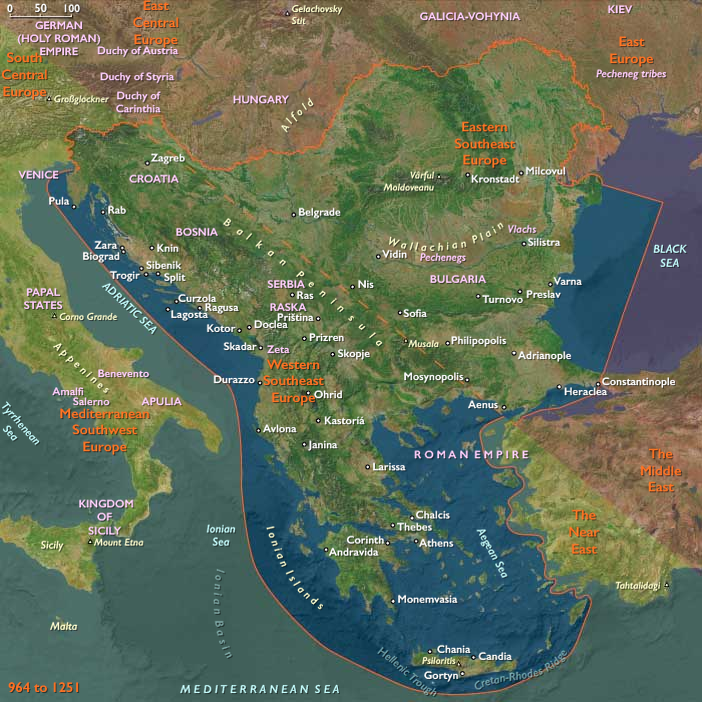
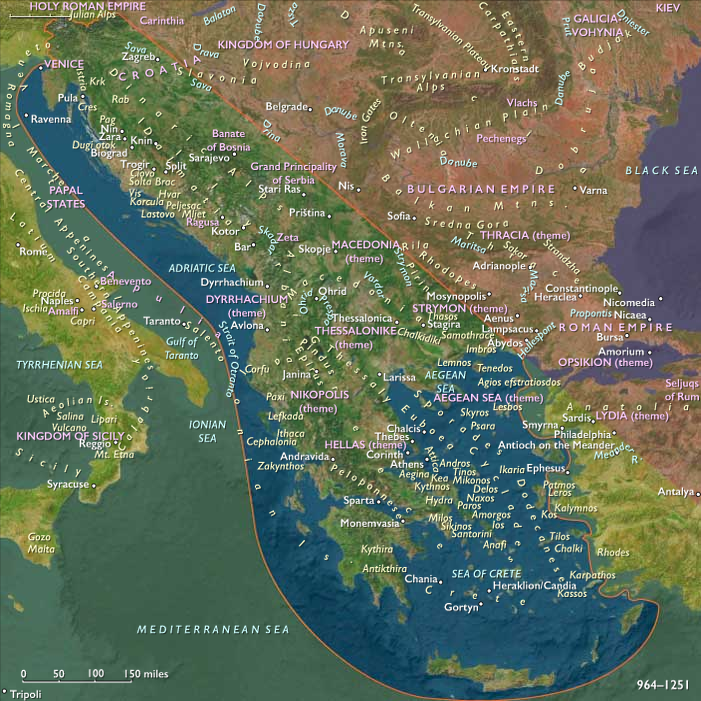
…Lagosta (Lastovo) and seize their strongholds in …
Years: 999 - 999
…Lagosta (Lastovo) and seize their strongholds in the 990s, but the pirates recover sufficiently to continue raiding commerce in the Adriatic Sea.
Locations
Groups
Commodoties
Subjects
Regions
Subregions
Related Events
Filter results
Showing 10 events out of 52094 total
The Khmer Empire, destined to be the largest empire of South East Asia and based in what is now Cambodia, had seceded from the kingdom of Chenla in the late eighth century; it will at times rule over and/or vassalize parts of modern-day Laos, Thailand, Vietnam, Myanmar, Malaysia, and Indonesia.
During the formation of the empire, Khmer has has close cultural, political and trade relations with Java, and later with Srivijaya empire that lies beyond Khmer's southern border.
By the close of the tenth century, the whole of the Chao Phraya valley is subject to Khmer rule.
Jayavarman V, the son of Rajendravarman II, has reigned over the Khmer Empire form 968.
After he had established himself as the new king over the other princes, his rule has been a largely peaceful period, marked by prosperity and a cultural flowering.
He has established a new capital near Yaśodharapura, Jayenanagari.
At the court of Jayavarman V live philosophers, scholars and artists.
New temples have also been established: the most important of these are Banteay Srei, considered one of the most beautiful and artistic of Angkor, and Ta Keo, the first temple of Angkor built completely of sandstone.
Angkor, the Khmer Empire’s greatest legacy and the capital during the empire's zenith, bears testimony to the Khmer empire's immense power and wealth, as well as the variety of belief systems that it is to patronize over time.
The empire's official religions at this time include Hinduism and Mahayana Buddhism.
Bektuzun and Fa'iq now form an alliance in order to stop Mahmud of Ghazni, who wants all of Khurasan for himself.
Fearing that Mansur will betray them to Mahmud, the two depose and then blind him in February 999, then appoint Mansur's younger brother 'Abd al-Malik II as amir.
Mansur's overthrow is used as a pretext by Mahmud of Ghazni to conquer the remainder of Khurasan still in the hands of the Samanids.
Bektuzun and Fa'iq, together with the ruler of Kuhistan, Abu'l-Qasim Simjuri, however, are judged to be too powerful by Mahmud.
He therefore makes peace with them in the spring of 999, keeping Balkh and Herat.
The allies spoil the peace by attacking the rearguard of Mahmud's army.
Mahmud's forces remain intact, however, and hostilities resume.
Mahmud defeats the allies near Merv and subsequently seizes all land south of the Oxus.
He also gains the loyalty of Chaghaniyan and other minor states to the north of the Oxus that had hitherto been loyal vassals of the Samanids.
At this point, 'Abd al-Malik and Fa'iq (to be joined later by Bektuzun) attempt to gain enough momentum for a renewed offensive against Mahmud.
However, Fa'iq soon dies.
Meanwhile, Kara-Khanid ruler Ali bin Musa (title: Kara Khan or Arslan Khan), a cousin of the late Hasan, has resumed the Kara-Khanids’ campaign against the Samanids, and in 999 Ali's son and successor Nasr launches an invasion.
Faced with the hostility of his subjects, 'Abd al-Malik is helpless against the Turkic onslaught.
Bukhara is occupied without a struggle, and 'Abd al-Malik is taken prisoner.
Although 'Abd al-Malik's brother Isma'il Muntasir will temporarily regain some of the Samanid lands in the following years, the Samanid state is effectively abolished.
The Samanid domains are split up between the Ghaznavids, who gain Khorasan and Afghanistan, and the Karakhanids, who receive Transoxiana; the Oxus River thus becomes the boundary between the two rival empires.

Sweyn Forkbeard, king of Denmark, with the help of the Swedish king Olaf Skötkonung and Norwegian Eiríkr Hákonarson, Earl of Lade, ambushes and defeats his former raiding partner King Olaf of Norway, who is killed in a naval battle at Svöld (location unknown, somewhere in the western Baltic, perhaps near Rugen or in the Oresund) in 999 or 1000 during his return after an expedition to Wendland (Pomerania).
Sweyn shares sovereignty with his allies, establishing Danish control over most of Norway by posing Hákonarson as his vassal.
The slain Bishop Adalbert/Vojtěch, canonized as Saint Adalbert by Pope Sylvester II in 999, will later be made the patron saint of Bohemia, Poland, Hungary, and Prussia.
The canonization of Adalbert increases the prestige of the Polish church in Europe and the prestige of Polish state on the international arena.
Prince Boleslaw incorporates Silesia and Kraków into his Polish principality from 999.
Basil II, brought once again to Syria in October 999 by this new defeat, spends three months campaigning, during which the imperial forces raid as far as Baalbek, …
…take and garrison Shaizar, capture three minor forts in its vicinity (Abu Qubais, Masyath, and 'Arqah), and …
…sack Rafaniya.
Hims is not seriously threatened, but a month-long siege of Tripoli in December fails.
Although Basil does not have sufficient forces to drive into Palestine and reclaim Jerusalem, his victories have restored much of Syria to the empire.
No emperor since Heraclius has been able to hold these lands for any length of time, and they will remain possessions of Constantinople for the next seventy-five years.
Raja Raja also expands his conquests in the north and northwest.
Before his fourteenth regnal year, around 998–999, Raja Raja conquers Gangapadi (Gangawadi) and Nurambapadi (Nolambawadi), which form part of the present Karnataka State.
This conquest is facilitated by the fact the Cholas have never lost their hold of the Ganga country from the efforts of Sundara Chola.
Nolambas, who are the feudatories of Ganga, who form the chief bulwark against the Chola armies in the northwest, could have turned against their overlords and aided the Cholas to conquer the Gangas.
The invasion of the Ganga country is a success and the entire Ganga country will be under the Chola rule for the next century.
The easy success against the Gangas is also due to the disappearance of the Rashtrakutas around 973, as they had been conquered by the Western Chalukyas.
From this time, the Chalukyas become the main antagonists of Cholas in the northwest.
To counter the interference of the Western Chalukyas, Raja Raja supports Saktivarman I, an Eastern Chalukya prince who is in exile in the Chola country.
He invades Vengi in 999 to restore Saktivarman to the Eastern Chalukya throne.
Venetian naval forces defeat Dalmatian Muslim pirates, based in Curzola (Korcula) and …