Labaya is accused of capturing cities that …
Years: 1353BCE - 1342BCE
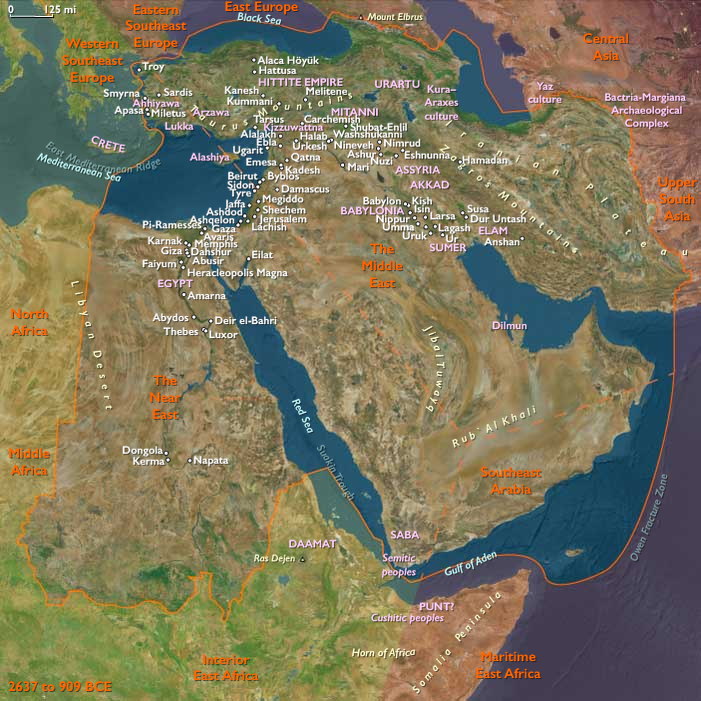
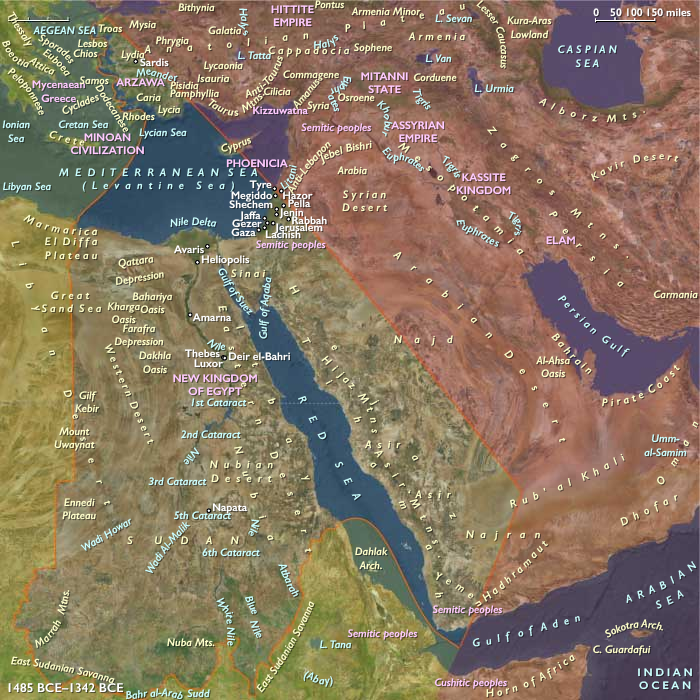
Labaya is accused of capturing cities that are under Egyptian protection.
Biridiya, the king of Megiddo and the author of five of the Amarna letters correspondence, accuses him of besieging his city and asks the pharaoh for a garrison of one hundred men.
Locations
People
Groups
Topics
Commodoties
Subjects
Regions
Subregions
Related Events
Filter results
Showing 10 events out of 67398 total
Some of the earliest Egyptian records of Damascus are from the Amarna letters of around 1350 BCE, when Damascus (called Dimasqu) is ruled by king Biryawaza, who was ordered by his Egyptian overlords to take armed action against the sons of Labaya (EA 250), a Habiru, possibly Canaanite, warlord.
The name Biryawaza is Indo-European in origin.
Biryawaza may have been of an Indo-European maryannu caste similar to that which rules Mitanni and the Hittite kingdom.
The Hittite empire suffers serious losses of territory during Tudhaliya's reign, with even the capital itself being burnt down.
But, under the able guidance of Tudhaliya's son, the future Suppiluliuma I, the Hittites begin to make a recovery while Tudhaliya still sits on the throne.
The proper numbering of the Hittite rulers who bore the name Tudhaliya is problematic.
There was a Hattian era figure who bore the name Tudhaliya who may or may not have ruled as king.
Other reconstructions insert a Tudhaliya directly after Muwattalli I, but before the more famous ruler frequently credited with founding the Empire.
The Tudhaliya discussed here will be generally found as either "the second" or "the third".
Tudhaliya III is never explicitly known to have been king at all.
The Hittite texts refer to him as "Tudhaliya the child" (or, as an alternate translation, "Tudhaliya the Young(er)".
He is killed by a group of officers that included his successor, and quite probably brother, Suppiluliuma I.
Ashur-uballit, with Assyrian power firmly established, tarts to make contacts with other great nations.
A time comes when the Kassite king in Babylon is glad to marry the daughter of Ashur-uballit, whose letters to Akhenaten of Egypt form part of the Amarna letters.
His messages to the Egyptians angers his Babylonian neighbor Burnaburiash II, who himself writes to the Pharaoh: “with regard to my Assyrian vassals, it was not I who sent them to you.
Why did they go to your country without proper authority?
If you are loyal to me they will not negotiate any business.
Send them to me empty-handed!” Yet the new Assyrian power cannot be denied, and Burnaburiash even marries the daughter of the Assyrian king.
This marriage will eventually lead to disastrous results.
Hittite king Suppiluliuma marries a sister to the Hayasan king Hukkana, and his daughter Muwatti to Maskhuiluwa of the Arzawan state Mira.
He retakes Arzawan territory as far as Hapalla.
The Assyrians under Ashur-uballit stage a successful revolt against their Mitanni overlords to the west around 1350.
The Hittites simultaneously invade the Mitanni state, already weakened by the Hittite victory of 1380, ending the kingdom.
Tyre is mentioned in Egyptian records of the fourteenth century BCE as being subject to Egypt; the city’s name appears on monuments as early as 1300 BCE.
The site was first occupied by one Hypsuranius, according to the antiquarian authority Sanchuniathon, the purported Phoenician author of three lost works originally in the Phoenician language, surviving only in partial paraphrase and summary of a Greek translation by Philo of Byblos, according to the Christian bishop Eusebius of Caesarea.
Sanchuniathon's work is said to be dedicated to "Abibalus king of Berytus"—possibly the Abibaal who was king of Tyre.
In the Amarna letters of 1350 BCE, Tyre has a body of letters (nine, detailed) from the mayor, Abi-Milku, written to Akhenaten.
The subject is often water, wood, and the Habiru overtaking the countryside of the mainland, and how it affects the island-city.
Shachmu (i.e., Shechem) is the center of a kingdom carved out by Labaya (or Labayu), a Canaanite warlord who recruits mercenaries from among the Habiru.
Labaya is the author of three Amarna letters from about 1350 BCE, and his name appears in eleven of the other three hundred and eighty-two letters, referred to twenty-eight times, with the basic topic of the letter, being Labaya himself, and his relationship with the rebelling, country-dwelling Habiru.
Labaya and his sons exert influence over a wide region in Samaria, and threaten many powerful Canaanite towns, including Jerusalem, Gezer, (called 'Gazru'), and Megiddo.
The Amarna letters give an incomplete look at Labaya's career.
In the first of Labaya's letters thus far discovered (EA 252), he defends himself to the Pharaoh against complaints of other city rulers about him (for example, the complaint that he has hired mercenaries from among the Habiru).
Labaya further admits to having invaded Gezer and insulting its king Milkilu.
He denies any knowledge of his son's alleged collaboration with the Habiru.
Other Canaanite rulers, such as Abdi-Heba of Jerusalem, complain of Labaya's depredations (e.g., EA 289).
Abdi-Heba will himself be referred to in later years, however, as "another Labaya" in EA 280.
The sons of Labaya, employing Habiru mercenaries, continue to campaign against other Egyptian vassals in Canaan.
One of Labaya's sons, Mutbaal, rules Pella in the Trans-Jordanian part of Canaan.
Amenhotep III had maintained extensive diplomatic contacts with other Near Eastern states, especially Mitanni and Babylonia.
His humbly born wife Tiye, his Chief Queen, had been prominently associated with him during his long and peaceful reign over the Egyptian empire (now at its most powerful).
The couple’s younger son, who had not originally been designated as the successor to the throne until the untimely death of his older brother, Thutmose, had in 1353 or 1351 BCE succeeded his father as Amenhotep IV after the latter’s death at the end of his thirty-eight-year reign, possibly after a coregency lasting between either one to two or twelve years.
Amenhotep IV soon prohibits the worship of other gods, especially of the state god Amen, or Amon, of Thebes, and institutes Aton, represented by the solar disk, as the only god.
Amenhotep is thus the first to introduce a monotheistic religion.
His form of monotheism is tempered, however, by Amenhotep’s retention of divine status, if secondary to that of Aton, for himself.
His religious reformation appears to have begun with his decision to celebrate a Sed festival in his third regnal year—a highly unusual step, since a Sed-festival, a sort of royal jubilee intended to reinforce the Pharaoh's divine powers of kingship, was traditionally held in the thirtieth year of a Pharaoh's reign.
His Year Five marks the beginning of his construction of a new capital, Akhetaten ('Horizon of Aten'), at the site known today as Amarna.
Amenhotep IV in the same year officially changes his name to Akhenaten ('Effective Spirit of Aten') as evidence of his new worship.
Very soon afterward, he centralizes Egyptian religious practices in Akhetaten, though construction of the city seems to have continued for several more years.
In honor of Aten, Akhenaten also oversees the construction of some of the most massive temple complexes in ancient Egypt, including one at Karnak, close to the old temple of Amun.
In these new temples, Aten is worshipped in the open sunlight, rather than in dark temple enclosures, as had been the previous custom.
Akhenaten is also believed to have composed the Great Hymn to the Aten.
He had originally presented Aten as a variant of the familiar supreme deity Amun-Ra (itself the result of an earlier rise to prominence of the cult of Amun, resulting in Amun becoming merged with the sun god Ra), in an attempt to put his ideas in a familiar Egyptian religious context.
However, by Year Nine of his reign Akhenaten declares that Aten is not merely the supreme god, but the only god, and that he, Akhenaten, is the only intermediary between Aten and his people.
He orders the defacing of Amun's temples throughout Egypt, and in a number of instances inscriptions of the plural 'gods' are also removed.
Akhenaten fosters new styles in Egyptian literature.
Contemporary art exaggerates the physical abnormalities of Akhenaten, portraying the king as having swollen limbs and an elongated head.
Akhenaten loses Egyptian-held territory in Syria and Canaan but maintains Egypt's status as a great power.