There is a substratum in Proto-Indo-Iranian which …
Years: 1917BCE - 1774BCE
There is a substratum in Proto-Indo-Iranian which can be plausibly identified with the original language of the BMAC, as argued by Michael Witzel and Alexander Lubotsky.
Moreover, Lubotsky points out a larger number of words apparently borrowed from the same language, which are only attested in Indo-Aryan and therefore evidence of a substratum in Vedic Sanskrit.
Some BMAC words have now also been found in Tocharian.
Michael Witzel points out that the borrowed vocabulary includes words from agriculture, village and town life, flora and fauna, ritual and religion, so providing evidence for the acculturation of Indo-Iranian speakers into the world of urban civilization.
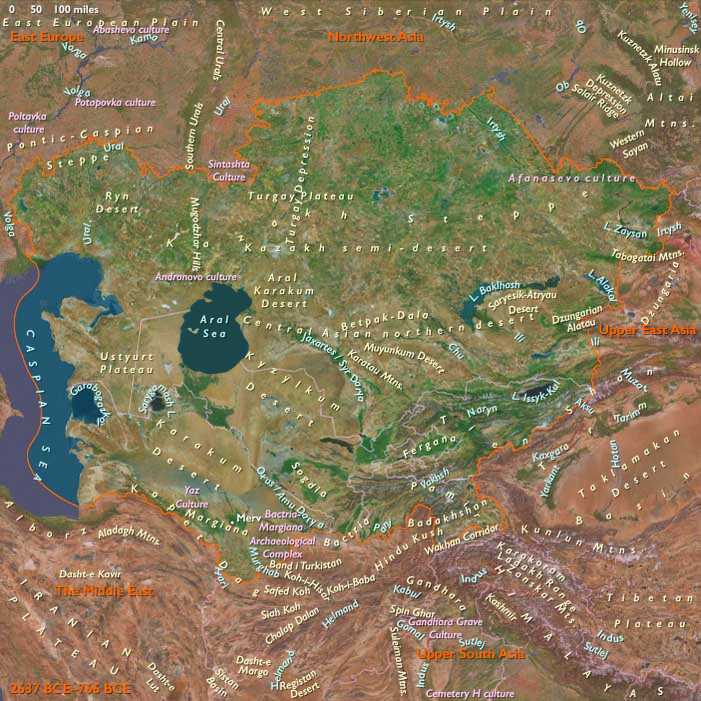
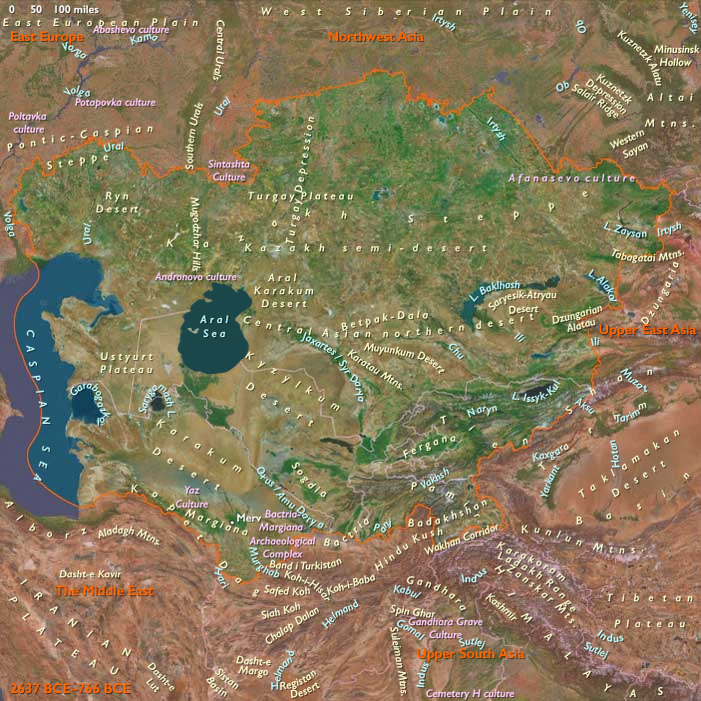
The Bactria-Margiana complex has attracted attention as a candidate for those looking for the material counterparts to the Indo-Iranians, a major linguistic branch that split off from the Proto-Indo-Europeans.
Sarianidi himself advocates identifying the complex as Indo-Iranian, describing it as the result of a migration from southeastern Iran.
Bactrian Margiana material has been found at Susa, Shahdad, and Tepe Yahya in Iran, but Lamberg-Karlovsky does not see this as evidence that the complex originated in southeastern Iran.
Western archaeologists are more inclined to see the culture as begun by farmers in the Near Eastern Neolithic tradition, but infiltrated by Indo-Iranian speakers from the Andronovo culture in its late phase, creating a hybrid.
In this perspective, Proto-Indo-Aryan developed within the composite culture before moving south into the Indian subcontinent.
Related Events
Showing 10 events out of 67922 total
Years: 1917BCE - 1774BCE
Groups
Topics
Subjects
Regions
Subregions