
Kumaragupta (Mahendraditya), ruler of the Gupta Empire …
Years: 424 - 435
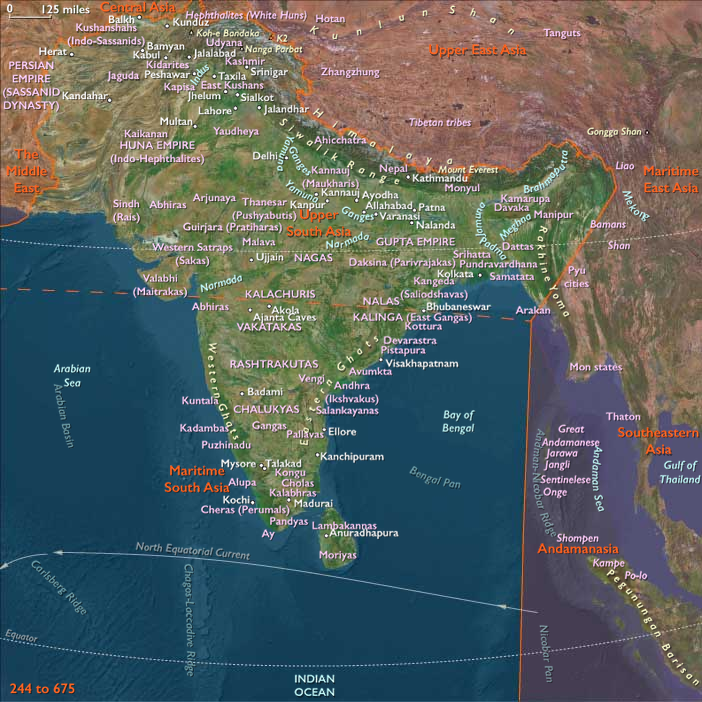
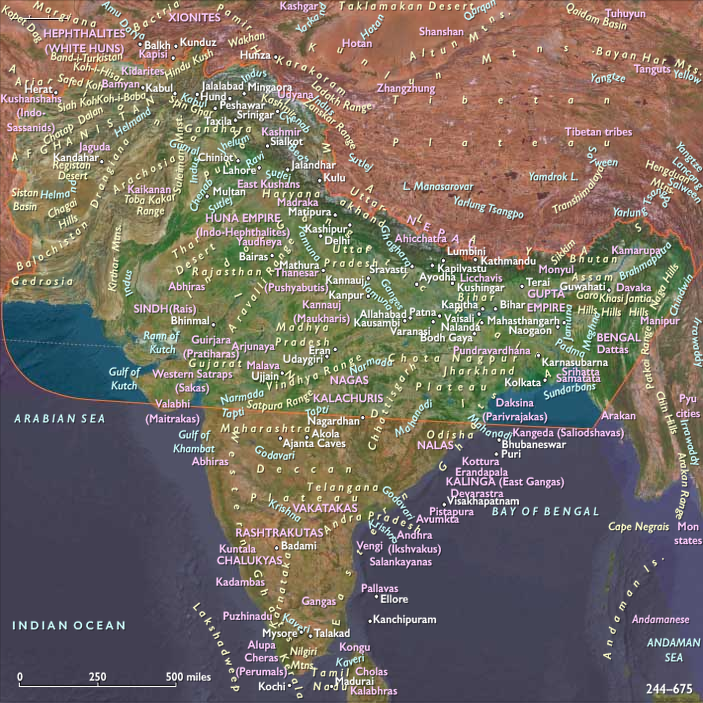
Kumaragupta (Mahendraditya), ruler of the Gupta Empire from 415, erects an iron pillar to his illustrious father and predecessor, Chandragupta II, today visible at the Qutb complex in Mahrauli, one of the seven ancient cities that make up the present state of Delhi.
One of the world's foremost metallurgical curiosities, the pillar was originally located in the Hindu temple of Muttra, with the idol of Garuda at the top, at a place called Vishnupadagiri (meaning “hill with footprint of Vishnu”), identified as modern Udayagiri, situated in the close vicinity of Besnagar, Vidisha and Sanchi.
(It is the only remaining piece of the temple, the rest of which will be destroyed by Qutb-ud-din Aybak to build the Qutub Minar and Quwwat-ul-Islam mosque.)
Made up of 98% wrought iron of impure quality, it is twenty-three feet, eight inches high and has a diameter of sisteen inches.
A testament to the high level of skill achieved by ancient Indian iron smiths in the extraction and processing of iron, it will continue to withstand corrosion for the next 1600 years, despite harsh weather.
Its unusually good corrosion resistance appears to be due to a high phosphorus content—as one per cent against less than 0.05 per cent in today's iron—which together with favorable local weather conditions promotes the formation of a solid protective layer of iron oxides and phosphates, rather than the non-protective, cracked rust layer that develops on most ironwork.
Another theory suggests that the reason that the pillar resists rust is due to its thickness, which allows the sun to heat the pillar sufficiently during the day to evaporate all rain or dew from its surface.
The accumulated heat also keeps the surface dry at night.
Locations
People
Groups
Topics
Commodoties
Subjects
Regions
Subregions
Related Events
Showing 10 events out of 59010 total
Years: 424 - 435
Locations
People
Groups
Topics
Commodoties
Subjects
Regions
Subregions