
Kukai had taken part in a government-sponsored …
Years: 805 - 805
Kukai had taken part in a government-sponsored expedition to China in 804 in order to learn more about the Mahavairocana Sutra.
Scholars are unsure why Kukai was selected to take part in an official mission to China, given his background as a private, not state-sponsored, monk.
Theories include family connections within the Saeki-Otomo clan, or connections through fellow clergy or a member of the Fujiwara clan.
The expedition included four ships, with Kukai on the first ship, while another famous monk, Saicho was on the second ship.
During a storm, the third ship turned back, while the fourth ship was lost at sea.
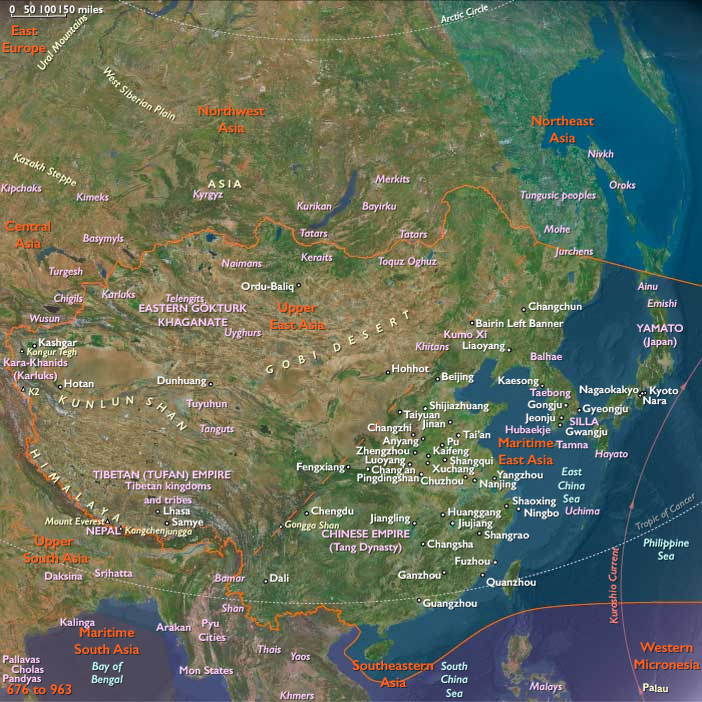
Kukai's ship arrived weeks later in the province of Fujian and its passengers were initially denied entry to the port while the ship was impounded.
Kukai, being fluent in Chinese, had written a letter to the governor of the province explaining their situation.
The governor allowed the ship to dock, and the party was asked to proceed to the capital of Chang'an (present day Xi'an), the seat of power of the Tang Dynasty.
After further delays, the Tang court granted Kukai a place in the Ximingsi temple where his study of Chinese Buddhism began in earnest as well as studies of Sanskrit with the Gandharan pandit Prajna (734-810?)
who had been educated at the Indian Buddhist university at Nalanda.
In 805, Kukai finally meets Master Hui-kuo (746 – 805) the man who will initiate him into the esoteric Buddhism tradition at Chang'an's Qinglong Monastery.
Huiguo comes from an illustrious lineage of Buddhist masters, famed especially for translating Sanskrit texts into Chinese, including the Mahavairocana Sutra.
Huiguo immediately bestows upon Kukai the first level Abhisheka or esoteric initiation.
Whereas Kūkai had expected to spend twenty years studying in China, in a few short months he is to receive the final initiation, and become a master of the esoteric lineage.
Huiguo is said to have described teaching Kukai as like "pouring water from one vase into another".
Huiguo dies shortly afterwards, but not before instructing Kukai to return to Japan and spread the esoteric teachings there, assuring him that other disciples will carry on his work in China.
Meanwhile, Tang Shunzong succeeds Tang Dezong as emperor of China, but does not last until the end of the year.
Locations
People
Groups
Topics
Subjects
Regions
Subregions

Related Events
Showing 1 events out of 1 total
Years: 805 - 805
Locations
People
Groups
Topics
Subjects
Regions
Subregions