
Kublai, a recluse since the death of …
Years: 1294 - 1294
Kublai, a recluse since the death of his favorite wife and the son he had chosen as heir, dies at seventy-nine in February 1294, his control over the other khanates greatly diminished.
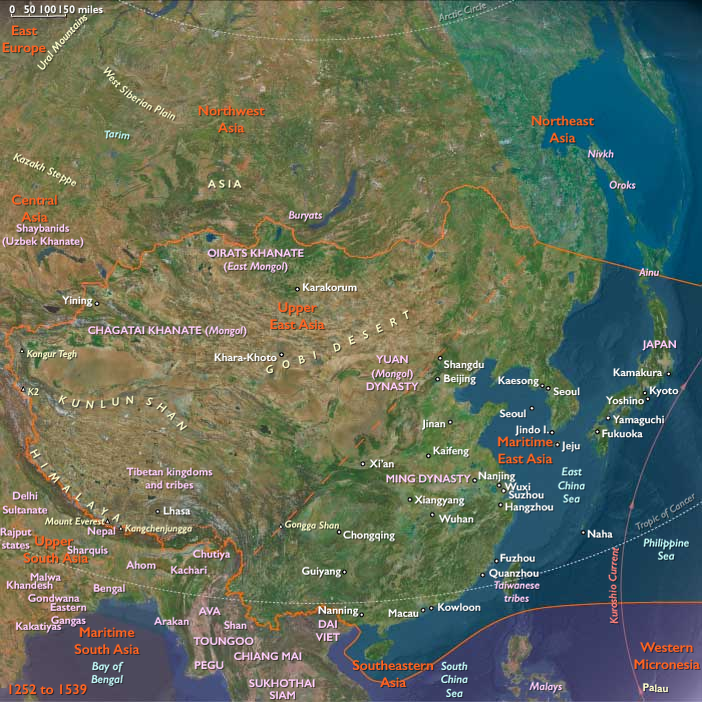
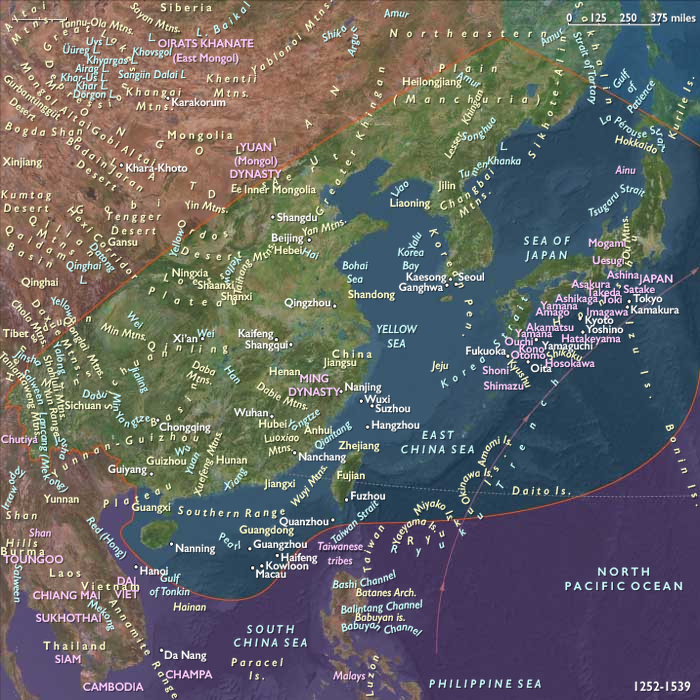
By this time, the separation of the four khanates of the Mongol Empire (the Chagatai Khanate in Central Asia, the Golden Horde in Russia, the Ilkhanate in Persia, and the Yuan Dynasty in China) have deepened.
Temür was born the third son of Zhenjin of the Borjigin and Kökejin (Bairam-Egechi) of the Khunggirad on October 15, 1265.
Because Kublai's first son Dorji died early, his second son and Temür's father, Zhenjin, became the crown prince.
However, he died in 1286 when Temür was twenty-one years old.
Kublai remained close to Zhenjin's widow Kökejin, who was high in his favor.
Like his grandfather Kublai, Temür is a follower of Buddhism.
Temür had followed his grandfather Kublai to suppress the rebellion of Nayan (Naiyan) and other rival relatives in 1287, after which he and Kublai's official, Oz-Temür, came to guard the Liao River area and Liaodong in the east from Nayan's ally, Qadaan, and defeated him.
Kublai had appointed Temür the princely overseer of Karakorum and surrounding areas in July 1293.
Three Chagatai princes submitted to him while he was defending Mongolia.
After Kublai Khan diesin 1294, Kublai's old officials urge the court to summon a kurultai in Shangdu.
Because Zhenjin's second son Darmabala had already died in 1292, only his two sons, Gammala and Temür, are left to succeed.
It is proposed that they hold a competition over who has better knowledge of Genghis Khan's sayings.
Temür wins and is declared the emperor.
John of Montecorvino, traveling by sea from Nestorian Meliapur in Bengal, reaches China in 1294, appearing in the capital "Cambaliech" (now Beijing), only to find that Kúblaí Khan had just died, and Temür had succeeded to the Mongol throne.
Though the latter does apparently not embrace Christianity, he throws no obstacles in the way of the zealous missionary, who soon wins the confidence of the ruler in spite of the opposition of the Nestorians already settled here.
Locations
People
Groups
- Buddhism
- Pandyan Dynasty
- Christians, Eastern (Diophysite, or “Nestorian”) (Church of the East)
- Greeks, Medieval (Byzantines)
- Papal States (Republic of St. Peter)
- Christians, Roman Catholic
- Christians, Eastern Orthodox
- Mongols
- Armenian Kingdom of Cilicia, or Little Armenia
- Mongol Empire
- Franciscans, or Order of St. Francis
- Dominicans, or Order of St. Dominic
- Chagatai Khanate
- Golden Horde, Khanate of the (Mongol Khanate)
- Il-khanate
- Kublai Khan, Empire of
- Ethiopia, Solomonid Dynasty of
- Chinese Empire, Yüan, or Mongol, Dynasty
- Delhi, Sultanate of (Khalji Dynasty)
Topics
Subjects
Regions
Subregions
Related Events
Showing 10 events out of 45250 total
Years: 1294 - 1294
Locations
People
Groups
- Buddhism
- Pandyan Dynasty
- Christians, Eastern (Diophysite, or “Nestorian”) (Church of the East)
- Greeks, Medieval (Byzantines)
- Papal States (Republic of St. Peter)
- Christians, Roman Catholic
- Christians, Eastern Orthodox
- Mongols
- Armenian Kingdom of Cilicia, or Little Armenia
- Mongol Empire
- Franciscans, or Order of St. Francis
- Dominicans, or Order of St. Dominic
- Chagatai Khanate
- Golden Horde, Khanate of the (Mongol Khanate)
- Il-khanate
- Kublai Khan, Empire of
- Ethiopia, Solomonid Dynasty of
- Chinese Empire, Yüan, or Mongol, Dynasty
- Delhi, Sultanate of (Khalji Dynasty)
Topics
Subjects
Regions
Subregions