
Krum dies suddenly on April 13, 814, …
Years: 814 - 814
April
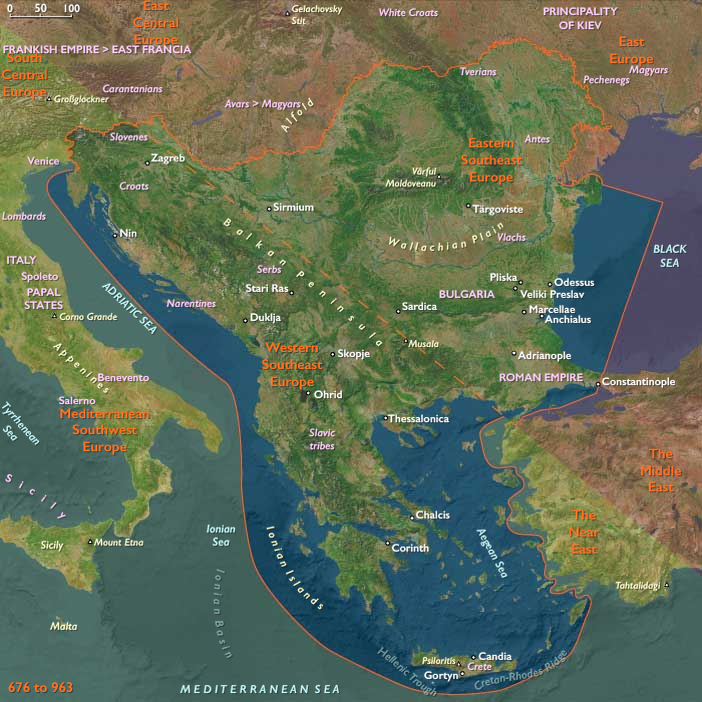
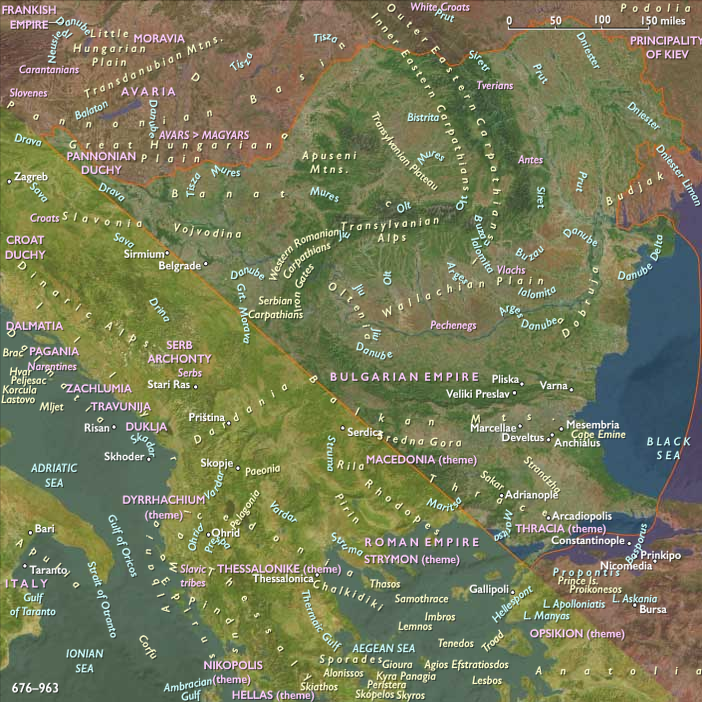
Krum dies suddenly on April 13, 814, during preparations for a second siege of the imperial capital.
As both countries are exhausted by the sustained military effort, peace negotiations begin.
Leo succeeds in drawing the Bulgarians back and concludes a truce with Krum's son and successor, Omortag, who agrees in order to protect the western frontiers of his Bulgarian empire against the pressures exerted by Frankish expansion under Charles and his successors.
Locations
People
Groups
- Franks
- Bulgarian Empire (First)
- Bulgarians (South Slavs)
- Francia (Carolingians)
- Frankish, or Carolingian (Roman) Empire
- Roman Empire, Eastern: Non-dynastic
Topics
- Byzantine-Bulgarian Wars
- Charlemagne, Conquests of
- Bulgarian-Byzantine War of 809-17
- Iconoclastic period, second
Commodoties
Subjects
- Commerce
- Labor and Service
- Conflict
- Faith
- Government
- Custom and Law
- Technology
- Movements
- Theology
- Christology
Regions
Subregions
Related Events
Filter results
Showing 10 events out of 54715 total
Halfdan the Mild may have won independence for Vestfold during the turbulent years of 813–14, according to the historian Halvdan Koh.
The Frankish annals state that the kings of Hedeby had to solve an uprising in Vestfold at this time.
Halfdan’s people, according to Ynglingatal, "gained victory" in this uprising, and Halfdan is thus the first independent ruler of Vestfold.
The city of Kannuaj remains a focal point for the age’s three powerful Indian dynasties, namely the Gurjara Pratiharas of Malwa, the Palas of Bengal and the Rashtrakutas of the Deccan.
The so-called tripartite struggle began with the defeat of Indrayudh at the hands of Gurjar Pratihar ruler Vatsaraja.
The Pala ruler Dharampala is also keen to establish his authority at Kannauj, giving rise to a struggle between Vatsaraja and Dharampala.
Dharampala was however defeated.
Taking advantage of the chaos, the Rashtrakuta ruler Dhruva had surged northwards, defeated Vatsaraja, and taken Kannauj for himself, completing the furthest northern expansion by a South Indian ruler.
When the Rashtrakuta ruler withdrew southward, Dharampala was left in control of Kannauj for some time.
The struggle between the two northern dynasties continued: the Pala Chakrayudh, the incumbent puppet ruler of Kannauj, had been defeated by the Pratihara Nagabhata II, and Kannauj was again occupied by the Gurjar Pratihars.
Dharampala had tried to take control of Kannauj but had been soundly defeated at Moongher by the Gurjar Pratihars.
Nagabhata II was in turn defeated by the Rashtrakuta Govinda III, who had initiated a second northern surge.
An inscription states that Chakrayudh and Dharampala had invited Govinda III to war against the Gurjar Pratihars, but Dharampala and Chakrayudh had both submitted to Govinda III, in order to win his sympathy.
After this defeat, Pratihara power had degenerated for some time, but following the death of Dharampala in 810, Nagabhata II regains his hold over Kannuaj.
He moves his capital here from Ujjain in 813.
During this period, the Rashtrakutas face internal conflicts, and neither they nor the Palas contest the move.
The Gurjar Pratihars are now the greatest power in North India.
Pro-Greek reaction to the Veneto-Frankish alliance under the doges of the Parteciaco family leads to the transfer of the seat of government from the island of Malamocco (now Lido) to the Rialto group of islands, by now the center for exiles in the factional fighting, and where where political independence could be more easily maintained.
Agnello Participazio’s Rialtine house on the Campiello della Cason becomes the first doge's palace in Venetian history and he soon begins expanding it in stone.
However, no traces remains of that ninth century building, owing to the partial destruction of the palace by a fire in the tenth century.
His reign begins on a happy note.
By the Pax Nicephori, Venetia is retained by the Constantinople and renounced by Charles I of the Franks, but its practical independence is affirmed.
Though the Franco-Greek treaty of 814 guarantees to Venice political and juridical independence from the rule of the Western Empire, it does not confirm any effective dependence on Constantinople.
Agnello begins the minting of the first Venetian coinage.
Louis the Pious Learns of Charlemagne’s Death (814)
On January 28, 814, Louis the Pious, King of Aquitaine, is residing at his villa in Doué-la-Fontaine, Anjou, when he receives news of the death of his father, Charlemagne. This moment marks the end of the reign of the greatest Carolingian ruler and the beginning of a new era for the Frankish Empire.
Unlike Charlemagne, who had ruled as both a warrior and administrator, Louis would face internal dynastic struggles, noble revolts, and external pressures, setting the stage for the eventual fragmentation of the Carolingian Empire. His reign would be defined not only by religious devotion and reforms but also by the challenge of maintaining the unity of his father's vast empire.
Charles, who stands out as an administrator for his many reforms—monetary, governmental, military, cultural, and ecclesiastical—is the main protagonist of the "Carolingian Renaissance."
At the death of Charles on January 814, his son Louis the Pious, hurrying to Aachen, he crowns himself and is proclaimed by the nobles with shouts of Vivat Imperator Ludovicus.
Louis assumes sole control of the entire Frankish empire, now extending from Catalonia in the west to Saxony in the east (with the sole exception of Italy, which remains within Louis's empire, but under the direct rule of Bernard, Pepin's son).
Louis also inherits his father’s troubles with invading Vikings, raiding Muslims, and an avaricious nobility.
The Carolingian empire will last only another generation in its entirety; its division, according to custom, between Louis's own sons after their father's death will lay the foundation for the modern state of Germany.
In his first coinage type, minted from the start of his reign, he imitates his father's portrait coinage, giving an image of imperial power and prestige in an echo of Roman glory.
He quickly enacts a "moral purge", in which he sends all of his unmarried sisters to nunneries, forgoing their diplomatic use as hostage brides in favor of the security of avoiding the entanglements that powerful brothers-in-law might bring.
He spares his illegitimate half-brothers and tonsures his father's cousins, Adalard and Wala, shutting them up in Noirmoutier and Corbie, respectively, despite the latter's initial loyalty.
Leo deposes Patriarch Nikephoros in 815 and convokes a synod for the following month that reimposes the decrees of the Iconoclast synod of Hieria of 754, which had opposed the use of icons.
Hasan ibn Hani, the Arabic poet famous as Abu Nuwas, the “Father of the Forelocks,” for the two locks of hair that reach to his shoulders, composes various poems in traditional style—panegyrics, satires, hunting verses, elegies, and religious poems‚—but uses the Arabic language with a new freedom and imagination.
He gains particular renown for his love poems, which he addresses, in the Persian manner, to young boys, and his wine (khamr) poetry.
Abu Nuwas was forced to flee to Egypt for a time, after he wrote an elegiac poem praising the elite Persian political family of the Barmakis, the powerful family which had been toppled and massacred by the caliph, Harun al-Rashid.
He had returned to Baghdad in 809 upon the death of Harun al-Rashid.
The subsequent ascension of Muhammad al-Amin, Harun al-Rashid's twenty-two-year-old libertine son (and former student of Abu Nuwas) has been a mighty stroke of luck for Abu Nuwas.
In fact, most scholars believe that Abu Nuwas wrote most of his poems during the reign of al-Amin (809-813).
His most famous royal commission is a poem (a 'Kasida') that he composed in praise of al-Amin.
He dies in 814.
Abu Nuwas is considered one of the great poets of classical Arabic literature.
He influenced many later writers, to mention only Omar Khayyám, and Hafiz—both of them Persian poets.
A hedonistic caricature of Abu Nuwas appears in several of the Thousand and One Nights tales.
Among his best known poems are the ones ridiculing the "Olde Arabia" nostalgia for the life of the Bedouin, and enthusiastically praising the up-to-date life in Baghdad as a vivid contrast.
His freedom of expression especially on matters forbidden by Islamic norms continue to excite the animus of censors.
While his works were freely in circulation until the early years of the twentieth century, in 1932 the first modern censored edition of his works appeared in Cairo.
The poet Bai Juyi had returned to the Tang court in the winter of 814, where he holds the title of Assistant Secretary to the Prince's Tutor.
It s not a high-ranking position, but nevertheless one which he is soon to lose.
While serving as a minor palace official in 814, Bai had managed to get himself in official trouble.
He has made enemies at court and with certain individuals in other positions.
It is partly his written works that have lead him into trouble.
He has written two long memorials, translated by Arthur Waley as "On Stopping the War", regarding what he considered to be an overly lengthy campaign against a minor group of Tatars; and he has written a series of poems, in which he satirizes the actions of greedy officials and highlights the sufferings of the common folk.
At this time, one of the post-An Lushan warlords (jiedushi), Wu Yuanji in Henan, had seized control of Zhangyi Circuit (centered in Zhumadian), an act for which he seeks reconciliation with the imperial government, trying to get an imperial pardon as a necessary prerequisite.
Despite the intercession of influential friends, Wu is denied, thus officially putting him in the position of rebellion.
Still seeking a pardon, Wu turns to assassination, blaming the Prime Minister (another Wu, Wu Yuanheng) and other officials.
The imperial court generally begins by dawn, requiring the ministers to rise early in order to attend in a timely manner; and, on July 13, 815, before dawn, the Tang Prime Minister Wu Yuanheng is set to go to the palace for a meeting with Emperor Xianzong.
As he leaves his house, arrows are fired at his retinue.
His servants all flee, and the assassins seize Wu Yuanheng and his horse, then decapitate him, taking his head with them.
The assassins also attack Pei Du, another official who favors the campaign against the rebellious warlords, but are unable to kill him.
The people at the capital are shocked and there is turmoil, with officials refusing to leave their personal residences until after dawn.
In this context, Bai Juyi oversteps his minor position by memorializing the emperor.
As Assistant Secretary to the Prince's Tutor, Bai's memorial is a breach of protocol—he should have waited for those of censorial authority to take the lead before offering his own criticism.
This is not the only charge which his opponents use against him.
His mother had died, apparently caused by falling into a well while looking at some flowers, and two poems written by Bai Juyi—the titles of which Waley translates as "In Praise of Flowers" and "The New Well"—are used against him as a sign of lack of filial piety, one of the Confucian ideals.
The result is exile: …
…Bai Juyi is demoted to the rank of Sub-Prefect and banished from the court and the capital city to Jiujiang, at this time known as Xun Yang on the southern shores of the Yangtze River in northwest Jiangxi Province, China.
After three years he was sent as Governor of a remote place in Sichuan.
At the time, the main travel route from the capital is up the Yangtze River.
This trip allows Bai Juyi a few days to visit his friend Yuan Zhen, who is also in exile and with whom he explores the rock caves located at Yichang.
Bai Juyi isdelighted by the flowers and trees for which his new location is noted.
…Bai Juyi writes another popular long poem in 816, “The Lute Song.”
Years: 814 - 814
April
Locations
People
Groups
- Franks
- Bulgarian Empire (First)
- Bulgarians (South Slavs)
- Francia (Carolingians)
- Frankish, or Carolingian (Roman) Empire
- Roman Empire, Eastern: Non-dynastic
Topics
- Byzantine-Bulgarian Wars
- Charlemagne, Conquests of
- Bulgarian-Byzantine War of 809-17
- Iconoclastic period, second
Commodoties
Subjects
- Commerce
- Labor and Service
- Conflict
- Faith
- Government
- Custom and Law
- Technology
- Movements
- Theology
- Christology
