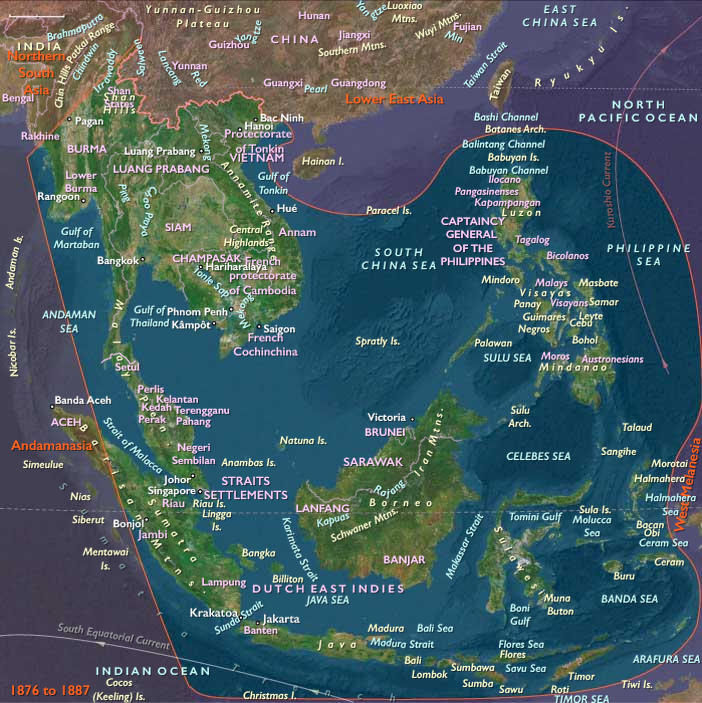
The German flag is flown over Kaiser-Wilhelmsland, the Bismarck Archipelago and the German Solomon Islands on November 23, 1884, under the auspices of the Deutsche Neuguinea-Compagnie (New Guinea Company).
The first Germans in the South Pacific were probably sailors on the crew of ships of the Dutch East India Company: during Abel Tasman's first voyage, the captain of the Heemskerck was one Holleman (or Holman), born in Jever in northwest Germany.
Hanseatic League merchant houses were the first to establish footholds: Johann Cesar Godeffroy & Sohn of Hamburg, headquartered at Samoa from 1857, operated a South Seas network of trading stations especially dominating the copra trade and carrying German immigrants to various South Pacific settlements; in 1877 another Hamburg firm, Hernsheim and Robertson, establishes a German community on Matupi Island, in Blanche Bay (the northeast coast of New Britain) from which it trades in New Britain, the Caroline and Marshall Islands.
By the end of 1875, one German trader reports: "German trade and German ships are encountered everywhere, almost at the exclusion of any other nation". (Hans-Jürgen Ohff (2008) Empires of enterprise: German and English commercial interests in East New Guinea 1884 to 1914 Thesis (Ph.D.) University of Adelaide, School of History and Politics; p. 26 quoting Schleinitz to Admiralty, 28 Dec. 1875, Drucksache zu den Verhandlungen des Bundesrath, 1879, vol. 1, Denkschrift, xxiv–xxvii, p. 3.)
In the late 1870s and early 1880s, an active minority, stemming mainly from a right-wing National Liberal and Free Conservative background, has organized various colonial societies all over Germany in order to persuade Chancellor Bismarck to embark on a colonial policy.
The most important ones are the "Kolonialverein of 1882" and the Gesellschaft für Deutsche Kolonisation, founded in 1884.
Bismarck's initial response may be summed up by a marginal note he wrote in 1881: "Colonies demand a fatherland in which the national feeling is stronger than the hatred of the parties [for each other]".
(Hartmut Pogge von Strandmann, "Domestic Origins of Germany's Colonial Expansion under Bismarck" (1969) Past & Present 42 pp 140–159 at p 144 citing Deutsches Zentralarchiv Potsdam, Reichskanzlei 7158.)
On April 24, 1884, Bismarck had signals a change in policy by placing German trading interests in southwestern Africa under the protection of the German Empire.
Bismarck tells the Reichstag on June 23, 1884 of the change of German colonial policy: annexations will now proceed but by grants of charters to private companies.
On his return to Germany from his 1879–1882 Pacific expedition, German ethnographer, naturalist and colonial explorer Otto Finsch had joined a small, informal group interested in German colonial expansion into the South Seas led by the banker, Adolph von Hansemann.
Finsch had encouraged them to pursue the founding of a colony on the northeast coast of New Guinea and the New Britain Archipelago, even providing them with an estimate of the costs of such a venture.