
...General Józef Zajączek is defeated in the …
Years: 1794 - 1794
June
Locations
People
- Antoni Madaliński
- Catherine the Great
- Józef Poniatowski
- Stanisław August Poniatowski
- Tadeusz Kościuszko
Groups
- Lithuanians (Eastern Balts)
- Germans
- Poles (West Slavs)
- Russians (East Slavs)
- Polish-Lithuanian Commonwealth (Commonwealth of the Two Nations)
- Prussia, Kingdom of
- Russian Empire
- Targowica Confederation
Topics
Subjects
Regions
Subregions
Related Events
Filter results
Showing 10 events out of 23492 total
Philip King had returned to Norfolk Island to find its nearly one thousand inhabitants torn apart by discontent after the strict regime of Major Robert Ross.
Setting about enthusiastically to improve conditions, he had encouraged settlers, drawn from ex-convicts and ex-marines, and had listened to their views on wages and prices.
The island is self-sufficient in grain by 1794, and surplus swine are being sent to Sydney.
The Lieutenant-Governor of New South Wales, Francis Grose, suggests the closure of Norfolk Island as a penal settlement as early as 1794, as it is too remote and difficult for shipping and too costly to maintain.
The number of people living off the government store is high, and few settlers want to leave.
King is faced in February 1794 with unfounded allegations by members of the New South Wales Corps on the island that he is punishing them too severely and ex-convicts too lightly when disputes arise.
As their conduct becomes mutinous, he sends twenty of them to Sydney for trial by court-martial.
There, Lieutenant-Governor Grose censures King's actions and issues orders which give the military illegal authority over the civilian population.
Grose later apologizes, but conflict with the military continues to plague King.
He also encouraged immigrants by promising them as much land as they could clear and by reportedly firing silver dollars from his ship's cannons deep into the jungle
Trade in Penang grew exponentially soon after its founding—incoming ships and boats to Penang will increased from eighty-five in 1786 to three thousand five hundred and sixty-nine in 1802.
Many early settlers, including Light himself in 1794, succumb to malaria, earning early Penang the epithet 'the white man's grave'.
After Light's demise, Lieutenant-Colonel Arthur Wellesley, who will go on to become the Duke of Wellington, arrives on the Prince of Wales Island to co-ordinate the island's defenses.
Open rebellion by the White Lotus Society against the Qing government breaks out in 1794.
The Qing administration, under the control of Heshen, at first sends inadequate and inefficient imperial forces to suppress the ill-organized rebels.
Coffee first arrived in Sweden around 1674, but was little used until the turn of the eighteenth century when it became fashionable among the wealthy.
In 1746, a royal edict was issued against coffee and tea due to "the misuse and excesses of tea and coffee drinking".
Heavy taxes were levied on consumption, and failure to pay the tax on the substance resulted in fines and confiscation of cups and dishes.
Later, coffee was banned completely; despite the ban, consumption continued.
Gustav III, who viewed coffee consumption as a threat to the public health and was determined to prove its negative health effects, is said to have ordered a scientific experiment to be carried out, although the authenticity of the event has been questioned.
The king ordered the experiment to be conducted using two identical twins. Both of the twins had been tried for the crimes they had committed and condemned to death.
Their sentences were commuted to life imprisonment on the condition that one of the twins drink three pots of coffee, and the other drink the same amount of tea, every day for the rest of their lives.
Two physicians were appointed to supervise the experiment and report its finding to the king.
Unfortunately, both doctors will die, presumably of natural causes, before the experiment is complete.
Gustav III, who was assassinated in 1792, also dies before seeing the final results.
Of the twins, the tea drinker will be the first to die, at age eighty-three; the date of death of the surviving coffee drinker is unknown.
Sweden's government in 1794 once again tries to impose a ban on coffee.
The ban, which will be renewed multiple times until the 1820s, will never be successful in stamping out coffee-drinking.
Johan Gadolin, a Finnish chemist, isolates yttria, a new earth or metallic oxide, in 1794 from a mineral found at Ytterby, Sweden, a village rich in unusual minerals and rare earths.
The first of the rare earths to be discovered, yttria turns out to be a mixture of oxides from which, over a span of more than a century, nine elements will be separated.
These include yttrium, scandium, and the heavy rare-earth metals from terbium to lutetium.
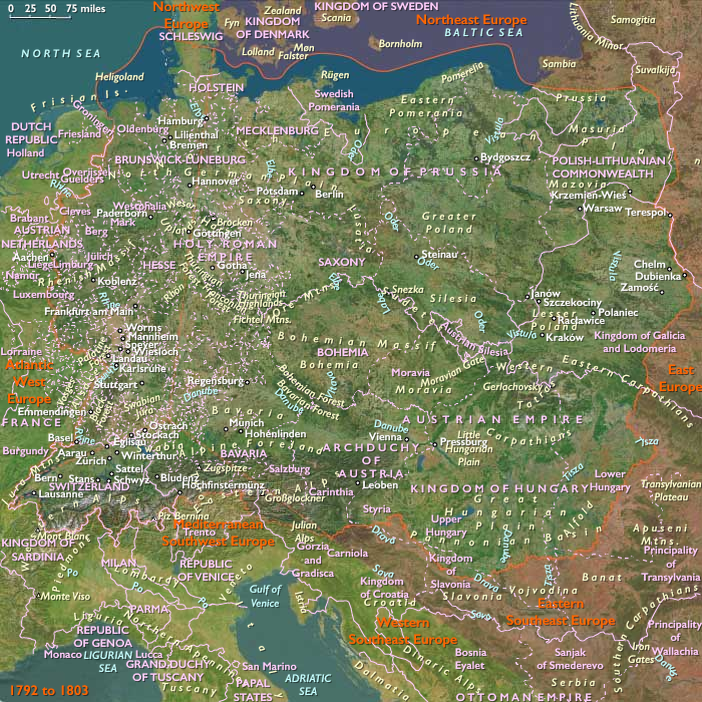
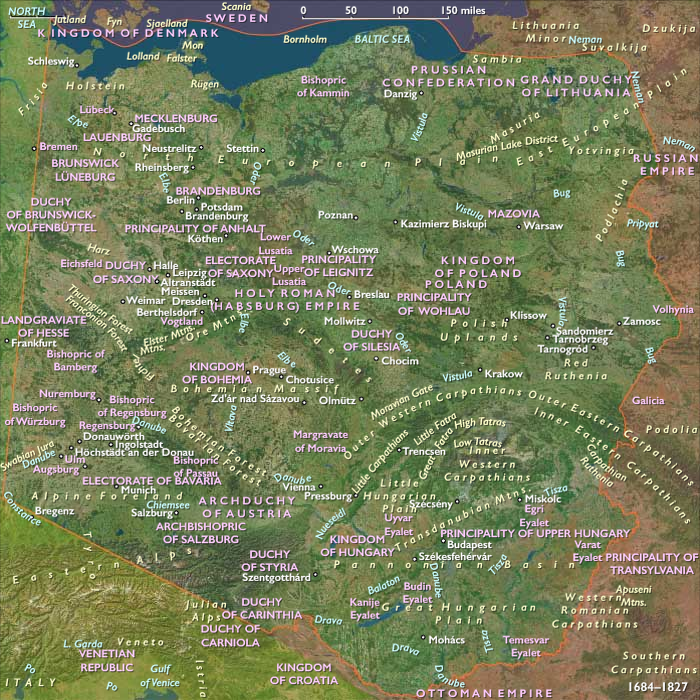
Following a series of nationwide riots, on March 24, 1794, Polish patriot Tadeusz Kościuszko takes command of the Polish armed forces and declares a nationwide uprising against Poland’s foreign occupiers, marking the beginning of the Kościuszko Uprising.
Catherine II and Frederick William II are quick to respond and, despite initial successes by Kosciuszko’s forces, the uprising is crushed by November 1794.
According to legend, when Kosciuszko falls off of his horse at the Battle of Maciejowice, shortly before he is captured, he says "Finis Poloniae", meaning in Latin "[This is] the end of Poland."
The Siege of Bellegarde had concluded in June with the French surrender of the Fort de Bellegarde, which dominates the key Pass of Le Perthus through the Pyrenees.
However, Ricardos had been repelled in the Battle of Perpignan on July 17.
The French army had revived again under General of Division Eustache Charles d'Aoust to deal their enemies a sharp reverse at the Battle of Peyrestortes on September 17.
Five days later, Ricardos defeated the French at the Battle of Truillas.
Subsequently, the Spanish general had fallen back to the valley of the Tech River, where he repulsed a series of French attempts to drive him back into Spain.
D'Aoust had tried and failed to oust the Spanish from Le Boulou on October 3.
In the Battle of the Tech (or Pla del Rey) from October 13 to 15, Ricardos had bloodily repulsed the attacks of General of Division Louis Marie Turreau.
D'Aoust had been defeated again in his December 7 attack on Villelongue-dels-Monts.
The Spanish had seized Fort Saint-Elme through the treason of its commander and captured the port of Collioure on December 20, wiping out four thousand of its garrison of five thousand men.
D'Aoust, arrested soon afterward, will eventually be executed in July.
The eighteenth-century Illuminés appear to have lingered in the Cevennes region until 1794, having affinities with those known contemporaneously in the United Kingdom as 'French Prophets', an offshoot of the Camisards.
Other lines are built, including a line from Paris to Toulon.
The system will be widely copied by other European states, and will be used by Napoleon to coordinate his empire and army.
Aachen loses its status as a free imperial city when the French, led by General Charles Dumouriez, occupy Aachen in 1794.
In decline since the sixteenth century, Aachen had been chosen as the site of several important congresses and peace treaties: the first congress of Aachen (often referred to as the Congress of Aix-la-Chapelle in English) on May 2, 1668, leading to the First Treaty of Aachen in the same year, which ended the War of Devolution.
The second congress had ended with the second treaty in 1748, ending the War of the Austrian Succession.
There had been a constitutional crisis in the Aachen government in 1789.
Years: 1794 - 1794
June
Locations
People
- Antoni Madaliński
- Catherine the Great
- Józef Poniatowski
- Stanisław August Poniatowski
- Tadeusz Kościuszko
Groups
- Lithuanians (Eastern Balts)
- Germans
- Poles (West Slavs)
- Russians (East Slavs)
- Polish-Lithuanian Commonwealth (Commonwealth of the Two Nations)
- Prussia, Kingdom of
- Russian Empire
- Targowica Confederation
