
A number of walled-town states on the …
Years: 189BCE - 46BCE
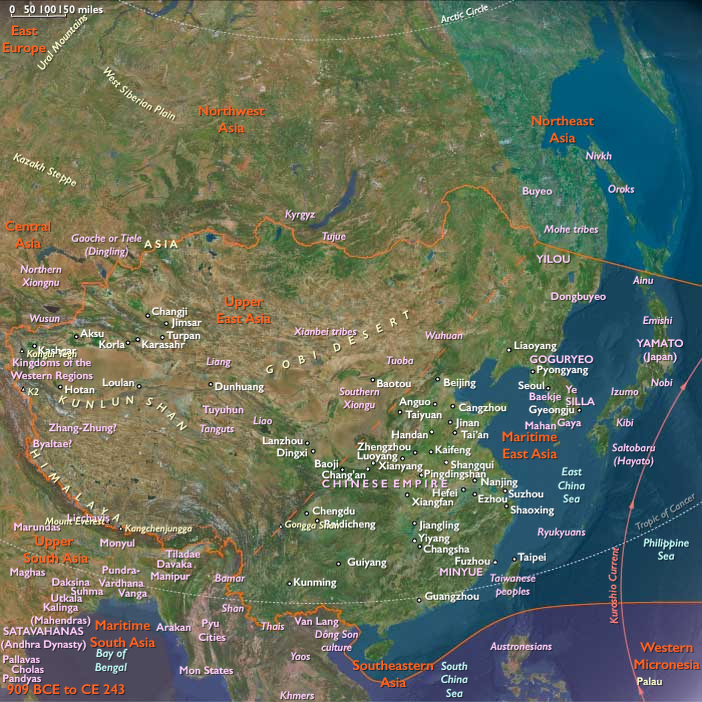
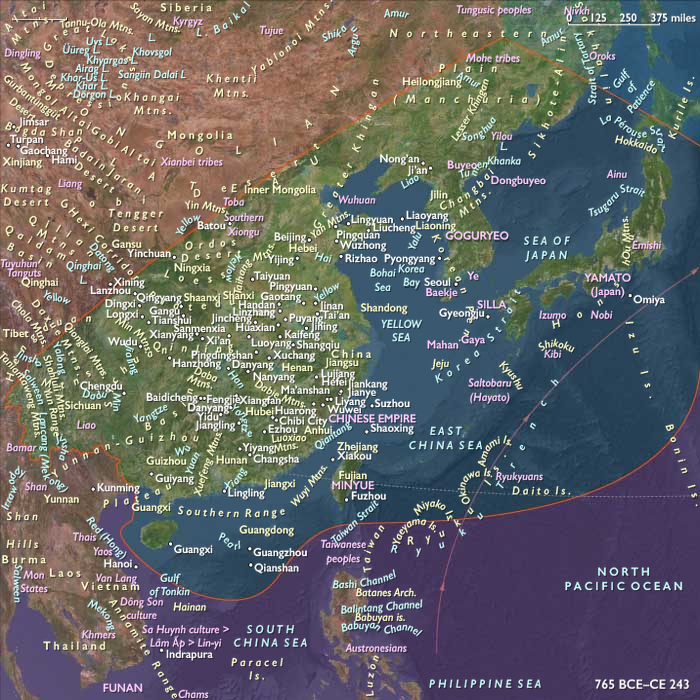
A number of walled-town states on the Korean peninsula had survived long enough to come to the attention of China by the fourth century BCE.
The most illustrious state is Old Choson, which had established itself along the banks of the Liao and the Taedong rivers in southern Manchuria and northwestern Korea.
Old Choson has prospered into a civilization based on bronze culture and a political federation of many walled towns, which, judging from Chinese accounts, is formidable to the point of arrogance.
Riding horses and using bronze weapons, the Choson people extend their influence to the north, taking most of the Liaodong Basin, but the rising power of the north China state of Yan (also known as Eastern Zhou) checks Choson's growth and eventually pushes it back to territory south of the Ch'ongch'on River, located midway between the Yalu and Taedong rivers.
As Yan gives way in China to the Qin (221-207 BCE) and the Han (206 BCE - CE 220) dynasties, Choson declines, and refugee populations migrate eastward.
Out of this milieu emerges Wiman, a man who assumes the kingship of Choson sometime between 194 and 180 BCE.
Wiman Choson melded Chinese influence and the Old Choson federated structure; apparently reinvigorated under Wiman, this state again expands over hundreds of kilometers of territory.
Its ambitions run up against a Han invasion, however, and Wiman Choson falls in 108 BCE.
Locations
People
Groups
Topics
Commodoties
Subjects
Regions
Subregions
Years: 189BCE - 46BCE
Locations
People
Groups
Topics
Commodoties
Subjects
Regions
Subregions