
Konrad, the Polish duke of Mazovia, hopes …
Years: 1226 - 1226
Konrad, the Polish duke of Mazovia, hopes to strengthen Polish Latin-rite Christianity and Poland’s position in regard to its neighbors.
Konrad is the youngest son of High Duke Casimir II the Just of Poland and Helen of Znojmo, daughter of the Přemyslid duke Konrad II of Znojmo (ruler of the Znojmo Appanage in southern Moravia, part of Duchy of Bohemia).
His maternal grandmother was Maria of Serbia, apparently a daughter of the pre-Nemanjić župan Uroš I of Rascia.
After his father's death in 1194, Konrad had been brought up by his mother, who had acted as regent of Masovia.
He had received Masovia in 1199 and in 1205 also the adjacent lands of Kuyavia.
In that year, he and his brother, Duke Leszek I the White of Sandomierz, had had their greatest military victory at the Battle of Zawichost against Prince Roman the Great of Galicia–Volhynia.
The Ruthenian army had been crushed and Roman had been killed in battle.
The Rurik princess Agafia of Rus became his wife.
In order to enlarge his dominions, Konrad had unsuccessfully attempted to conquer the adjacent pagan lands of Chelmno in Prussia during a 1209 crusade with the consent of Pope Innocent III.
The monk Christian of Oliva had in 1215 been appointed a missionary bishop among the Old Prussians; his residence at Chelmno had been devastated by Prussian forces the next year.
Several further campaigns in 1219 and 1222 had failed, involving Konrad in a long-term border quarrel with the Prussian tribes.
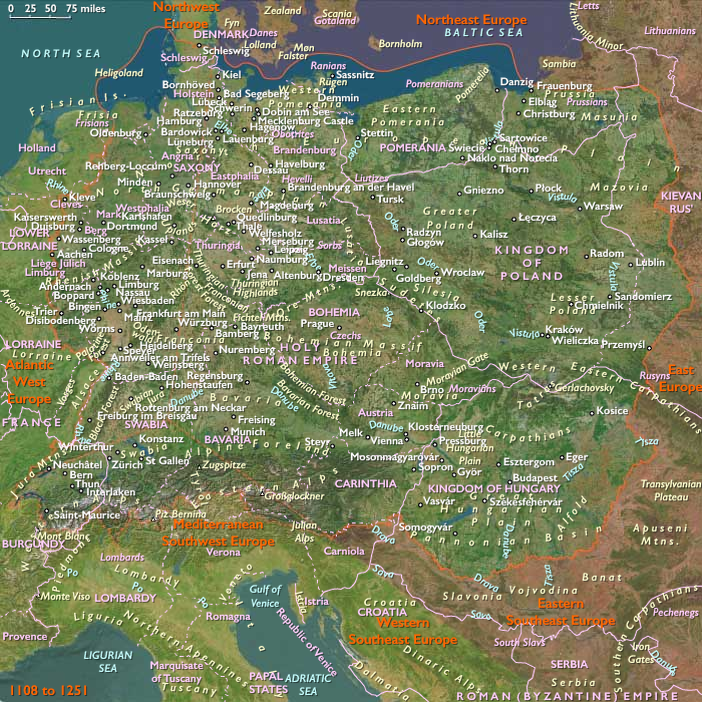
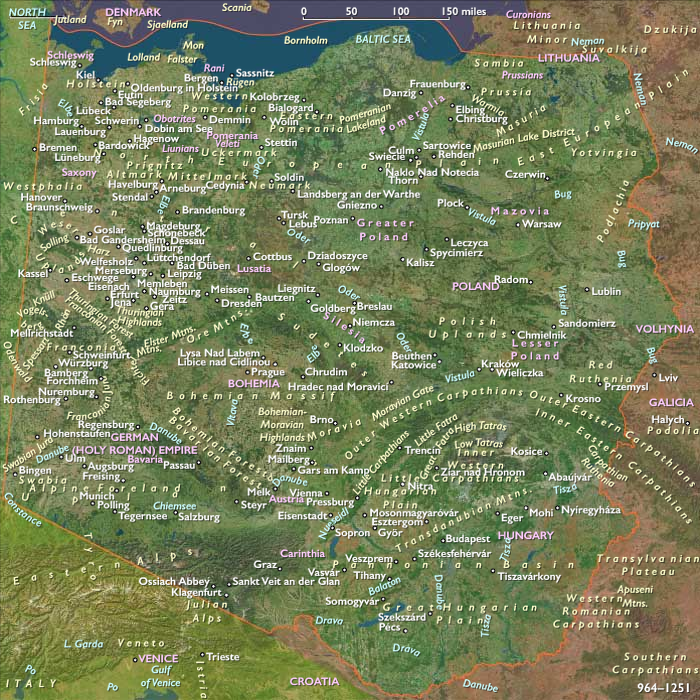
The duke's ongoing attempts on Prussia have been answered by incursions across the borders of his Masovian lands, while Prussians are in the process of gaining back control over the disputed Chelmno Land and even threaten Konrad's residence at Plock Castle.
Subjected to constant Prussian raids and counter-raids, Konrad now wants to stabilize the north of his Duchy of Masovia in this fight over the border area of Chełmno.
Thus in 1226, Konrad, having difficulty with constant raids over his territory, invites the religious military order of the Teutonic Knights to fight the Prussians, as they already had supported the Kingdom of Hungary against the Cuman people in the Transylavanian Burzenland from 1211 to 1225.
When the Knights notified Hungary that the Order was firstly responsible to the pope, they had been expelled by the Hungarian king Andrew II.
Thus, in return for the Order's service, Grand Master Hermann von Salza wants to have its rights documented beforehand, by a deal with Konrad that is to be confirmed by the Holy Roman Emperor and the Roman Curia.
Locations
People
Groups
- Polytheism (“paganism”)
- Prussians, Old, or Baltic (Western Balts)
- Germans
- Poles (West Slavs)
- Christians, Roman Catholic
- Mazovia, Duchy of
- Poland during the period of fragmentation, Kingdom of
- Teutonic Knights of Acre (House of the Hospitalers of Saint Mary of the Teutons in Jerusalem)
- Galicia–Volhynia, Principality of
Topics
- Crusades, The
- Ostsiedlung (German: Settlement in the East), a.k.a. German eastward expansion
- Poland, Fragmentation of
- Northern Crusades, or Baltic Crusades
- Livonian Crusade
Commodoties
Subjects
Regions
Subregions
Years: 1226 - 1226
Locations
People
Groups
- Polytheism (“paganism”)
- Prussians, Old, or Baltic (Western Balts)
- Germans
- Poles (West Slavs)
- Christians, Roman Catholic
- Mazovia, Duchy of
- Poland during the period of fragmentation, Kingdom of
- Teutonic Knights of Acre (House of the Hospitalers of Saint Mary of the Teutons in Jerusalem)
- Galicia–Volhynia, Principality of
Topics
- Crusades, The
- Ostsiedlung (German: Settlement in the East), a.k.a. German eastward expansion
- Poland, Fragmentation of
- Northern Crusades, or Baltic Crusades
- Livonian Crusade
Commodoties
Subjects
Regions
Subregions