
Konrad I, Duke of Masovia in northeastern …
Years: 1239 - 1239
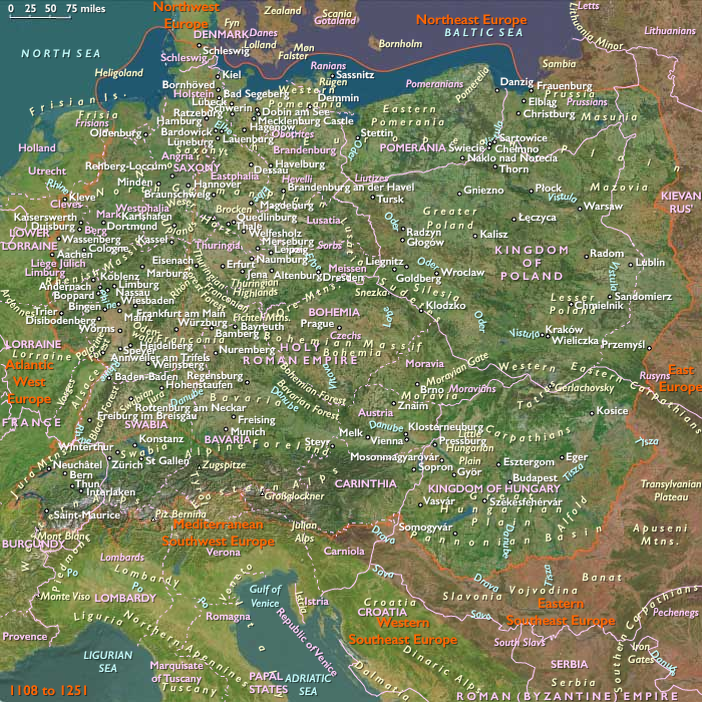
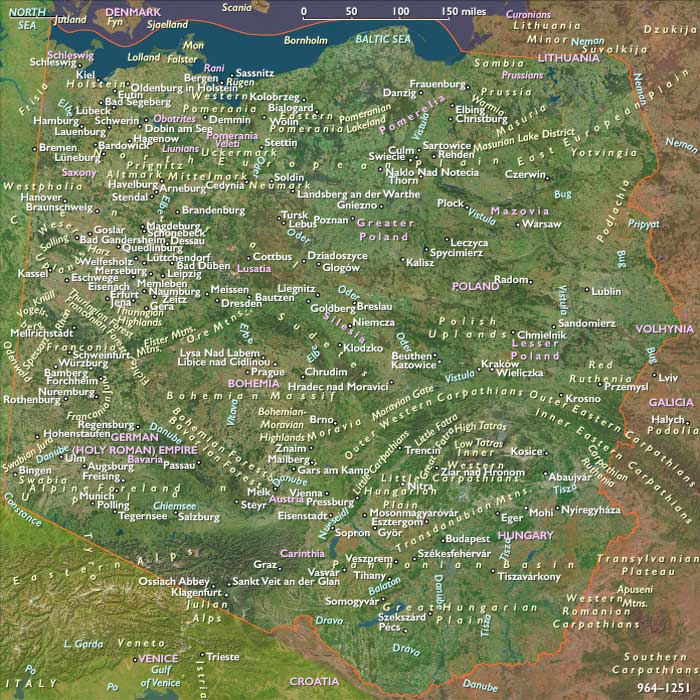
Konrad I, Duke of Masovia in northeastern Poland, had in 1226, appealed to the Knights to defend his borders and subdue the pagan Baltic Prussians, allowing the Teutonic Knights use of Chelmno Land (Culmerland) as a base for their campaign.
This being a time of widespread crusading fervor throughout Western Europe, Hermann von Salza, grand master of the Teutonic Knights from 1210, had considered Prussia a good training ground for his knights for the wars against the Muslims in Outremer.
Accepting the invitation to settle, the Teutonic knights have moved north and established a stronghold at Thorn (Torun) on the Vistula River in northwestern Poland and begun the conquest and forced Christianization of the pagan Prussians to the east.
With the Golden Bull of Rimini, Emperor Frederick II had bestowed on the Order a special imperial privilege for the conquest and possession of Prussia, including Chelmno Land, with nominal papal sovereignty.
In 1235, the Teutonic Knights had assimilated the smaller Order of Dobrzyń, which had been established earlier by Christian, the first Bishop of Prussia.
Under von Salza’s leadership, the order has begun to carve out for itself the military-monastic state of Prussia, currently peopled by the original Prussians, pagan peoples who have thus far resisted outside control.
Hermann's subsequent visits with the Pope or the Emperor have brought new privileges and donations to the Order.
He was also able to obtain the incorporation of the Livonian Brothers of the Sword into the Teutonic Order in 1237.
Within the Teutonic Order, however, the knights had begun to grow dissatisfied at the absence of their Grand Master, so they had recalled him and had him withdraw from his political life.
However, he is less successful as a religious leader, and soon retired in 1238 to Salerno in 1238, where he dies the following year.
The importance of Hermann's role as mediator between Pope Gregory IX and the emperor can be seen by the fact that all communication between Frederick and the pope breaks off with Hermann's death.
At Salza’s death in 1239, the Poles attempt unsuccessfully to assert their claim to suzerainty over the Knights, who continue carving their state from the territory of the Prussians.
Locations
People
Groups
- Polytheism (“paganism”)
- Prussians, Old, or Baltic (Western Balts)
- Papal States (Republic of St. Peter)
- Holy Roman Empire
- Christians, Roman Catholic
- Poland during the period of fragmentation, Kingdom of
- Teutonic Knights of Acre (House of the Hospitalers of Saint Mary of the Teutons in Jerusalem)
- Ordensstaat (Monastic state of the Teutonic Knights)
- Livonian Order
Topics
- Crusades, The
- Ostsiedlung (German: Settlement in the East), a.k.a. German eastward expansion
- Poland, Fragmentation of
- Northern Crusades, or Baltic Crusades
Commodoties
Subjects
Regions
Subregions
Related Events
Showing 10 events out of 46909 total
Years: 1239 - 1239
Locations
People
Groups
- Polytheism (“paganism”)
- Prussians, Old, or Baltic (Western Balts)
- Papal States (Republic of St. Peter)
- Holy Roman Empire
- Christians, Roman Catholic
- Poland during the period of fragmentation, Kingdom of
- Teutonic Knights of Acre (House of the Hospitalers of Saint Mary of the Teutons in Jerusalem)
- Ordensstaat (Monastic state of the Teutonic Knights)
- Livonian Order
Topics
- Crusades, The
- Ostsiedlung (German: Settlement in the East), a.k.a. German eastward expansion
- Poland, Fragmentation of
- Northern Crusades, or Baltic Crusades
Commodoties
Subjects
Regions
Subregions