
Kish, occupied beginning in the Jemdet Nasr …
Years: 2925BCE - 2782BCE
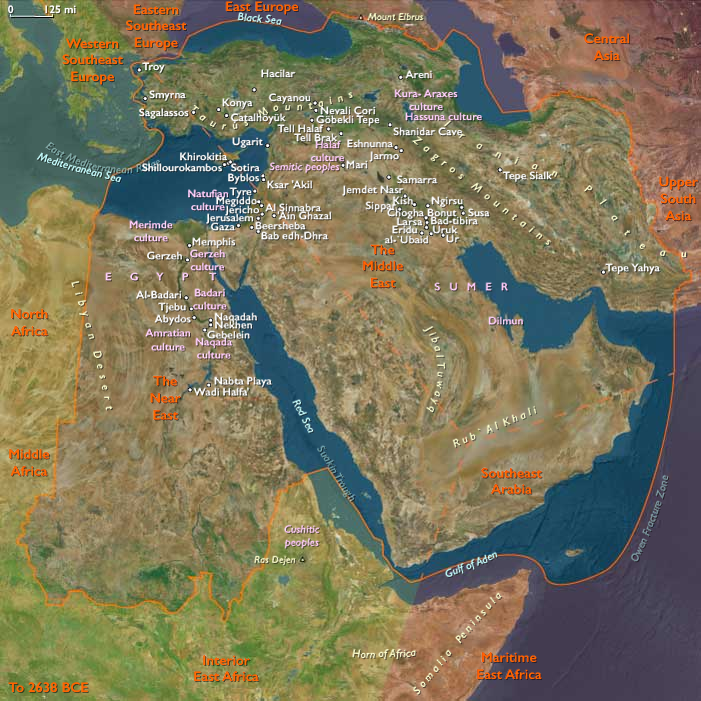
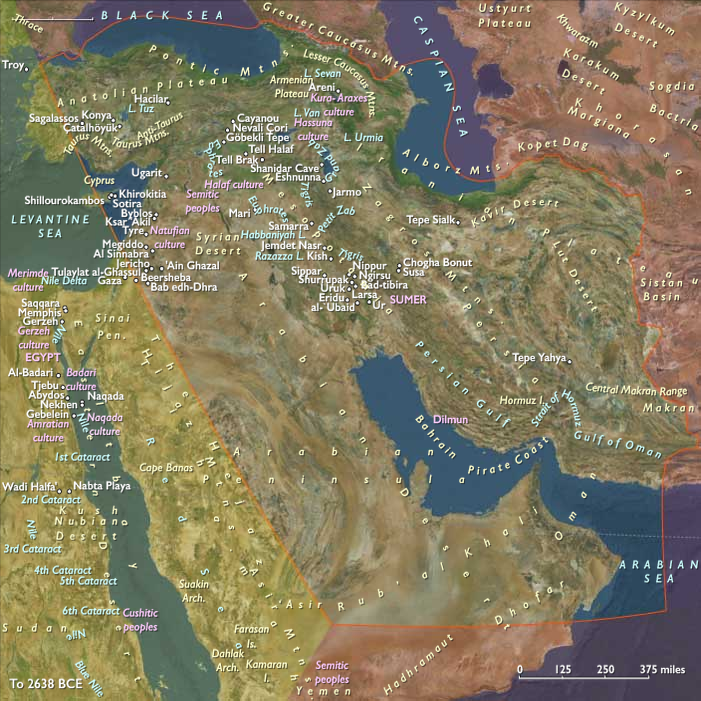
Kish, occupied beginning in the Jemdet Nasr period, gains prominence as one of the preeminent powers in the region during the early dynastic period.
In the possibly mythical pre-dynastic period, the Sumerian king list portrays the passage of power from Eridu to Shuruppak in the south, until a flood occurred, from where it relocated to the northern city of Kish at the start of the Early Dynastic period.
It would then pass back to Uruk, Ur, and Lagash until the Akkadians overtook the area.
The twelfth king of Kish appearing on the list, Etana, is noted as "the shepherd, who ascended to heaven and consolidated all the foreign countries.” Although his reign has yet to be archaeologically attested, his name is found in later legendary tablets, and Etana is sometimes regarded as the first king and founder of Kish himself.
Archaeologists have confirmed the presence of a widespread layer of riverine silt deposits, shortly after the Piora oscillation, interrupting the sequence of settlement, that left a few feet of yellow sediment in the cities of Shuruppak and Uruk and extended as far north as Kish.
The polychrome pottery characteristic of the Jemdet Nasr period (3100–2900 BCE) below the sediment layer was followed by Early Dynastic I artifacts above the sediment layer.
The Sumerian king list states that it was the first city to have kings following the deluge, beginning with Jushur.
Jushur's successor is called Kullassina-bel, but this is actually a sentence in Akkadian meaning "All of them were lord.” Thus, some scholars have suggested that this may have been intended to signify the absence of a central authority in Kish for a time.
The names of the next nine kings of Kish preceding Etana are all Akkadian words for animals, e.g., Zuqaqip "scorpion.” The Semitic nature of these and other early names associated with Kish reveals that its population had a strong Semitic component from the dawn of recorded history.
Akkadian, a now-extinct Semitic language (part of the greater Afroasiatic language family) that was spoken in ancient Mesopotamia, is first attested in Sumerian texts in proper names from around 2800 BCE.
Locations
Groups
Topics
- Piora Oscillation ending the Neolithic Subpluvial
- Early Bronze Age II (Near and Middle East)
- Subboreal Period
Commodoties
Subjects
- Language
- Environment
- Government
- Custom and Law
- Catastrophe
- Mythology
- Anthropology
- Archaeology
- Linguistics
Regions
Subregions
Years: 2925BCE - 2782BCE
Locations
Groups
Topics
- Piora Oscillation ending the Neolithic Subpluvial
- Early Bronze Age II (Near and Middle East)
- Subboreal Period
Commodoties
Subjects
- Language
- Environment
- Government
- Custom and Law
- Catastrophe
- Mythology
- Anthropology
- Archaeology
- Linguistics
Regions
Subregions