
K'inich Yax K'uk' Mo', the founder and …
Years: 437 - 437
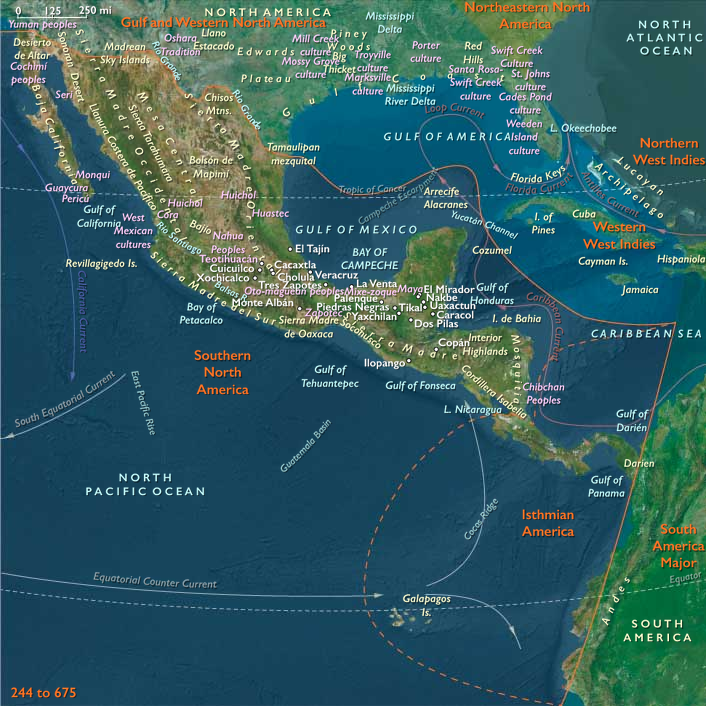
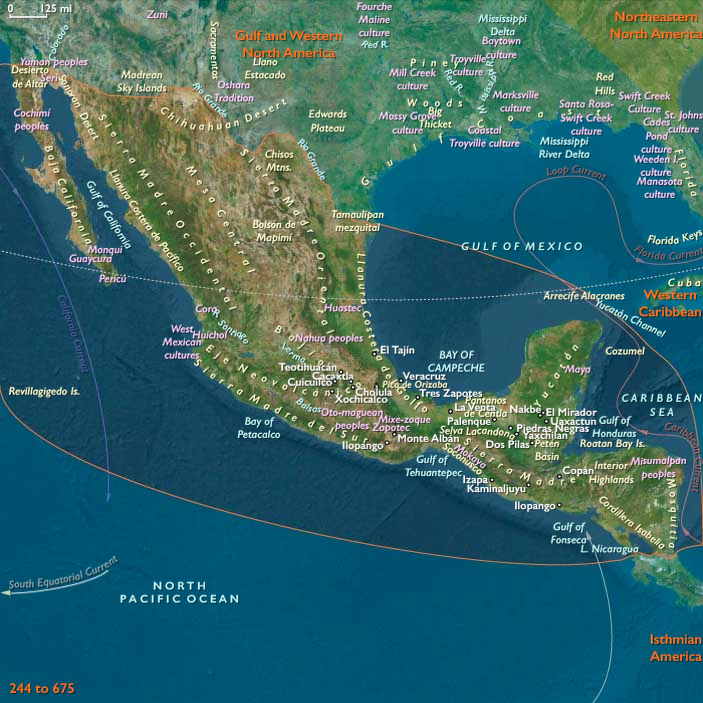
K'inich Yax K'uk' Mo', the founder and first ruler of the pre-Columbian Maya civilization centered at Copán (modern Honduras), dies after an eleven-year reign.
Locations
People
Groups
Topics
Subjects
Regions
Subregions
Related Events
Filter results
Showing 10 events out of 58842 total
A synod at Constantinople attempts to impinge on the pope's rights in Illyria.
Proclus tries to implement the synod's decisions, and Pope Sixtus III reminds the Illyrian bishops of their obligations to his vicar at Thessaloniki.
Through Litorius, Avitus obliges Theodoric to lift the siege of Narbonne.
Aetius settles the defeated Burgundians in Sapaudia (Savoy) near Lake Geneva.
Aetius is again consul in 437.
Valentinian III, Emperor in the West, marries Licinia Eudoxia, the daughter of Eastern Emperor Theodosius II and Eudocia, on October 29, of this year.
This marks the reunion of two branches of the House of Theodosius.
Valentinian’s mother Galla Placidia ends her regency, but will continue to exercise political influence until her death in 450.
Avitus and the Defense of Gaul
In 437 CE, Avitus, a prominent Gallo-Roman aristocrat, returns to Avernia (modern Auvergne), where he assumes a high-ranking military office, likely that of Magister Militum per Gallias (Master of Soldiers for Gaul). His elevation to the rank of vir inlustris, a prestigious title reserved for Rome’s highest officials, underscores his rising influence within the Western Roman Empire.
That same year, Avitus demonstrates his military capability by leading Roman forces against a group of Hunnic raiders near Clermont (Clermont-Ferrand). This victory, though localized, is significant in a time when imperial defenses in Gaul are faltering under pressure from multiple fronts. By repelling the Hunnic incursion, Avitus not only protects a key Roman stronghold but also reinforces his standing as one of the last effective Roman commanders in the region.
His successes in Gaul will later pave the way for his ascension to the imperial throne in 455 CE, during a period of deepening crisis for the Western Roman Empire. However, his rule will be short-lived, as Rome's internal political instability and the continued rise of barbarian powers prove insurmountable.
Aetius and the Franks: Containment or Integration
During the mid-fifth century, Flavius Aetius, the magister militum and de facto ruler of the Western Roman Empire, confronts the growing threat of the Salian and Ripuarian Franks, who have been expanding their influence west of the Rhine. Recognizing the strategic necessity of maintaining control over northern Gaul, Aetius takes a two-pronged approach:
-
Military Containment – Aetius pushes back some Frankish groups beyond the Rhine, temporarily securing the frontier against further encroachment. This effort is part of a broader campaign to maintain Roman influence in Gaul, where multiple barbarian groups—Visigoths, Burgundians, and Alemanni—are vying for dominance.
-
Foederati Agreements – Rather than seeking to expel the Franks entirely, Aetius follows Rome’s long-standing policy of incorporating Germanic groups as federates (foederati). He grants some Frankish leaders lands within the empire in exchange for military service, ensuring their loyalty (at least temporarily) to Rome. This pragmatic approach allows Aetius to bolster his forces against larger threats, particularly the looming invasion of Attila and the Huns.
The Long-Term Impact
While Aetius successfully delays full Frankish expansion into Gaul, his death in 454 CE removes the last major Roman leader capable of holding the empire’s frontiers together. With Rome’s grip on Gaul disintegrating, the Franks will soon resume their territorial expansion, ultimately leading to the rise of the Frankish Kingdom under Clovis I in the late fifth century.
Bahram V dies after an eighteen-year reign, and is succeeded by his son Yazdegerd II as the fifteenth Sassanid king of the Persian Empire.
Aelia Eudocia, wife of Theodosius II, goes on a pilgrimage in 438 to Jerusalem, bringing back with her holy relics to prove her faith.
She arranges to remove the ban on Jews' praying at the Temple site, and the heads of the Jewish Community in Galilee issue a call “to the great and mighty people of the Jews” which begins, “Know that the end of the exile of our people has come!”
The last gladiatorial fights are held in the Colosseum (Rome) in 438; animal hunts will continue until at least 523.
In the Suebic Kingdom of Galicia, King Hermeric, after suffering from a seven-year illness, abdicates and hands over power to his son, Rechila. Rechila is married to a daughter of Wallia, the Visigothic king from 415 to 419.
Rechila has a sister, Ricina, and a brother, Ricimer, who will later become the de facto ruler of the Western Roman Empire.
Determined to expand the Suevic kingdom, Rechila seeks to fill the power vacuum left by the departing Vandals and Alans. In 438 CE, he achieves a major victory, defeating Andevotus, the comes Hispaniarum, at the Genil River (Singillio), further consolidating Suevic dominance in Hispania.
