King's College is the first university in …
Years: 1495 - 1495
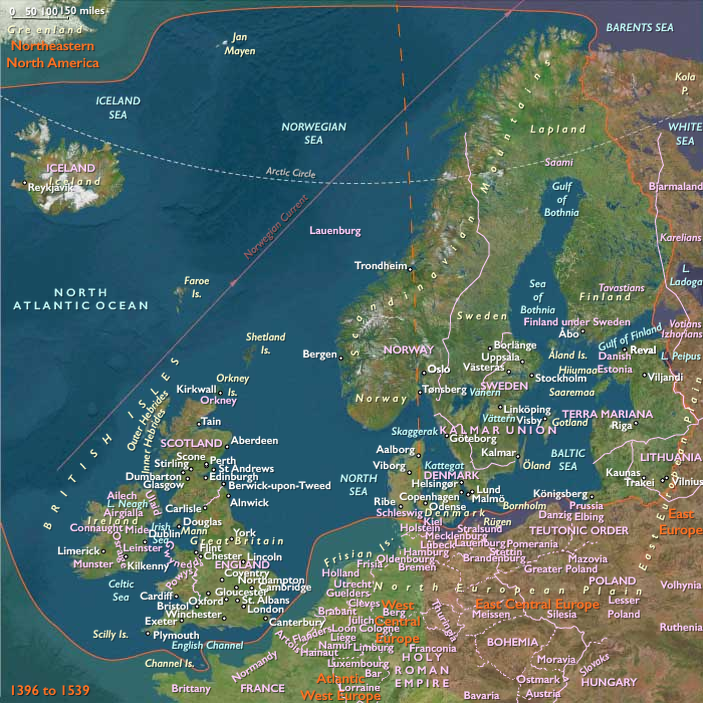
King's College is the first university in Aberdeen, the third in Scotland and the fifth in the British Isles.
William Elphinstone, the relatively newly appointed Bishop of Aberdeen, has petitioned Pope Alexander VI on behalf of King James IV to create the facility to cure the ignorance he has witnessed within his parish and in the north generally.
A papal bull is issued in February 1495 (1491 in the calendar of the day) founding the university; a royal charter later this year recognizes Aberdeen's status as equal to that of Scotland's two existing universities at Glasgow and St Andrews.
As a former professor at the University of Paris, Elphinstone models the university very much on the continental European tradition.
Hector Boece, a fellow professor at Paris, is awarded the status of first principal of the new institution.
Locations
People
Groups
Topics
Subjects
Regions
Subregions
Related Events
Filter results
Showing 10 events out of 40195 total
Alexander Jagiellonian, Grand Duke of Lithuania, expels the Jews from the country in 1495.
Askia Muhammad Toure, who promotes Islamic literature and learning, in his West African domains, gains fame for his lavish pilgrimage to Mecca in 1495.
The Eidgenossen, or Swiss Confederation, when asked in 1488 by Emperor Frederick to also join the Swabian League, had flatly refused: they had seen no reason to join an alliance designed to further Habsburg interests, and they are wary of this new, relatively closely knit and powerful alliance that has arisen on their northern frontier.
Furthermore, they resent the strong aristocratic element in the Swabian League, so different from their own organization, which has grown over the last two hundred years liberating themselves from precisely such an aristocratic rule.
The independence and freedom of the Eidgenossen is a powerful and attractive role model for the common people in Swabia.
Many a baron in southern Swabia fears that his own subjects might revolt and seek adherence to the Swiss Confederacy.
These fears are not entirely without foundation: the Swiss had begun to form alliances north of the Rhine river, concluding a first treaty with Schaffhausen in 1454 and then also treaties with cities as far away as Rottweil in 1463 and Mulhouse in 1466.
The city of Constance and its bishop are caught in the middle between these two blocks: they hold possessions in Swabia, but the city also still exercises the high justice over the Thurgau, where the Swiss had assumed the low justice since the annexation in 1460.
The foundation of the Swabian League had prompted the Swiss city states of Zürich and Bern to propose accepting Constance into the Swiss Confederacy.
The negotiations had failed, though, due to the opposition of the founding cantons of the Confederacy and Uri in particular.
The split jurisdiction over the Thurgau has been the cause of many quarrels between the city and the Confederacy.
In 1495, one such disagreement is answered by a punitive expedition of soldiers of Uri and the city has to pay the sum of three thousand guilders to make them retreat and cease their plundering. (The Thurgau is a condominium of the Swiss Confederacy, and Uri is one of the cantons involved in its administration.)
Andrea della Robbia, a favorite nephew and pupil of sculptor Luca della Robbia, popularizes terra cotta sculptures by giving them a sweeter, softer look and more colors.
Born in Florence, Robbia is the son of Marco della Robbia, whose brother, Luca della Robbia, had popularized the use of glazed terra-cotta for sculpture.
Andrea, who is the most important artist of ceramic glaze of the times, has carried on the production of the enamelled reliefs on a much larger scale than his uncle had ever done; he has also extended its application to various architectural uses, such as friezes and to the making of lavabos, fountains and large retables.
One variety of method has been introduced in his enameled work.
Sometimes he omits the enamel on the face and hands of his figures, especially in those cases where he has treated the heads in a realistic manner; as, for example, in the tympanum relief of the meeting of St Domenic and St Francis in the loggia of the Florentine hospital of San Paolo, a design suggested by a fresco of Fra Angelico's in the cloister of St Mark's.
One of the most remarkable works by Andrea is the series of medallions with reliefs of the Infant Jesus in white on a blue ground set on the front of the foundling hospital in Florence.
These child-figures are individually modeled with skill and variety.
Andrea has also produced, for guilds and private persons, a large number of reliefs of the Madonna and Child varied with much invention.
These are frequently framed with realistic yet decorative garlands of fruit and flowers painted with colored enamels, while the main relief is left white.
The hospital of San Paolo, near Santa Maria Novella, has also a number of fine medallions with reliefs of saints, two of Christ Healing the Sick, and two fine portraits, under which are white plaques inscribed "DALL ANNO 1451 ALL ANNO 1495".
The first of these dates is the year when the hospital was rebuilt owing to a papal brief sent to the archbishop of Florence.
Francisco Jimenez de Cisneros, born as Gonzalo Jiménez de Cisneros to a poor family in Torrelaguna in Castile in 1436, had studied at Alcalá de Henares and Salamanca, afterward having been ordained a priest.
In 1459, he had traveled to Rome to work as a consistorial advocate where he attracted the notice of Pope Pius II.
He had returned to Spain in 1465 carrying an "executive" letter from the Pope giving him possession of the first vacant benefice, which turned out to be Uceda.
However, Alfonso Carrillo de Acuña, the Archbishop of Toledo and Primate of Spain, had refused to accept the letter, wishing instead to bestow the benefice upon one of his own followers.
When Cisneros insisted, he was thrown in prison.
For six years, Cisneros held out for his claim, free to leave at any time if he would give it up, but at length in 1480 Carillo relented at Cisneros' strength of conviction and gave him a benefice.
Cisneros had traded it almost at once for a chaplaincy at Sigüenza, under Cardinal Pedro González de Mendoza, the bishop of Sigüenza, who shortly after appointed him vicar general of his diocese.
At Siguenza, Cisneros had won praise for his work and seemed to be on the sure road to success among the secular clergy when, in 1484 at the late age of forty-eight, he had made the abrupt decision to become a Franciscan friar.
Giving up all his worldly belongings, and changing his baptismal name, Gonzalo, for that of Francisco, he had entered the Franciscan friary of San Juan de los Reyes, recently founded by Ferdinand II of Aragon and Isabella I of Castile at Toledo.
Not content with the normal lack of comforts for a friar, he voluntarily slept on the bare ground, wore a cilice, doubled his fasts, and generally denied himself with enthusiasm; indeed throughout his whole life, even when at the height of power, his private life is rigorously ascetic.
He had retired to the isolated friary of Our Lady of Castañar and built a rough hut in the neighboring woods, in which he lived at times as an anchorite, and later became guardian of a friary at Salzeda.
Meanwhile, Mendoza (now Archbishop of Toledo) had not forgotten him, and in 1492 had recommended him to Isabella as her confessor.
Jiménez had accepted the position on condition that he might still live in his community and follow the religious life, only appearing at court when sent for.
The post was politically important, for Isabella had taken counsel from her confessor not only in religious affairs but also matters of state.
Isabella's Alhambra Decree, which expelled the Jews from Spain, followed almost immediately upon Cisneros' appointment as her confessor.
Cisneros' severe sanctity had soon won him considerable influence over Isabella, and in 1494 he had been appointed Minister Provincial of the order for Spain.
Cardinal Mendoza dies in 1495, and Isabella had meanwhile secretly procured a papal bull nominating Cisneros to Mendoza's Archdiocese of Toledo, the richest and most powerful in Spain.
With this office is also given the office of chancellor of Castile.
Isabella tries to surprise Cisneros by presenting the bull as a gift in person, but he does not react as she had expected.
Instead, he flees her presence and runs away, only to be overcome by Isabella's guards and forced to accept the position against his will.
Despite this, Cisneros personally still maintains a simple life: although a message from Rome requires him to live in a style befitting his rank, the outward pomp only conceals his private asceticism.

Albrecht Dürer has come to Venice to study its more advanced artistic world.
Through Wolgemut's tutelage, Dürer had learned how to make prints in drypoint and design woodcuts in the German style, based on the works of Martin Schongauer and the Housebook Master.
He also would have had access to some Italian works in Germany, but the two visits he makes to Italy will have an enormous influence on him.
He will write that Giovanni Bellini is the oldest and still the best of the artists in Venice.
His drawings and engravings show the influence of others, notably Antonio Pollaiuolo with his interest in the proportions of the body, Mantegna, Lorenzo di Credi and others.
Dürer probably also visits Padua and Mantua on this trip.
The late Verrocchio’s unfinished equestrian monument to the condottiere Bartolommeo Colleoni, a work of great dramatic power, is completed in 1495 by the Venetian sculptor Alessandro Leopardi.
The Portrait of Fra Luca Pacioli and his student (?) Guidobaldo da Montefeltro, Duke of Urbino, a disputed but famous work, shows the Franciscan mathematician and expert on perspective demonstrating geometry at a table on which lie his own Summa and a work by Euclid.
His exquisitely dressed pupil ignores this and looks out at the viewer.
Attributed to Jacopo de' Barbari, the work is signed "IACO. BAR VIGEN/NIS 1495". (It is currently in the Museo di Capodimonte in Naples.)
Leonardo, working in Milan from 1482 until 1499, is commissioned to paint the Virgin of the Rocks for the Confraternity of the Immaculate Conception and, in 1495, The Last Supper for the monastery of Santa Maria delle Grazie.
Between 1493 and 1495 Leonardo has listed a woman called Caterina among his dependents in his taxation documents.
At her death in 1495, the list of funeral expenditures suggests that she was his mother.
Pinturicchio and his school complete three years of fresco work on the Vatican Palace’s Borgia Apartment in about 1495.
These six rooms now form part of the Vatican library, and five still retain a series of Pinturicchio frescoes.
Recent cleaning of Pinturicchio's fresco "The Resurrection" has revealed a scene believed to be the earliest known European depiction of Native Americans, painted just two short years after Christopher Columbus returned from the New World.