King Wenceslaus of Bohemia dies on September …
Years: 1253 - 1253
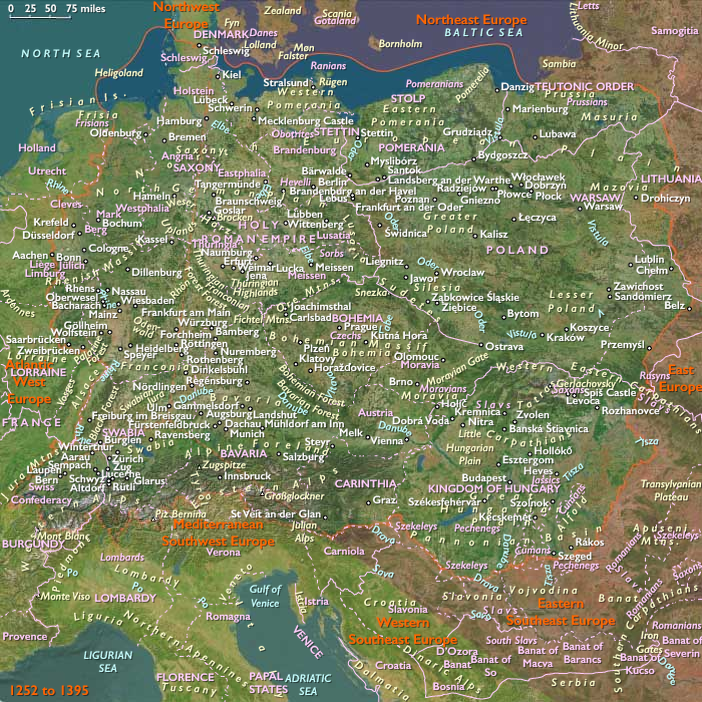
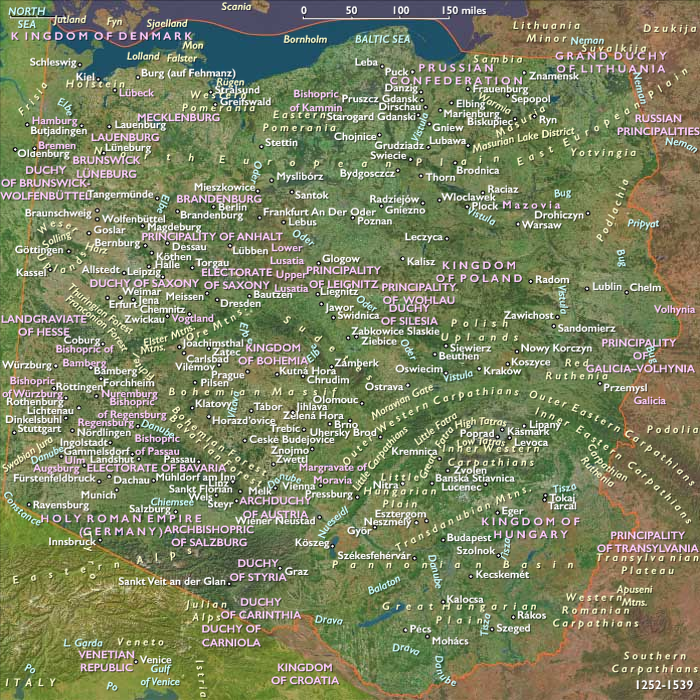
King Wenceslaus of Bohemia dies on September 22, 1253, having added Austria to the possessions of the Przemysl dynasty and developed Bohemia’s prosperity by encouraging German immigration.
His son, recently created Duke of Austria, succeeds him to the Bohemian throne as Ottokar II.
Locations
People
Groups
Topics
Subjects
Regions
Subregions
Related Events
Filter results
Showing 10 events out of 46220 total
Construction of Kamakura’s Kencho Temple, Japan's first seminary exclusively for Buddhist priests of the Zen sect, is completed in 1253.
Chinese Chan monk Lanxi Daolong (Rankei Doryu), a master of the Yogi line of the Rinzai lineage who had traveled to Japan in 1246 and founded the Joraku-ji and Kencho-ji monasteries, accepts an invitation from Hojo Tokiyori, supreme commander of the shogunate in Kamakura, to become the Kencho-ji’s first abbot.
Zennichimaro, born in the fishing village of Kominato in the province of Awa, had begun his Buddhist study at a nearby temple, Seichoji, at age eleven.
At his formal ordination at sixteen, he took the Buddhist name Zeshō-bō Renchō.
He left Seichoji shortly thereafter to study in Kamakura and several years later traveled to western Japan for more in-depth study in the Kyoto–Nara area, where Japan's major centers of Buddhist learning were located.
During this time, he became convinced of the pre-eminence of the Lotus Sutra and in 1253, returned to Seichoji.
On April 28, he expounds Nam(u) Myōhō Renge Kyō for the first time, marking his Sho Tempōrin ("first turning the wheel of the Law").
With this, he proclaims that devotion to and practice of the Lotus Sutra is the only correct form of Buddhism for the present time period.
At the same time he changes his name to Nichiren, wherein the kanji character for nichi means "sun" and that for I means "lotus".
The significance of this choice, as Nichiren himself explained it, is manifold and rooted, among other things, in passages from the Lotus Sutra.
After making his declaration, which all schools of Nichiren Buddhism regard as marking their foundation.
Nichiren begins propagating his teachings in Kamakura, Japan's de facto capital since it is the residence of the shikken (regent for the shogun) and the seat of the apparatus of government.
He gains a fairly large following here, consisting of both priests and laity, and many of his lay believers come from among the samurai class.
Nichiren Buddhism will develop into a major Japanese Buddhist stream encompassing several schools of often widely conflicting doctrine.

China’s Southern Song Dynasty had been able to hold back the Jin, but a new and considerable foe had come to power over the steppe, deserts, and plains north of the Jin Dynasty in the person of the Mongols.
Led by Genghis Khan, the Mongols had initially invaded the Jin Dynasty in 1205 and 1209, engaging in large raids across its borders, and in 1211 an enormous Mongol army was assembled to invade the Jin.
The Jin Dynasty had been forced to submit and pay tribute to the Mongols as vassals; when the Jin suddenly moved their capital city from Beijing to Kaifeng, the Mongols had seen this as a revolt.
Under the leadership of Ögedei Khan, both the Jin Dynasty and Western Xia Dynasty had been conquered by Mongol forces.
The Mongols were at one time allied with the Southern Sung Dynasty, with its capital in Hangzhou, but this alliance had been broken when the Song recaptured the former imperial capitals of Kaifeng, Luoyang, and Chang'an at the collapse of the Jin Dynasty in 1234.
Great Khan Möngke, seeming to take much more seriously the legacy of world conquest he had inherited than had Güyük, concerns himself more with the war in China.
Goryeo's royal court had moved in 1232 to Ganghwa Island in the Bay of Gyeonggi after Mongols under Ögedei Khan invaded Goryeo the preceding year as part of a general campaign to conquer China.
The military ruler, Choe U, had insisted on fighting back; the Mongols had ravaged parts of Gyeongsang and Jeolla provinces in the major campaigns of 1231-1232, 1235, 1238.
In 1247, the Mongols had begun the fourth campaign against Goryeo, again demanding the return of the capital to Songdo and the Imperial Family as hostages.
With the death of Güyuk Khan in 1248, however, the Mongols had again withdrawn.
Upon the 1251 ascension of Möngke Khan, the Mongols had again repeated their demands.
Goryeo refuses, and in 1253 the Mongols begin a large campaign.
King Gojong, the twenty-third king of the Goryeo dynasty, finally agrees to move the capital back to the mainland, and sends one of his sons, Prince Angyeonggong, as a hostage.
The Mongols withdraw, but later learn that top Goryeo officials remain on Ganghwa Island, and have punished those who had negotiated with the Mongols.
They renew their campaign.
Mongke’s brother Kublai is thirty-eight in 1253 when, ordered to attack Yunnan to outflank the Song, he leads one hundred thousand soldiers through eastern Tibet to Yunnan.
It is claimed that despite their military prowess and superior numbers, the Mongols could not breach the defenses of the Erhai valley, which was so suited to defense that even just a few defenders could hold out for years.
It is said that the Mongols had found a traitor who led them over the Cangshan mountains along a secret path, and only in this way were they able to penetrate and overrun the Bai defenders.
Thus ends five centuries of Bai independence.
Turning back a flank of the Song army, Kublai marches his troops through Laos to attack the Song southern flank.
Flemish Franciscan missionary William of Rubruck, after reaching the Crimean town of Sudak, …
…continues his trek with oxen and carts.
Nine days after crossing the Don he meets Sartaq Khan, ruler of the Kipchak Khanate.
The Khan sends William on to his father, Batu Khan, at Sarai near the Volga.
Five weeks later, after the departure from Sudak, he reaches the encampment of Batu Khan, Mongol ruler of the Volga River region.
Batu refuses conversion but sends the ambassadors on to the Great Khan, Möngke.
He and his traveling companions set off on horseback on September 16, 1253 on a journey of five thousand miles to the court of the Great Khan at Karakorum.
Mindaugas, the first known Grand Duke of Lithuania, a title he had gained in around 1235, had been crowned King of Lithuania in 1251.
He is generally considered the founder of the Lithuanian state, and the first leader to unite the Balts.
During the course of internal power struggles, he had been baptized as a Roman Catholic in 1250 or 1251; this action has enabled him to establish an alliance with the Livonian Order, and he is crowned King of Lithuania on June 29 or July 6, 1253.
However, as later events will show, Lithuanians are not prepared to accept Christianity, and Mindaugas' baptism is to have little impact on further developments.
The Ascanian dynasty of Brandenburg founds Frankfurt an der Oder In 1253 as a river crossing and staging point for further expansion eastward.
Mstislav Mstislavich, son of Mstislav Rostislavich, had liberated Galicia-Volhynia, a principality in post-Kievan Rus from the late twelfth century, from Hungarian rule in 1221.
Within the next two decades, Mstislav’s son-in-law, Daniil Romanovich, the son of Roman Mstyslavich, had reunited all of south western Rus, including Volhynia, Galicia and the ancient Rus' capital of Kiev, which Daniil had captured in 1239.
He had defeated the Polish and Hungarian forces in the battle of Yaroslav (Jarosław) in 1245, but at the same time had been compelled to acknowledge, at least nominally, the supremacy of the Mongol Blue Horde.
Pope Innocent IV had in that year granted permission for Daniil to be crowned king, although his realm will continue to be ecclesiastically independent from Rome.
Thus, Daniil becomes the only member of the Rurik dynasty to be crowned king, made so in 1253 by the papal archbishop Opizo in Drohiczyn on the Bug River.
Galicia-Volhynia is important enough that in 1252 Daniil had been able to marry his son Roman to the heiress of the Austrian Duchy in the vain hope of securing it for his family.
Poland of the thirteenth century is no longer one solid political entity, the sovereignty of the former state having become diffused among a number of smaller independent political units, with only the common bonds of language, race, religion and tradition.
At the death of Ladislaus Odonic Plwacz, duke of Greater Poland, Przemysl, his son by Jadwiga of Pomerania, daughter of Mściwój I, duke of Eastern Pomerania, had inherited the part of Greater Poland controlled by Ladislaus and become duke of Ujście; subsequently he strove to recover the remaining part of Greater Poland.
In 1241, after the death of Henry II the Pious, duke of Silesia at the battle of Legnica, Przemysl and his brother Boleslaus had acquired the duchies of Poznań and Gniezno, and subsequently managed to conquer also the parts of Greater Poland once controlled by Silesia.
In 1244 he had married Elizabeth, Henry’s daughter.
In exchange, he obtained by Wladylaw, duke of Opole, the reincorporation of Kalisz into Greater Poland.
Przemysl had become duke of Poznań and Kalisz in 1247, but had been forced by the local nobility to leave Kalisz to Boleslaus.
He had also obtained Santok (Zantoch) by Boleslaw II the Bald and allied with Bogufal II, bishop of Poznań.
In 1249, he had again exchanged territories with his brother, giving him Gniezno and becoming duke of Poznań and Kalisz.
For unknown reasons, Przemys had had Boleslaus arrested in 1250, becoming in this way the sole ruler of Greater Poland (Poznań, Gniezno et Kalisz) until in 1253, when Boleslaus is freed and given Kalisz and Gniezno.