
King Stephen of Hungary has established church …
Years: 1038 - 1038
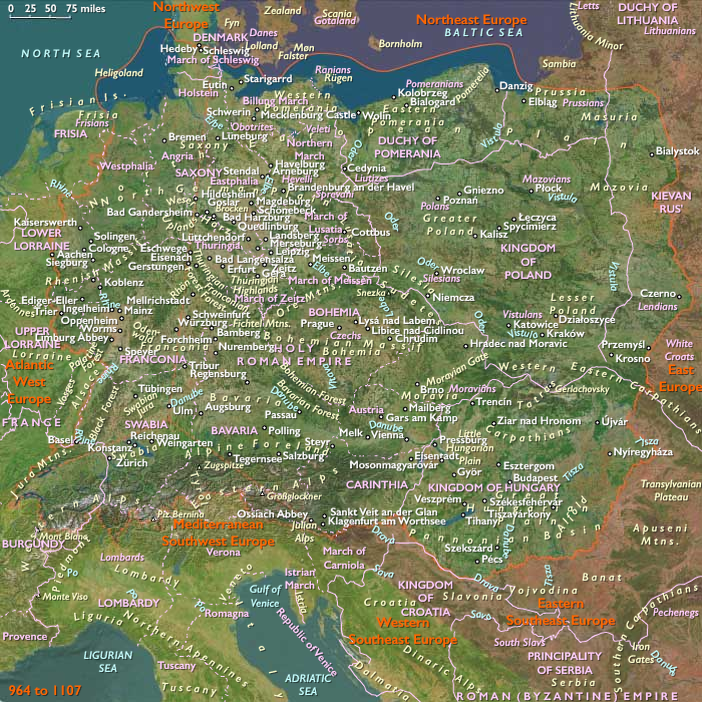
King Stephen of Hungary has established church institutions, replaced tribal land systems with individual proprietorship, and extended Hungarian political influence to the foothills of the Carpathians.
As his only son, Emeric, had died in a hunting accident in 1031 and he has exiled his closer Árpád relatives for their unwillingness to renounce their pagan faith, he designates as his successor his distant relative Pietro Orseolo, who was born on in Venice as the only son of Doge Otto Orseolo; his mother is a sister of Stephen.
After the Venetians rose up and deposed Otto in 1026, Peter had not followed his father in flight to Constantinople.
He instead went to Hungary, where his uncle had appointed him commander of the royal army.
Stephen's cousin Vazul had had the strongest claim to the throne, but the king had overlooked him and named Peter as his heir.
Vazul had been blinded shortly thereafter and his three sons—Levente, Andrew and Béla—exiled, which has strengthened Peter's right of succession.
The king has asked Peter to take an oath respecting the property of his wife, Queen Giselle, suggesting that Peter's relationship with his aunt was tense.
Stephen dies on August 15, 1038.
Peter succeeds him and adopts an active foreign policy.
Locations
People
Groups
- Polytheism (“paganism”)
- Hungarian people
- Christianity, Chalcedonian
- Venice, Duchy of
- Bohemia, Duchy of
- Kievan Rus', or Kiev, Great Principality of
- Bavaria, Ottonian Duchy of
- German, or Ottonian (Roman) Empire
- Hungary, Kingdom of
- Poland of the first Piasts, Kingdom of
- Poland of the first Piasts, Kingdom of
Commodoties
Subjects
Regions
Subregions
Years: 1038 - 1038
Locations
People
Groups
- Polytheism (“paganism”)
- Hungarian people
- Christianity, Chalcedonian
- Venice, Duchy of
- Bohemia, Duchy of
- Kievan Rus', or Kiev, Great Principality of
- Bavaria, Ottonian Duchy of
- German, or Ottonian (Roman) Empire
- Hungary, Kingdom of
- Poland of the first Piasts, Kingdom of
- Poland of the first Piasts, Kingdom of
Commodoties
Subjects
Regions
Subregions