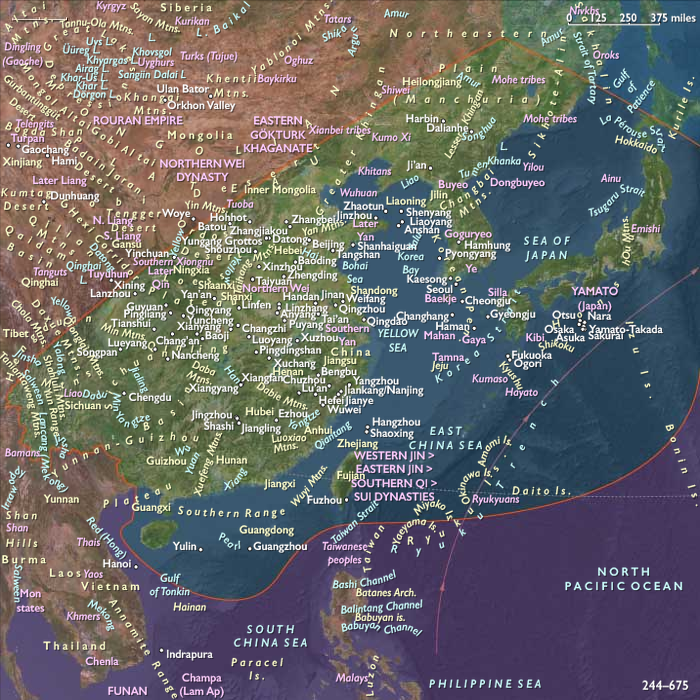
King Sosurim of Baekje has attacked the …
Years: 378 - 378
King Sosurim of Baekje has attacked the Korean kingdom of Baekje to the south in 374, 375, and 376, and in 378 is attacked by the Khitan people from the north.
Locations
People
Groups
Topics
Commodoties
Subjects
Regions
Subregions
Related Events
Filter results
Showing 10 events out of 59590 total
The Lentienses Alemanni Cross the Frozen Rhine and the Battle of Argentovaria (377–378 CE)
In the late winter of 377–378 CE, the Lentienses, the southernmost branch of the Alemanni, took advantage of the frozen Rhine to launch a major invasion of Roman territory. Their incursion was part of the continued Germanic pressure on Rome’s frontiers, which had been increasing throughout the 4th century.
In response, Emperor Gratian, ruling the Western Roman Empire, mobilized his forces and engaged the Lentienses at the Battle of Argentovaria (near modern Colmar, France) in May 378 CE.
1. The Lentienses Cross the Rhine
- The Lentienses were one of the most aggressive Alemannic factions, residing in the Upper Rhine region.
- Exploiting severe winter conditions, they crossed the frozen Rhine, bypassing Roman river defenses.
- Their invasion of Gaul was part of wider unrest along Rome’s borders, as various Germanic groups began probing Roman weaknesses.
2. The Death of the Alemannic King and Gratian’s Counterattack
- By May 378 CE, the Lentienses' king had died, possibly weakening their coordination.
- Gratian seized the opportunity to strike back, leading his forces into battle at Argentovaria (near modern Colmar, France).
- The Roman legions, with superior discipline and tactics, decisively defeated the Lentienses, inflicting heavy losses.
3. The Significance of the Battle of Argentovaria
- This victory reaffirmed Roman control over northeastern Gaul, securing the Rhine frontier—at least temporarily.
- It demonstrated Gratian’s effectiveness as a military commander, proving his ability to defend the empire against Germanic incursions.
- However, the Alemanni remained a persistent threat, and Rome’s ability to contain these invasions continued to weaken over the coming decades.
4. Conclusion: A Temporary Roman Victory Amid Growing Barbarian Pressures
- While the Battle of Argentovaria was a clear Roman victory, it did not permanently eliminate the Alemannic threat.
- The broader instability along the Rhine and Danube frontiers would soon culminate in the Gothic War, leading to Rome’s devastating defeat at Adrianople (August 378 CE).
- Gratian’s victory in Gaul was overshadowed by the worsening crisis in the Eastern Roman Empire, where Emperor Valens was killed by the Visigoths at Adrianople—marking a turning point in Rome’s decline.
Gratian’s defeat of the Lentienses was one of the last major Roman victories in Gaul, but it could not stop the rising tide of Germanic migrations and invasions that would reshape the Western Roman world in the following century.
The massive revolt against the central government in spring 378 will later be often compared to that launched by Zenobia a century earlier.
Mavia’s forces, which she often leads personally, sweep into Arabia and Palestine and reach the edges of Egypt, defeating the armies of Rome many times.
Because she and the Tanukhids have left Aleppo to use the desert as their base, the Romans are left without a standing target upon which to inflict retribution.
Mavia's highly mobile units, using classic guerilla warfare tactics, conduct numerous raids and frustrate Roman attempts to subdue the revolt.
Mavia and her forces prove themselves to be superior to Roman forces in open battle as well.
A century of having fought alongside Roman forces means that they are familiar with Roman tactics and easily defeat the forces of the Roman governor over Palestine and Phoenicia, the first to be sent in to crush the revolt.
She gains favor among townspeople in the region, sympathetic to her cause as well, and it seems as though the whole Roman East will break away to be ruled by Mavia and her Arabs.
Roman forces in the region suffer unexpected difficulty in battling the rebels, the Romans finally choose to make a truce with her, and she agrees to it due to the influence of the teachings of a Christian hermit, one Moses, upon her.
Her Christianized tribe thus becomes a valuable ally for Roman interests in the region.
Moses is appointed the first Arab bishop of the Arabs, and an incipient Arab church begins to emerge in the Roman East, attracting many Tanukh from Mesopotamia.
Mavia also manages to regain the Tanukh's allied status and the privileges they had enjoyed prior to Julian's reign.
At the war's conclusion, Mavia's daughter, Princess Chasidat, is married to a devout Nicene commander in Rome's army, Victor, to cement the alliance.
As part of the truce agreement, Mavia sends her forces to Thrace to help the Roman fight the Goths.

The Goths’ numbers continually increase by the addition of new bands, until finally they threaten Constantinople itself, though they lack the siege instruments necessary to take the Roman capital.
Valens’ generals, despite reinforcements, are unable to halt the roaming and plundering by the new settlers, so Valens takes command of the army.
He sends for aid from Gratian, but joins battle without waiting for it to arrive.
The Therving army, led by Fritigern and augmented by Greuthung and other reinforcements, engages the imperial forces on August 9, 378, in the great Battle of Adrianople (modern Edirne, Turkey).
The emperor’s poor tactics lead to the total defeat of his army, which the Goths annihilate to the tune of forty thousand men, by some accounts, killing Valens on the battlefield.
This major victory of barbarian horse over Roman infantry, which leaves the eastern provinces nearly defenseless, marks the beginning of serious Germanic inroads into Roman territory and, to some critics, foreshadows the approaching fall of the Roman Empire.
The victory frees the Goths to roam at will, plundering throughout Thrace for the rest of 378.
The Goths meet only light Roman resistance and advance northwest into Dacia in 379, plundering this region.
General Theodosius the Younger, who has remained in retirement in Spain following the execution of his father, had married a fellow Spaniard, Aelia Flacilla, at the end of 376.
Theodosius' first son, the future emperor Arcadius, had been born in 377, and his daughter Pulcheria in January 378.
Immediately after the catastrophic defeat and death of Valens at Adrianople, Gratian unexpectedly summons to his court Theodosius to control the incursions.
When Theodosius once again proves his military ability by a victory over the Sarmatians, Gratian, before the army, proclaims him co-emperor on January 19, 379.
The extremely pious Gratian, having come under the influence of Bishop Damasus or Rome and of Bishop Ambrose of Milan, has chosen Theodosius not only for his military ability but also for his orthodoxy.
His dominion is to be the eastern part of the empire, including the provinces of Dacia (present-day Romania) and Macedonia, taken from Gratian's stepbrother, the augustus Valentinian II, which have been especially infiltrated by barbarians in the preceding few years.
Emperor Theodosius, residing chiefly in Thessalonica, seeks first to rebuild the imperial army, the discipline of which is considerably impaired, and to consolidate Rome's position on the Balkan peninsula.
Military unpreparedness cannot be overcome by conscription alone, which applies only to certain classes.
Theodosius therefore directs that the army accept large numbers of Germans, who had been barred from military service.
Foreigners have by 379, however, already intermingled extensively with the rest of the army, both among the troops and in all ranks of the officer corps, so Theodosius does no more than many of his predecessors to encourage this process.
Both Romans and Germans are among the leading generals in Theodosius' provinces, in contrast to the West.
Theodosius' situation is complicated by the sharp antagonism that arises around 379 between disciples of the Nicene Creed (according to which Jesus Christ is of the same substance as God the Father) and several other Christian groups in his part of the empire.
Gregory of Nazianzus assumes leadership of the orthodox community in Constantinople, a city divided by religious controversy, in 379.
Jerome moves from Antioch to the desert of Chalcis, to the southwest of Antioch, known as the Syrian Thebaid, from the number of hermits inhabiting it.
During this period, however, he seems to have found time for study and writing.
He had made his first attempt to learn Hebrew under the guidance of a converted Jew; and at this time he seems to have been in relation with the Jewish Christians in Antioch, and perhaps as early as this to have interested himself in the Gospel of the Hebrews, asserted by them to be the source of the canonical Matthew.
Returning to Antioch in 378 or 379, he was ordained by Bishop Paulinus, apparently with some unwillingness and on condition that he still continue his ascetic life.
Soon afterward, …
…Jerome goes to Constantinople to pursue his study of Scripture under the instruction of Gregory Nazianzen.
Here he seems to have spent two years.
The anti-Arian bishop Meletius of Antioch remains in exile as ordered by the Eastern emperor Valens.
The bishops of Alexandria and Rome, viewing the presbyter Paulinus as more orthodox than Meletius, had taken the side of the former; Basil of Caesarea had been the latter’s principal supporter.
A further complication had been added when, in 375, the heretical bishop Apollinaris of Laodicea consecrated Vitalius, one of Meletius' presbyters, as bishop.
Meanwhile, under the influence of his situation, Meletius has been more and more approximating to the views of Nicene Creed.
Basil, throwing over the cause of Meletius’ predecessor Eustathius, deposed as an Homousian heretic by the synod of Melitene, championed that of Meletius who, when after the death of Valens he returns in triumph to his diocese, is hailed as the leader of Eastern orthodoxy.
As such, he presides in October 379 over the great synod of Antioch, in which the dogmatic agreement of East and West is established.
Jerome, returning in this year to Antioch, had heard the teachings of Apollinaris and been admitted to the priesthood by Paulinus, apparently with some unwillingness and on condition that he still continue his ascetic life.
Soon afterward, he goes to Constantinople to pursue his study of Scripture under the instruction of Gregory Nazianzen.