King Seong of Baekje attacks the kingdoms …
Years: 553 - 553
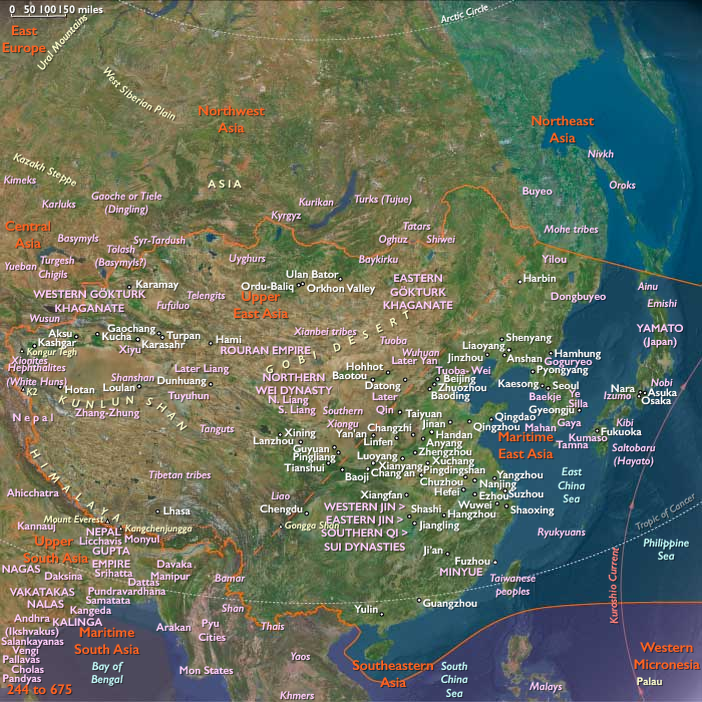
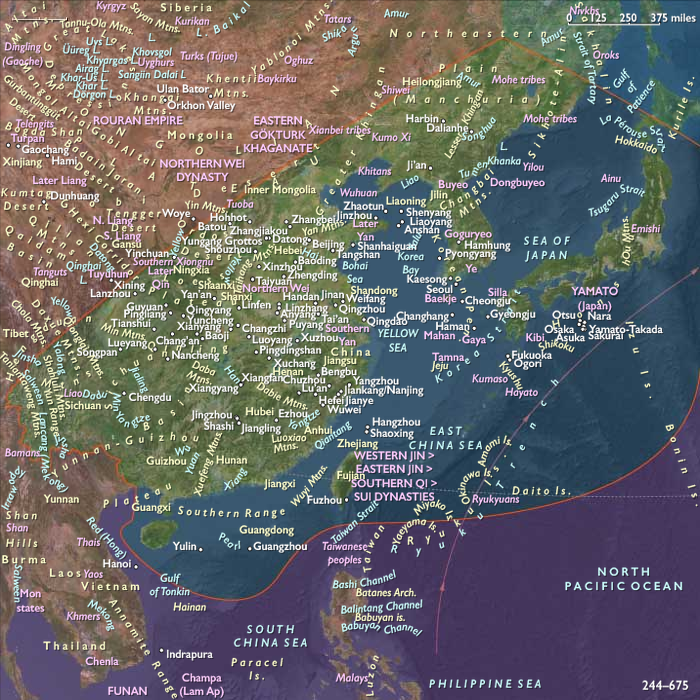
King Seong of Baekje attacks the kingdoms of Goguryeo and Silla.
However, under a secret agreement, Silla troops attack the exhausted Baekje army and take possession of the entire Han River valley.
Locations
People
Groups
Topics
Commodoties
Subjects
Regions
Subregions
Related Events
Filter results
Showing 10 events out of 11 total
Jayavarman II, according to an older established interpretation, was supposed to be a prince who lived at the court of the Sailendra dynasty in Java (today's Indonesia) and brought back to his home the art and culture of the Javanese Sailendran court to Cambodia.
At this time, Sailendras allegedly rule over Java, Sumatra, the Malay Peninsula and parts of Cambodia.
This classical theory was revisited by modern scholars, such as Claude Jacques and Michael Vickery, who noted that Khmer called chvea the Chams, their close neighbors.
Moreover, Jayavarman's political career began at Vyadhapura (probably Banteay Prei Nokor) in eastern Cambodia, which make more probable long time contacts with them (even skirmishes, as the inscription suggests) than a long stay in distant Java.
Finally, many early temples on Phnom Kulen shows both Cham (e.g., Prasat Damrei Krap) and Javanese influences (e.g., the primitive "temple-mountain" of Aram Rong Cen and Prasat Thmar Dap), even if their asymmetric distribution seems typically Khmer.
Jayavarman appears to have been of aristocratic birth, beginning his career of conquest in the southeast of present-day Cambodia.
After he eventually returned to his home, the former kingdom of Chenla, he quickly built up his influence, conquered a series of competing kings, and in 790 became king of a kingdom called "Kambuja" by the Khmer.
In the following years he extended his territory and eventually established his new capital of Hariharalaya near the modern Cambodian town of Roluos.
He thereby laid the foundation of Angkor, which is to arise some fifteen kilometers to the northwest.
In 802, he declares himself Chakravartin, in a ritual taken from the Indian-Hindu tradition, thereby becoming not only the divinely appointed and therefore uncontested ruler, but also simultaneously declares the independence of his kingdom from Java.
The foundation of Hariharalaya near present day Roluos is the first settlement in what will later become the empire of Angkor.
Despite this key role in Khmer history, few firm facts survive about Jayavarman.
No inscriptions authored by him have been found, but he is mentioned in numerous others, some of them written long after his death.

Jayavarman II settles north of the Tonle Sap, possibly to put distance between himself and the seaborne Javanese.
He builds several capitals before establishing one, Hariharalaya, near the site where the Angkorian complexes are built.
Indravarman I (877-89) extends Khmer control as far west as the Korat Plateau in Thailand, and he orders the construction of a huge reservoir north of the capital to provide irrigation for wet rice cultivation.
His son, Yasovarman I (889-900), builds the Eastern Baray (reservoir or tank), evidence of which remains to the present time.
Its dikes, which may be seen today, are more than six kilometers long and one point six kilometers wide.
The elaborate system of canals and reservoirs built under Indravarman I and his successors are the key to Kambuja' s prosperity for half a millennium.
By freeing cultivators from dependence on unreliable seasonal monsoons, they make possible an early "green revolution" that provides the country with large surpluses of rice.
Kambuja's decline during the thirteenth and fourteenth centuries probably is hastened by the deterioration of the irrigation system.
Attacks by Thai and other foreign peoples and the internal discord caused by dynastic rivalries divertshuman resources from the system's upkeep, and it gradually falls into disrepair.
Jayavarman II, the first king of Angkor, had declared the sovereignty of the Khmer state in 802, eventually establishing his capital at Hariharalaya near modern Siem Reap in Cambodia.
A few decades later, his successors had begun constructing Bakong in stages as the first temple mountain of sandstone at Angkor, its large brick structure elaborately ornamented and filled with stonecut images.
Located in the capital’s center and surrounded by double-walled moats, the inscription on its stele (classified K.826) says that in 881 King Indravarman I dedicated the temple to the god Shiva and consecrated its central religious image, a lingam whose name Sri Indresvara is a combination of the king's own and the suffix "-esvara", which stands for Shiva ("Iśvara").
The Bakong, with one hundred and eight tower-shrines around its central sanctuary, is his state shrine; therefore, it also houses the official Śiva's liṅga.
Although his shrines are bigger than his predecessors, they are modest compared to the later shrines.
It is also the first time in Khmer architecture where nāgas—a deity or class of entity or being, taking the form of a very great snake, specifically the king cobra, found in Hinduism, Buddhism and Jainism—are employed as guardians for the bridge between the human world and the temple, house of god.
Yasovaram, a son of King Indravarman I and his wife Indradevi becomes emperor of the Khmer in 889.
After the death of Indravarman, a succession war had been fought between his two sons, Yasovarman and his brother.
It is believed that the war was fought on land and on sea by the Tonlé Sap.
In the end, Yasovarman prevailed.
During the first year of his reign, he builds about one hundred monasteries (ashrams) throughout his kingdom.
Each ashram is used as a resting place for the ascetic and the king during his trips.
Jayavarman V, Emperor of Angkor, had succeeded his father, Rajendravarman, when he was only ten years old.
During his early years, the court officials dominated royal politics.
He had studied under the knowledgeable Yajnavaraha, a grandson of King Harshavarman I who in 967 had constructed Banteay Srei, considered the jewel of Khmer art for its very beautiful display of bas-reliefs.
At seventeen (in 975), Jayavarman V had begun the construction of his own state temple, whose modern name is Ta Keo.
The Khmer kingdom’s early so-called “temple-mountains” were made of brick; Ta Keo possibly the first temple of Angkor to have been built completely of sandstone.
It remains unfinished.
Yogisvarapandita, a high priest who will become the minister of Suryavarman I and "receive" the temple from him many years later, says in inscriptions that a lightning strike hit the unfinished building, an evil omen, so the works stopped.
Possibly, work stopped simply because of the death of Jayavarman V, as there was a struggle for succession.
The temple will serve continuously as a cult center until the thirteenth century, and even Yogisvarapandita worships the shrines at the first levels of the temple.
There is no clear successor after the reign of Khmer monarch Udayadityavarman I, which ends around 1000.
Two kings, Jayaviravarman and Suryavarman I, both claim the throne.
The aristocratic families had dominated Jayavarman V's court.
Atmashiva, who had served under the two previous kings, was his purohita, chaplain.
And Narayana, who had also served under King Rajendravarman, was his hotar, high priest.
However, the most influential and powerful ruling family is the house of Saptadevakula, which dominates most of the royal affairs, and helps King Suryavarman I come to power in 1002.
Years of conflict had followed Jayavarman’s death in 1001.
Kings have reigned only for a few years, and have been successively violently replaced by their successors until eventually Suryavarman I, a Buddhist, assumes the Khmer throne for the final time around 1010.
Suryavarman I establishes diplomatic relations with the Chola dynasty of south India, sending a chariot as a present to the Chola Emperor Rajaraja Chola I.
Cham king Jaya Paramesvarman and his son Yuvaraja Mahsenapati suppress a revolt in Panduranga, the kingdom’s border province with the Khmer empire.
Yuvaraja’s forces then advance into Khmer territory, and seize Sambhupara, where the Cham troops destroy all the temples and donate looted treasure and prisoners to the Mi-son temples.
Suryavarman II has built the colossal (4920 by 4265 feet/1500 by 1300-meters) temple complex known as Angkor Wat during a reign of nearly four decades.
Dedicated to Vishnu, it has been built as the king's state temple and capital city.
The largest monument ever built in the capital, Angkor Wat fills the temple mountain it is meant to emulate, like all Angkor’s previous temple mountains, with three-dimensional images and miles of relief sculpture that cover every inch of available wall space.
According to Guinness World Records, it is the largest religious structure in the world.
Work seems to have come to an end on the king's death around 1150, with some of the bas-reliefs unfinished.
As the best-preserved temple at the site, it is the only one to have remained a significant religious center since its foundation—first Hindu, then Buddhist.
The modern name, Angkor Wat, in use by the sixteenth century, means "City Temple": Angkor is a vernacular form of the word nokor which comes from the Sanskrit word nagara (capital), while wat is the Khmer word for temple.
Prior to this time the temple is known as Preah Pisnulok, after the posthumous title of its founder.
Inscriptional evidence suggests that Suryavarman II died between 1145 and 1150, possibly during a military campaign against Champa.
He is succeeded by Dharanindravarman II, a cousin, son of the brother of the king’s mother.
A period of weak rule and feuding begins.
Indravarman III, a ruler of the Khmer Empire from 1295 to 1308, rises to power after the abdication of his father in law Jayavarman VIII.
A follower of Theravada Buddhism, Inravarman makes it the state religion upon his ascension to power.