
King Oswiu invades Pengwern and kills king …
Years: 656 - 656
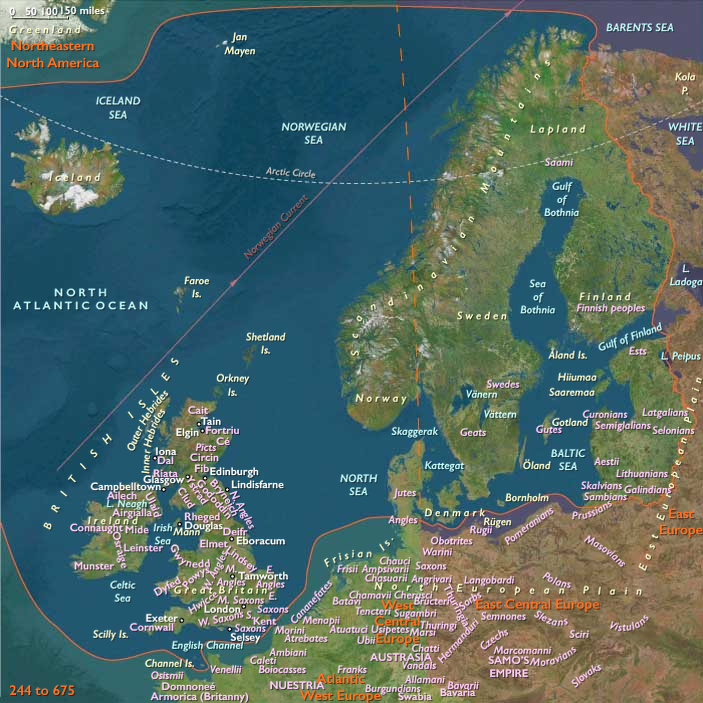
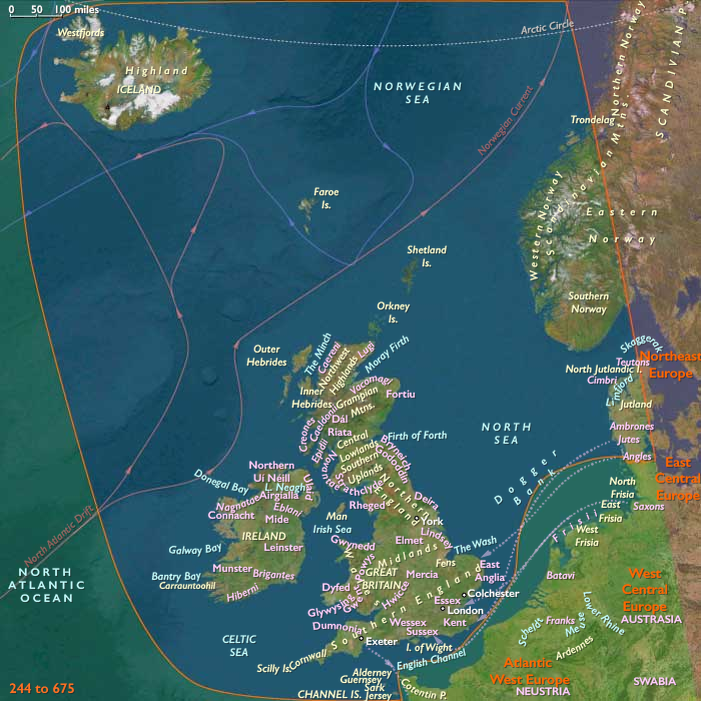
King Oswiu invades Pengwern and kills king Cynddylan in battle, near the River Trent.
His brother Morfael and the remains of the royal family flee to Glastening (Glastonbury?) in Wessex.
Locations
People
Groups
- Britons (historical)
- Saxons
- Angles
- Anglo-Saxons
- Deira, Kingdom of
- Wessex, English Kingdom of
- Britain, Medieval
Topics
Subjects
Regions
Subregions
Related Events
Filter results
Showing 10 events out of 56347 total
Atlantic West Europe, 656–667: Merovingian Decline and Rise of Regional Power
The period from 656 to 667 marked a pivotal moment in the Merovingian kingdom of the Franks, as royal authority weakened significantly, allowing local aristocratic families and regional powers to assert greater independence. These developments laid the foundation for future political structures across Atlantic West Europe.
Political and Military Developments
-
Neustria and Austrasia:
- After the death of King Clovis II (657), the kingdom was divided among his sons. Clotaire III became king in Neustria and Burgundy (r. 657–673), while his brother Childeric II ruled Austrasia (r. 662–675).
- Increasing rivalry between these Frankish kingdoms intensified, contributing to political fragmentation.
-
Rise of the Mayors of the Palace:
- The weakening Merovingian monarchy led to the increasing power of aristocratic administrators known as Mayors of the Palace, especially Ebroin in Neustria and Wulfoald in Austrasia. These figures effectively controlled royal authority and dominated internal politics.
-
Aquitaine's Growing Autonomy:
- Aquitaine increasingly functioned as a semi-autonomous region under local dukes, who managed to distance themselves politically and militarily from central Frankish authority.
-
Brittany and Normandy:
- Breton chieftains consolidated control within Brittany, increasingly independent from Merovingian influence.
- The region later known as Normandy saw only intermittent Frankish influence, with limited central oversight.
Economic and Social Developments
- Ruralization and Estate Consolidation:
- Continued growth in large estates controlled by local elites shaped rural society, as the decline of urban centers accelerated the shift toward agrarian-based economies dominated by manorial holdings.
- Localized Trade Networks:
- Long-distance trade declined temporarily; economic activity was primarily regional and local, focused around monasteries and manorial estates.
Religious and Cultural Developments
-
Monastic Expansion and Influence:
- Monastic communities, such as Luxeuil in Burgundy, remained significant centers of learning, manuscript production, and spiritual influence.
- The monasteries provided stability amidst political uncertainty, preserving cultural continuity.
-
Spread of Christianity in Peripheral Regions:
- Continued missionary activities gradually consolidated Christianity in more remote areas, notably Brittany, which still retained elements of Celtic religious traditions alongside the growing Christian influence.
Long-Term Significance
This era laid critical foundations for the political structure of medieval Europe, highlighting the transition from centralized Merovingian royal control to the rise of regional aristocratic governance and autonomy. The weakening of royal authority, combined with the growing strength of local leaders and monasteries, shaped the socio-political landscape of Atlantic West Europe in subsequent decades.
Empress Saimei builds a new palace at Asuka because her former residence had burned in a fire.
This construction is called the "Mad Canal" by the people, as it is seen as wasting the labor of tens of thousand workers and a large amount of money.
Constans makes his eldest son, Constantine, co-emperor in 656, excluding his brother Theodosius from the succession.
Constans fights the naval battle of Phoenix (modern Finike, Turkey) off the coast of Lycia near Rhodes in 655; his fleet routed by the Arabs, he escapes death only through the heroism of one of his soldiers.
The Death of Sigebert III and the Usurpation of the Austrasian Throne by Grimoald (656 CE)
On February 1, 656 CE, King Sigebert III of Austrasia dies at age twenty-five, after a twenty-two-year reign. His six-year-old son, Dagobert II, is the rightful heir, but the powerful Mayor of the Palace, Grimoald the Elder, seizes the opportunity to remove the Merovingian line from power, installing his own son, Childebert the Adopted, as king.
1. The Coup: Grimoald’s Seizure of Power
- With Sigebert III’s young son Dagobert II as heir, the Austrasian nobility expects a continued Merovingian rule.
- Grimoald the Elder, already the most influential figure in the Austrasian court, orchestrates a political coupto install his own lineage on the throne.
- Grimoald has Dagobert II kidnapped and exiled, ensuring he cannot reclaim power.
2. The Fate of Dagobert II: Exile to an Irish Monastery
- Dagobert is initially placed under the care of Dido, Bishop of Poitiers, who arranges for him to be sent into exile.
- He is taken to an Irish monastery, where he is raised in obscurity, far from the Frankish court.
- This reflects a common Merovingian practice, where political rivals were often exiled to monasteries instead of being executed, reducing their threat.
3. Childebert the Adopted: A Non-Merovingian King in Austrasia
- With Dagobert II removed, Grimoald declares his own son, Childebert the Adopted, as King of Austrasia.
- This is unprecedented, as the Merovingians had ruled the Franks for over a century, and legitimacy was tied to dynastic heritage.
- Grimoald’s move alienates both Austrasian and Neustrian factions, as it undermines the sacred lineage of the Merovingian kings.
4. The Aftermath: The Collapse of Grimoald’s Plan
- While Grimoald briefly secures power, his usurpation is ultimately short-lived.
- In 657 CE, Clovis II of Neustria has Grimoald captured and executed, restoring Merovingian rule over Austrasia.
- Dagobert II remains in exile, and Austrasia eventually falls under the rule of Chlothar III, Clovis II’s successor.
Conclusion: A Failed Usurpation That Weakened the Merovingians
The death of Sigebert III in 656 CE and the subsequent coup by Grimoald mark a significant attempt to overthrow the Merovingian dynasty, demonstrating the growing power of the Mayors of the Palace. While Grimoald’s plan fails, it weakens Merovingian authority, foreshadowing the eventual rise of the Carolingians, who will succeed where Grimoald could not—replacing the Merovingians entirely.
Œthelwald of Deira, because of his desertion at the Battle of the Winwaed, is removed from office by his uncle Oswiu and replaced by the latter's son Alhfrith, as subject king in a united Northumbria.
Ali ibn Abi Talib—husband of Fatima, Muhammad’s daughter by Khadijah—heads a reform movement that leads, albeit indirectly, to the assassination of Uthman after an eleven-year reign.
Dissident Muslim contingents assigned to Egypt and Kufa (in present Iraq), increasingly incensed at Uthman’s nepotism, march on Medina in 656 calling for Ali to become caliph.
The rebels besiege 'Uthman in his home, and, after several days of desultory fighting, he is killed on June 20, 655.
This is the beginning of beginning the first fitna (literally meaning the 'trail of faith').
The Muslim expansion come to a halt as the martial energies of the Islamic forces are directed inwards.
Ali ibn Abi Talib, the cousin and son-in-law of Muhammad, is invited by the Muslims of Medina to accept the caliphate; reluctant, he agrees only after long hesitation.
Acutely aware of the neglect of the Qur'an and the traditions of Muhammad that his predecessors had allowed to develop, he bases his rule on the Islamic ideals of social justice and equality.
Ali and his party (shi'ah) at first gain power over the representatives of the other leading Meccan families, but his policy is a blow to the interests of the Quraysh aristocracy of Mecca who have grown rich in the wake of the Muslim conquests.
In order to embarrass 'Ali they demand that he bring the murderers of 'Uthman to trial, and when he rejects their request, a rebellion against him is instigated in which two prominent Meccans along with Aishah, Muhammad's widow and the daughter of Abu Bakr, the first caliph, take a leading part.
Aishah, left a childless widow of eighteen at Muhammad's death in 632, had remained politically inactive until the time of 'Uthman, during whose reign she had played an important role in fomenting opposition that led to his murder.
Ali becomes the fourth caliph upon the murder of Uthman.
Muhammad’s widow, Aishah, leader of an aristocratic faction, immediately challenges him by supporting Mu'awiyah, governor of Syria, as a rival claimant.
Muawiyah has periodically dispatched land expeditions into Anatolia at the same time that has been prosecuting his naval campaigns against Constantinople.
All these campaigns, however, cease with the accession of 'Ali ibn Abi Talib to the caliphate.
A member of 'Uthman's Meccan clan, the Banu Umayyah, Muawiyah takes up the demands for vengeance for the blood of his murdered kinsman and questions the validity of 'Ali's caliphate.
Years: 656 - 656
Locations
People
Groups
- Britons (historical)
- Saxons
- Angles
- Anglo-Saxons
- Deira, Kingdom of
- Wessex, English Kingdom of
- Britain, Medieval
