
King Omri, after conquering Moab, forms an …
Years: 873BCE - 862BCE
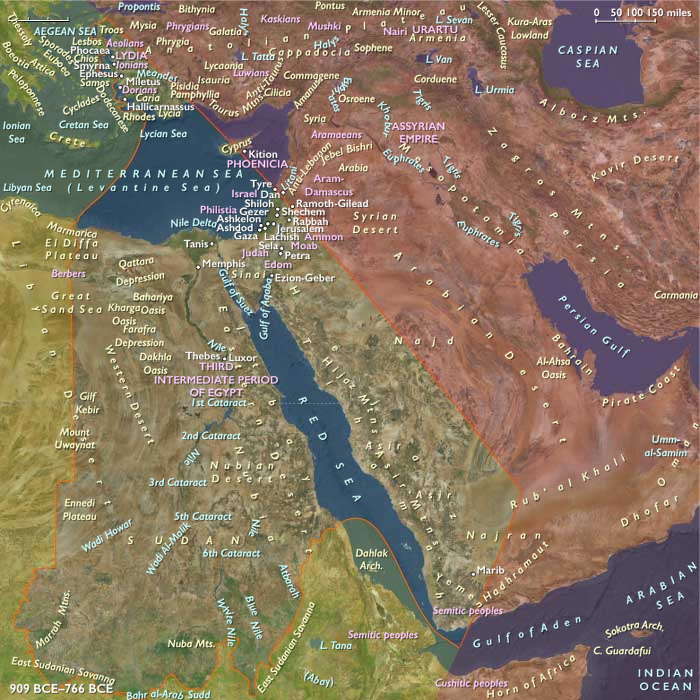
King Omri, after conquering Moab, forms an alliance with the Phoenician city of Tyre and moves the capital of Israel to Samaria.(Omri, whose name appears frequently in Assyrian inscriptions, is mentioned briefly and unfavorably in I Kings 16 Micah 6:16 but is thought by modern scholars to have been one of the most important rulers of the northern kingdom.)
Ahab, who succeeds Omri as king of Israel, concludes an alliance with King Asa of Judah, ending the nearly half-century of warfare between the two nations.
Omri has reestablished Israel's economic and military significance among the Syrian and Palestinian minor kingdoms, so much so that years after his death the Assyrians will refer to the northern kingdom as “the land of Omri” He leaves to his son Ahab an empire that comprises not only territory east of the Jordan River, in Gilead and probably Bashan, but also the land of Moab, whose king is tributary.
The southern kingdom of Judah, if not actually subject to Omri, is certainly a subordinate ally.
Ahab's marriage to Jezebel, daughter of Ethbaal of Sidon, reported in the Bible, forges an alliance with the Phoenicians.
According to the Hebrew scriptures, King Ahab leads Israel in incessant warfare with neighboring Aram (Syria) and undertakes large-scale construction projects in the cities of Israel, …
Locations
People
Groups
- Phoenicians
- Tyre, Kingdom of (Phoenicia)
- Moabites, Kingdom of the
- Hebrews
- Aram-Damascus (Syria), Kingdom of
- Judah, Kingdom of
- Israel (Northern Kingdom of)
- Assyria, (New) Kingdom of (Neo-Assyrian Empire)
Topics
Commodoties
Subjects
Regions
Subregions
Years: 873BCE - 862BCE
Locations
People
Groups
- Phoenicians
- Tyre, Kingdom of (Phoenicia)
- Moabites, Kingdom of the
- Hebrews
- Aram-Damascus (Syria), Kingdom of
- Judah, Kingdom of
- Israel (Northern Kingdom of)
- Assyria, (New) Kingdom of (Neo-Assyrian Empire)
Topics
Commodoties
Subjects
Regions
Subregions