King Olaf III Guthfrithson of the Norse …
Years: 941 - 941
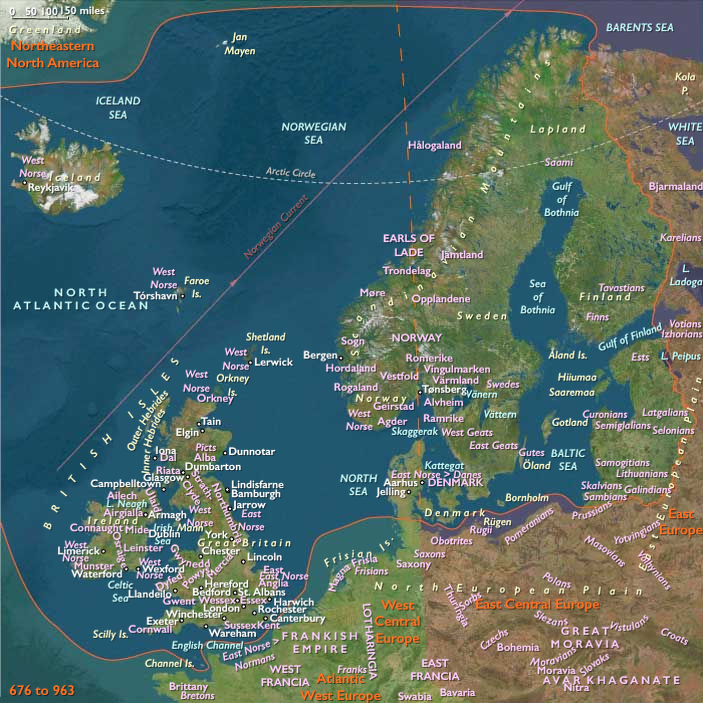
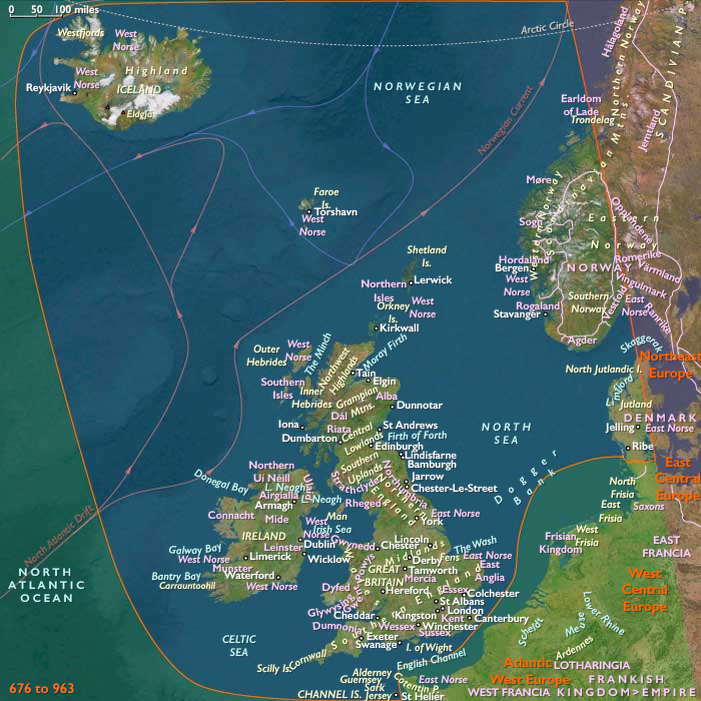
King Olaf III Guthfrithson of the Norse Kingdom of York dies in 941, shortly after sacking the church of Saint Baldred at Tyninghame, struck dead by the saint's power according to the Historia de Sancto Cuthberto.
The career of Amlaíb Cuarán, or Olaf of York, begins in 941, following the death of his cousin Amlaíb mac Gofrith (Olaf Guthefrithsson), when he becomes co-ruler of York, sharing power with his cousin Ragnall son of Gofraid.
Amlaíb mac Gofrith according to the Annals of Clonmacnoise had been in Britain since 940, having left another son of Gofraid, Blácaire, as ruler of Dublin.
Locations
People
Groups
- Christianity, Chalcedonian
- Vikings
- Norse
- Dublin, Kingdom of
- York, Scandinavian (Norse)
- England, (Anglo-Saxon) Kingdom of
Topics
Commodoties
Subjects
Regions
Subregions
Related Events
Filter results
Showing 10 events out of 53029 total
The Rus' and their Pecheneg allies, both still nominally allies of Constantinople, disembark on the northern coast of Asia Minor and swarm over Bithynia in May 941.
As usual, they seem to have been well informed that the Imperial capital stands defenseless and vulnerable to attack: the imperial fleet had been engaged against the Arabs in the Mediterranean, while the bulk of the Imperial army had been stationed along the eastern borders.
Co-emperor Romanos I Lekapenos arranges a defense of Constantinople by having fifteen retired ships fitted out with throwers of Greek fire fore and aft.
Igor, wishing to capture these Greek vessels and their crews but unaware of the fire-throwers, has his fleet surround them.
Then, in an instant, the Greek-fire is hurled through tubes upon the Rus' and their allies: Liudprand of Cremona wrote: "The Rus', seeing the flames, jumped overboard, preferring water to fire.
Some sank, weighed down by the weight of their breastplates and helmets; others caught fire."
The captured Rus' are beheaded.
The imperial forces thus manage to dispel the Rus' fleet but not to prevent the pagans from pillaging the hinterland of Constantinople, venturing as far south as Nicomedia.
Many atrocities are reported: the Rus' are said to have crucified their victims and to have driven nails into their heads.
John Kourkouas and Bardas Phokas, two leading generals, speedily return to the capital in September, anxious to repel the invaders.
The Kievans promptly transferred their operations to Thrace, moving their fleet there.
When they are about to retreat, laden with trophies, the imperial navy under Theophanes falls upon them.
Greek sources report that the Rus' lost their whole fleet in this surprise attack, so that only a handful of vessels returned to their bases in the Crimea.
The captured prisoners are taken to the capital and beheaded.
Khazar sources add that the Rus' leader managed to escape to the Caspian Sea, where he met his death fighting the Arabs.
These reports might have been exaggerated, because Igor will be able to mount a new naval campaign against Constantinople as early as 944/945.
Bajkam, before returning to Wasit, where he now holds his court, goes out on a hunting party, and meets his death at the hands of a band of marauding Kurds.
The capital again becomes the scene of renewed anarchy.
Ibn Ra'iq, Caliph's amir al-umara, persuades the Caliph to flee with him to Mosul.
Bajkam had remained amir al-umara until his death in 941, whereupon Ibn Ra'iq had seized the opportunity to recover his position: he had sidelined Bajkam's successor Kurankij and secured his own reappointment as amir al-umara in September 941.
He does not long enjoy it, however, as in early 942 he is assassinated at the orders of the Hamdanid prince Nasir al-Dawla, who, with the assistance of his brother Ali (known as Sayf al-Dawla), soon succeeds him as amir al-umara.
Merkava initiates (tzenu'im) in Babylonian Jewish mysticism, limited to a select few with specific moral qualities, are required to prepare themselves by fasting.
A successful visionary journey depends, in part, on the use of certain magical formulas (called seals) that are used to placate the angelic gatekeeper of each heavenly dwelling.
The use of an incorrect seal could result in severe injury or a fiery death.
The Talmud warns that among four men who engaged in Merkava, one died, one went mad, one apostatized, and only Rabbi Akiva ben Joseph had a true visionary experience.
Those who practice Merkava are sometimes called Explorers of the Supernatural World (Yorde Merkava).
The oldest literary sources of the movement are two hekhalot texts: the “Lesser” attributed to Rabbi Akiva, the “Greater” to Rabbi Ishmael ben Elisha.
The Book of Enoch and the Shi 'ur qoma (”Divine Dimensions”) belong to this same tradition.
The latter contains highly exaggerated anthropomorphic descriptions of God.
Known as a religious philosopher, Bible exegete, apologist, and liturgical poet, Saadia Gaon serves as head (Gaon) of the Talmudic academy of Sura, in Babylonia, and spiritual head of Babylonian Jewry.
Saadia has been party to a protracted dispute with Babylonia’s Karaite rulers over their opposition to Judaic tradition.
Among Saadia’s important translations of the Bible from the Hebrew into Arabic and his Arabic commentary on the Scriptures is his well-known Emunot ve-Deot (“Book of Beliefs and Opinions”).
In this, he expounds a system of Jewish faith, colored by Muslim rational theology (Kalam) and Aristotelianism, which harmoniously blends revelation and reason.
The first to compose a Hebrew grammar and an Order of Prayer, Saadia also writes religious poetry and a commentary on the mystical Book of Creation.
Saadia compiles his siddur (Jewish prayer book) in 940.
The office of the Exilarch, for seven centuries the seat of the temporal leader of Babylonian Jewry, seems to have been abolished in 942; dissension with the 'Abbasid rulers of the Islamic world is the precipitating factor in its demise.
'Ukba is mentioned as exilarch immediately following Hasdai II; he had been deposed at the instigation of Kohen Zedek, gaon of Pumbedita, but had been reinstated in 918 due to some Arabic verses with which he had greeted the caliph Al-Muktadir.
Deposed again soon afterward, he had fled to Kairouan, where he was treated with great honor.
After a short interregnum, 'Ukba's nephew, David ben Zakkai, became exilarch; but he had had to contend for nearly two years with Kohen Zedek before he was finally confirmed in his power (921).
In consequence of Saadia's call to the gaonate of Sura and his controversy with David, the latter had become one of the best-known personages of Jewish history.
Saadia had had David's brother Josiah (Al-Hasan) elected anti-exilarch in 930, but the latter had been defeated and banished to Khorasan.
David ben Zakkai, the last exilarch to play an important part in history, died a few years before Saadia; his son Judah died seven months afterward.
Judah had left a son (whose name is not mentioned) twelve years of age, whom Saadia had taken into his house and educated.
His generous treatment of the grandson of his former adversary is continued until Saadia's death in 942, at which the role of the Jewish Academy in Babylonia begins to decline.

Abbasid commander ibn-Ra'iq wins control of Syria by defeating its Hamdanid rulers and repulsing an invasion by the Ikhshidites of Egypt.
The Cholas, despite many skirmishes with the Pallavas and the eastern Chalukyas, have from 926 to 942 gained influence (but incompletely control) the entire southern tip of the Indian subcontinent.
Under their king Parantaka I, the Cholas have begun to annex former Pallavan lands adjacent to their kingdom and coveted by Rashrakuta, ruled by Krishna III.
The Cholans had taken Nellore from the Rashrakutans in 940.
Hugh of Italy has maintained friendly relations with Constantinople and, in 942, Hugh even comes to terms with Alberic, who marries one of Hugh's daughters.
The Attempted Pagan Revival in Normandy (c. 942): Clash Between New and Old Norse Settlers
By 942, a group of newly arrived Danish settlers in Normandy attempt to revive pagan practices, challenging the region’s gradual Christianization. However, this effort is largely unsuccessful, as most of the earlier Norse settlers—who arrived under Rollo in 911—have already converted to Christianity and integrated into Frankish feudal society.
Context: Christianization of Normandy
- The Treaty of Saint-Clair-sur-Epte (911) had established Rollo and his followers as vassals of the Frankish king, leading to their progressive adoption of Christianity.
- By the 930s–940s, many Norman noble families had converted, intermarried with the local Frankish elite, and adopted French language and customs.
- Normandy had become more culturally Frankish, though Viking influences persisted in law, military organization, and seafaring traditions.
The Danish Pagan Revival Attempt (942)
- New waves of Norse settlers, particularly Danes arriving around 942, attempt to reintroduce pagan traditions in Normandy.
- These settlers are likely unassimilated Viking warriors and traders, still following Odinic rituals and Norse customs.
- The majority of Norman elites, already Christianized, reject the attempt, seeing themselves as part of the Frankish Christian world rather than a pagan Scandinavian outpost.
Outcome: Christianity Prevails in Normandy
-
The Christianized Norman Nobility Reject Paganism
- The descendants of Rollo and earlier Norse settlers had already become feudal lords aligned with Frankish Christian traditions.
- These powerful figures oppose the pagan revival, ensuring that Christianity remains dominant in Normandy.
-
Assimilation of Later Viking Arrivals
- The newly arrived Danes gradually assimilate rather than resist the prevailing Christian culture.
- Many likely adopt Christianity over time, as conversion becomes necessary for land ownership, alliances, and political stability.
-
Normandy Continues to Strengthen as a Feudal Christian State
- By the mid-10th century, Normandy is fully integrated into West Francia’s feudal system, making it one of the most stable and powerful regions in the kingdom.
- This consolidation sets the stage for Norman expansion, culminating in the Norman Conquest of England in 1066.
Conclusion: The Final End of Norse Paganism in Normandy
The failed pagan revival in 942 marks one of the last significant attempts to resist Christianization in Normandy. With the Christianized Norman elite firmly in power, the region continues its transformation into a major feudal Christian state, ensuring that pagan Norse traditions fade into history.
The Death of William Longsword and the Struggle Between Normandy and Flanders (939–942)
William Longsword, the son and successor of Rollo, Duke of Normandy, spent much of his rule expanding and consolidating his duchy. However, his conflicts with Arnulf I, Count of Flanders, and Louis IV, King of West Francia, led to a period of warfare and shifting alliances, culminating in his assassination in 942.
The Conflict Between Normandy and Flanders (939–940)
-
William’s Attack on Flanders (939)
- In 939, William Longsword launches an offensive against Flanders, provoking the wrath of Arnulf I, Count of Flanders.
- In response, Arnulf and King Louis IV retaliate, leading to a West Frankish campaign against Normandy.
-
Arnulf Captures Montreuil-sur-Mer
- As part of this retaliation, Arnulf captures the castle of Montreuil-sur-Mer, expelling its ruler, Herluin, Count of Ponthieu.
-
William and Herluin Retake Montreuil
- William joins forces with Herluin, and together they recapture the fortress, restoring Herluin’s rule over Ponthieu.
- This action further escalates tensions between Normandy and Flanders.
William’s Excommunication and Pledge of Loyalty (940)
- Due to his aggressive military campaigns, including the destruction of Arnulf’s estates, William is excommunicated by the Church.
- In 940, he meets King Louis IV of West Francia to seek reconciliation.
- In exchange for pledging loyalty to the king, William is confirmed in the lands granted to his father, Rollo, ensuring the continued legitimacy of Norman rule.
- This marks a temporary peace, allowing William to consolidate Norman control over the lower Seine region.
The Assassination of William Longsword (942)
- Almost three years later, on December 17, 942, William meets with Arnulf I of Flanders at a peace conference intended to settle their disputes.
- Instead of achieving reconciliation, William is ambushed and killed by Arnulf’s supporters, likely with Arnulf’s direct involvement.
- His murder is a major turning point in Norman history, as it leaves Normandy without a strong ruler, leading to a period of instability.
Consequences of William Longsword’s Death
-
Normandy is Weakened
- William’s death creates a power vacuum, leading to a struggle over Norman succession.
- His young son, Richard I, is left vulnerable to noble factions and external threats.
-
Arnulf Strengthens His Position
- The Count of Flanders eliminates a key rival, ensuring that Normandy is temporarily destabilized.
- However, the Normans will eventually regroup under Richard I and seek revenge for William’s murder.
-
Continued Turmoil in West Francia
- The assassination of William underscores the brutal and unstable nature of feudal politics in the 10th century.
- Normandy, Flanders, and West Francia remain embroiled in conflicts over land, loyalty, and power.
Conclusion: The Murder of William Longsword and the Shifting Balance of Power
The assassination of William Longsword in 942 at the hands of Arnulf of Flanders’ supporters marks a significant turning point in Norman history. Though William had expanded and solidified Norman control, his death throws the duchy into crisis, setting the stage for his son Richard I’s struggle to reclaim power. Meanwhile, Arnulf’s treacherous act further fuels the feudal rivalries that define 10th-century France.
Edmund had come to the throne in 939 as the son of Edward the Elder, grandson of Alfred the Great, great-grandson of Ethelwulf of Wessex, great-great grandson of Egbert of Wessex and great-great-great grandson of Ealhmund of Kent.
Shortly after his proclamation as king, he had had to face several military threats.
King Olaf III Guthfrithson had conquered Northumbria and invaded the Midlands; after Olaf’s death in 941, Edmund reconquers the Five Boroughs in 942, an event celebrated in verse by the Anglo-Saxon Chronicle.
The Chronicle reports the baptism of Amlaíb, with King Edmund becoming his godfather.
This need not mean that Amlaíb was not already a Christian, nor would such a baptism have permanently committed him to Christianity, as such baptisms are often political acts.
Years: 941 - 941
Locations
People
Groups
- Christianity, Chalcedonian
- Vikings
- Norse
- Dublin, Kingdom of
- York, Scandinavian (Norse)
- England, (Anglo-Saxon) Kingdom of