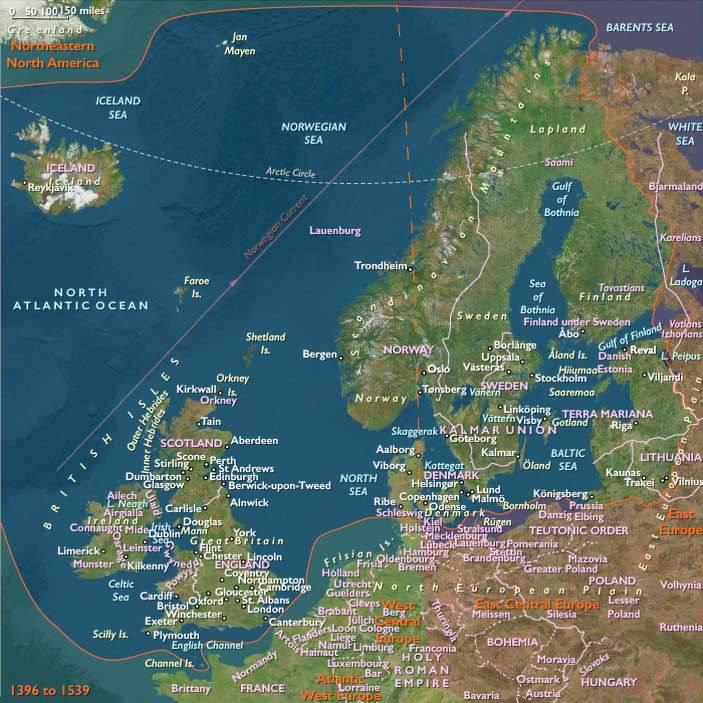
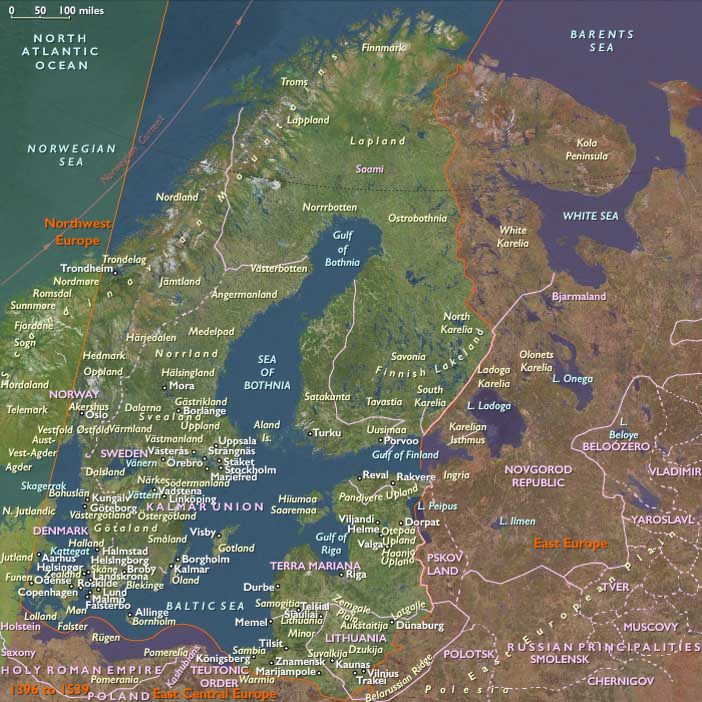
…King of Norway in Trondheim on July …
Years: 1483 - 1483
…King of Norway in Trondheim on July 20.
Locations
People
Groups
Subjects
Regions
Subregions
Related Events
Filter results
Showing 10 events out of 40535 total
Printed works appear in Sweden in 1483.
A meeting between the Councils of Denmark, Sweden and Norway had been scheduled for January 13, 1483 at Halmstad, to work out the terms for electing John as king—his håndfæstning.
The Swedish Council fails to turn up at the meeting, but the Norwegian and Danish councils proceed to produce a joint declaration containing the terms for John's rule, and electing him king.
It is hoped that Sweden will later accept the same document and thereby acknowledge John as king.
John is subsequently crowned King of Denmark in Copenhagen on May 18, and …
Clashes between Poles and Turks have increased in Moldavia during the reign of King Casimir IV of Poland (1427-92).
Because the Ottoman advances conflict with the ambitions of Poland, war ensues.
Under the new reign of Mehemed II, an immediate reaction has set in against some of his policies.
Influenced by the 'ulama', interpreters of the law of Islam, and by the great officials aligned with them, Bayezid restores the Muslim properties dedicated to religious and charitable purposes that Mehmed had taken over for the state.
Bayezid also rejects Mehmed's marked pro-European orientation by such acts as removing from the imperial palace the paintings that Italian artists had executed for his father, such as Gentile Bellini's later-famous “Portrait of Mohammad II” (circa 1480), a masterful characterization of the shrewd, cultivated ruler.
At the same time, Bayezid continues the territorial consolidation that his father had begun.
Alesso Baldovinetti is appointed curator and restorer of the Florence Baptistery mosaics at fifty-eight in 1483.
Verrocchio in this year completes eighteen years of work on his major public sculpture in Florence, the “Doubting of Thomas,” a life-size group cast in bronze.
Placed in a niche at Or San Michele, the work displays the mastery and sensitivity of Desiderio at his best.
Luigi Pulci polishes and exploits the Carolingian epic of “Roland” in his Italian romantic epic Morgante, sometimes also called Morgante Maggiore (i.e., the "Greater Morgante", the name given to the complete twenty-eight canto edition published in 1483; a now lost twenty-three canto version had likely appeared in late 1478; two other twenty-three canto versions had been published in 1481 and 1482.)
Based on popular Matter of France material, the poem tells the story of Orlando and Renaud de Montauban (in Italian, Renaldo or Rinaldo), the most famous of Charlemagne's paladins, in a frequently burlesque fashion.
The title character is a giant who becomes Orlando's loyal follower after the knight stops him from attacking the monastery of Chiaromonte and converts him to Christianity.
After many strange adventures, Morgante is killed by a bite from a crab.
Other characters include Morgante's friend, the gluttonous Margutte who dies in a fit of laughter, and the philosophically inclined demon Astarotte.
The poem ends with an account of Orlando's defeat and death at the Battle of Roncesvalles.
The last five cantos of Pulci's work are based on La Spagna, a fourteenth-century Italian epic attributed to the Florentine Sostegno di Zanobi.

The pope’s entreaties with Venice to cease hostilities are vigorously rebuffed, with threats of excommunication countered by the withdrawal of the Venetian ambassador, followed by Sixtus' interdict of Venice in May 1483.
Now Sixtus grants free passage to Alfonso and his troops to go to defend Ferrara against the pope's recent allies, aided by papal troops under Virginio Orsini.
A contingent of Florentine troops arrives also, and the fortunes of Este begin to look much better.
Venice, in a diversionary maneuver, sends Roberto Sanseverino to attack the Duchy of Milan under the pretext of supporting the rights of the Visconti heir, but the diversion is further diverted when Robert has to counter Alfonso, who is sacking Milanese territories.
The war begins to lose momentum.
Pope Sixtus IV, at the insistence of Ferdinand II of Aragon and Isabella I of Castile, who see the eradication of non-Christian faiths in Spain as a holy mission, in 1483 endorses the creation of an independent Spanish Inquisition presided over by a high council and grand inquisitor in the person of Tomas de Torquemada, now sixty-three.
The war continues into 1483.
Abu Hasan's brother, al-Zagal, defeats a large Christian raiding force in the hills of the Axarquia east of Málaga.
Muhammad XII lays siege to the Spanish Christian town of Lucena in April 1483, but, seized by the Christians while in flight and negotiating to secure his release, he acknowledges the sovereignty of Ferdinand II of Aragon over the kingdom of Granada; Muhammad’s father Abdu l-Hasan Ali rejects it, however.
Ferdinand II and Isabella I had previously not been intent on conquering all of Granada.
With the capture of King Boabdil, however, Ferdinand decides to use him to conquer Granada entirely.
Ferdinand in a letter of August 1483 writes, "To put Granada in division and destroy it We have decided to free him....
He [Boabdil] has to make war on his father."
With the release of Boabdil's, now a pseudo-Christian ally, the Granadan civil war will continue.
The Spanish Christians continue to invest Granada on land from mid-1483 while a Spanish fleet blockades Granada’s North African supply lines.