
John needs money for armies, but the …
Years: 1215 - 1215
May
John needs money for armies, but the loss of the French territories, especially Normandy, has greatly reduced the state income, and a huge tax would need to be raised to reclaim these territories.
Yet, it is difficult to raise taxes because of the tradition of keeping them unchanged.
John relies on clever manipulation of preexisting rights, including those of forest law, which regulate the king's hunting preserves, which are easily violated and severely punished.
John has also increased the preexisting scutage (feudal payment to an overlord replacing direct military service) eleven times in his seventeen years as king, as compared to eleven times during the reign of the preceding three monarchs.
The last two of these increases have been double the increase of their predecessors.
He has also imposed the first income tax, raising the (then) extortionate sum of seveny thousand pounds.
John’s failed expedition to Poitou in 1214, coupled with the defeat of his ally, Holy Roman Emperor Otto IV, in the Battle of Bouvines, provides the restive English barons with their excuse for rebellion.
Their act stems from a royal demand for overseas service that they feel is not owed, from the king’s policies of ensuring their personal loyalties by intimidation, and from the domestic policies—especially increased financial exactions—not only of the king himself but also of his immediate Angevin predecessors.
The baronial opposition initially swears, in the church of Bury St. Edmunds, to force the king to restore its powers under the Norman kings.
Realistic considerations lead, however, to an insistence on pragmatic reforms aimed at controlling, rather than nullifying, the innovations introduced by Henry II, Richard, and John.
The barons request of Scotland’s new monarch, Alexander II, that he invade England against their king, pledging their support, but Alexander demurs.
The barons draw up a document later called Magna Carta (“Great Charter” of King John)—some of it framed by Stephen Langton, archbishop of Canterbury—setting forth the law on several points and targeted at the reform of specified abuses.
Many of the charter’s sixty-three clauses deal with feudal privileges of benefit only to the barons, who acquiesce in the growth of royal jurisdiction since 1154, but seek, under certain clauses, to control the direction of legal reforms.
The Magna Carta, in specifying ecclesiastical concessions, states that the church is to be free.
Following these concessions, Magna Carta specifies liberties for all free men so that all might be defended from royal whim, and stipulates that certain taxes may not to be levied without the common consent of the kingdom, whose representatives' decisions are binding on all.
The Magna Carta, which places the king under the rule of law, is the first legal document to enunciate, if vaguely, due process of law: "No free man shall be arrested or imprisoned...except by the lawful judgment of his peers or by the law of the land."
Locations
People
Groups
- Alba (Scotland), Scots Kingdom of
- Christians, Roman Catholic
- England, (Plantagenet, Angevin) Kingdom of
Topics
Commodoties
Subjects
Regions
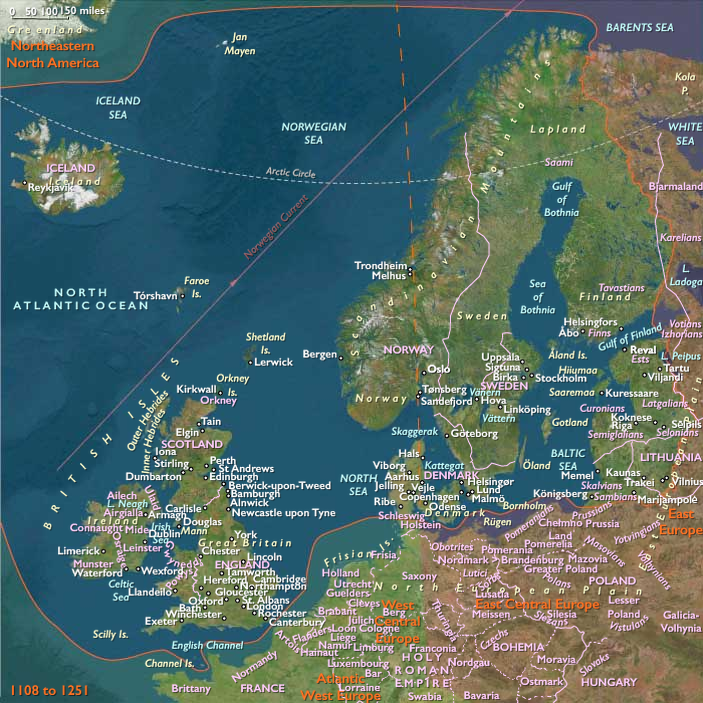
Subregions
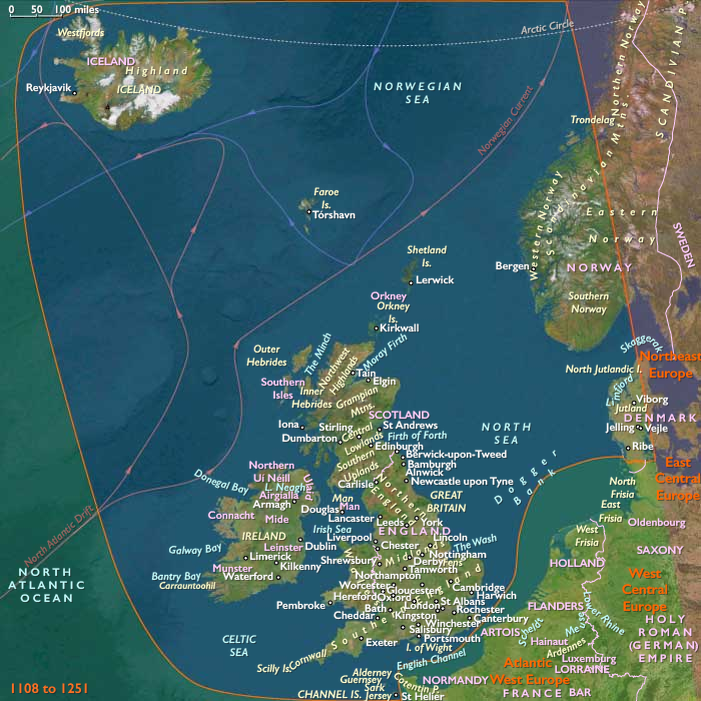
Years: 1215 - 1215
May
Locations
People
Groups
- Alba (Scotland), Scots Kingdom of
- Christians, Roman Catholic
- England, (Plantagenet, Angevin) Kingdom of
Topics
Commodoties
Subjects
Regions
Subregions