King James of Aragon, following a turbulent …
Years: 1229 - 1229
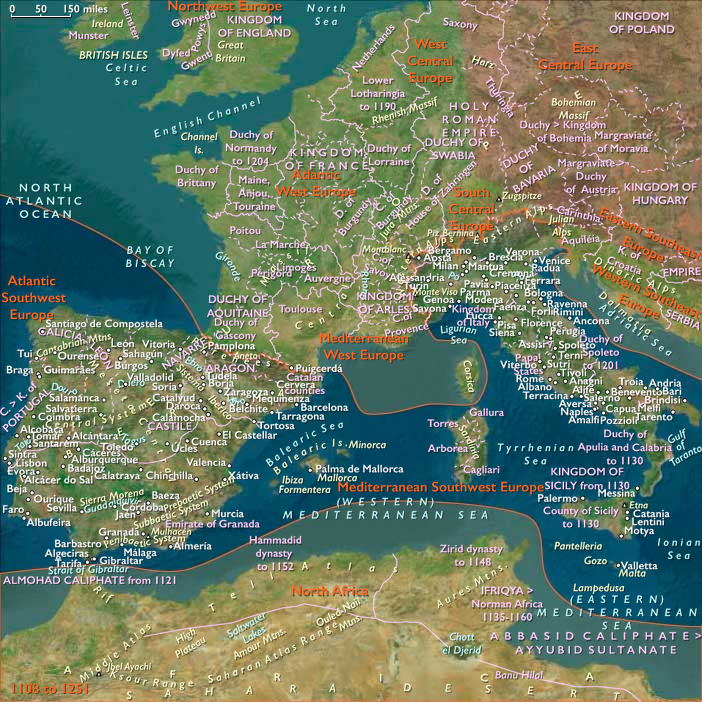
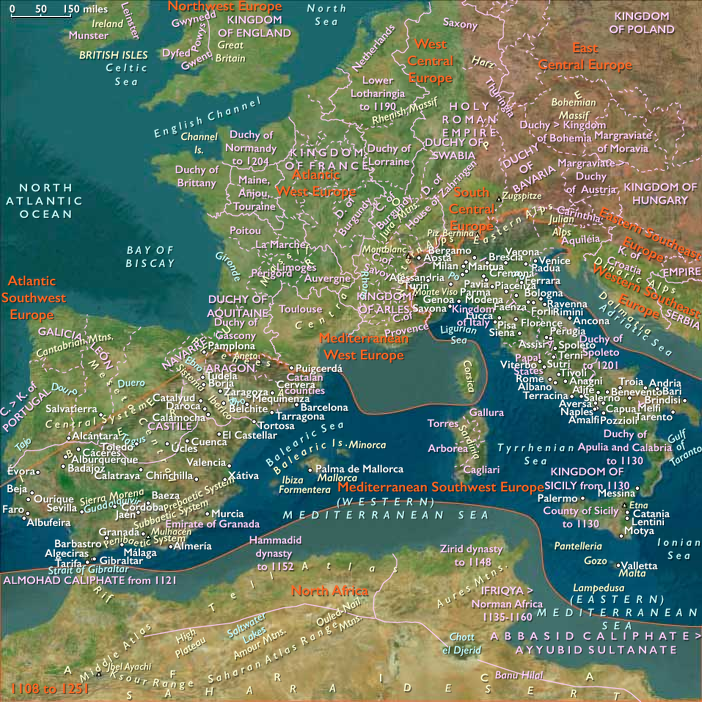
King James of Aragon, following a turbulent minority, undertakes the conquest of the Muslim kingdom of Majorca in 1229.
This act is the first stage in the aggressive extension of Aragonese power into the western Mediterranean.
Locations
People
Groups
Topics
Commodoties
Subjects
Regions
Subregions
Related Events
Filter results
Showing 10 events out of 47050 total
Batu is a grandson of Genghis Khan and the son of Mongol leader Jochi.
After Jochi's death in early 1227, Genghis Khan had assigned Jochi's appanages to his sons, but the Great Khan had installed Batu as Khan of the Ulus of Jochi.
Jochi's eldest son, Orda Khan, had also agreed that Batu should succeed their father.
Genghis Khan's youngest brother Temüge attended the coronation ceremony as an official representative of Genghis.
When Genghis Khan died in August 1227, he left four thousand Mongol men to Jochi's family.
Jochi's lands were divided between Batu and his older brother Orda.
Orda's White Horde ruled the lands roughly between the Volga river and Lake Balkhash, while Batu's Horde ruled all the Mongol-claimed territories west of the Volga River and has been given responsibility for the invasion of Europe.
According to Abulghazi, Batu had joined Ögedei's military campaign against the Jin Dynasty in North China while his younger brother was fighting the Bashkirs, the Cumans, the Bulgars and the Alans in the west.
Despite heavy resistance of their enemies, the Mongols had conquered the major cities of the Jurchens and made the Bashkirs their ally.
Ögedei dispatches three tumens under Kukhdei and Sundei in 1229 to conquer the tribes on the lower Ural River.
The despots of Epirus and Thessaly, who had saved much of northern Greece from Western conquest after 1204, are direct descendants of Constantine Angelos and Theodora, daughter of Emperor Alexios I Komnenos.
Theodore Komnenos Doukas, who had earlier seized Thessalonica and been crowned emperor there, marches on Constantinople, but his rivals, the Nicaean emperor and the Bulgarian tsar, attack him from the east and north.
The French queen mother, Blanche of Castile, successfully overcomes the princely opposition and in 1229 concludes a treaty with the count of Toulouse that affords the crown a foothold on the Mediterranean and officially ends the brutal crusade against the Albigenses.
The formation of the University of Toulouse is imposed on Count Raymond VII as a part of the Treaty.
As he is suspected of sympathizing with the heretics, Raymond VII has to finance the teaching of theology.
The murderously anti-Cathar Bishop Foulques de Toulouse is among the founders of the University.
The Construction of Notre-Dame de Dijon Begins (1229): A Burgundian Gothic Masterpiece
In 1229, construction began on Notre-Dame de Dijon, one of the finest examples of Burgundian Gothic architecture. The church, located in Dijon, the historic capital of the Duchy of Burgundy, would later become renowned for its elaborately carved exterior, showcasing intricate stonework and sculptural decoration characteristic of the region’s distinct Gothic style.
Architectural Features and Gothic Innovations
-
Notre-Dame de Dijon follows the Burgundian Gothic style, which blends elements of French Gothic with regional influences.
-
The church is notable for its façade, featuring:
- Rows of ornamental arcades, creating a visually striking, layered effect.
- Gargoyles and grotesques, sculpted in exquisite detail, adding both decorative and functional (water drainage) elements.
- A harmonious blend of verticality and ornamentation, in keeping with High Gothic aesthetics.
-
The interior was designed to be spacious yet elegant, with:
- A large nave and pointed arches, emphasizing height and luminosity.
- Ribbed vaults, characteristic of Gothic structural advances.
Significance of Notre-Dame de Dijon
- It became a symbol of Dijon’s religious and cultural heritage, reflecting the wealth and artistic patronage of medieval Burgundy.
- The church’s unique façade and sculptural details distinguish it from other Gothic churches, making it a rare architectural gem.
- Notre-Dame de Dijon remains one of the best-preserved Burgundian Gothic churches, drawing visitors for its historical significance and artistic beauty.
The construction of Notre-Dame de Dijon in 1229 exemplified Burgundy’s contribution to Gothic architecture, creating a distinctive and artistically rich religious structure that continues to be admired today.
The Treaty of Paris (Treaty of Meaux, 1229): The End of the Albigensian Crusade and the Integration of Occitania into the French Crown
The Treaty of Paris, also known as the Treaty of Meaux, was signed in 1229, bringing an official end to the Albigensian Crusade (1209–1229) and resulting in the integration of Occitania into the French Crown. This treaty marked the final submission of the southern lords and the Capetian consolidation of power over Languedoc, effectively ending Occitan political independence.
Background: The Albigensian Crusade and the Fall of Occitania
- The Albigensian Crusade, launched in 1209, was originally intended to suppress the Cathar heresy in southern France but quickly evolved into a broader war of conquest between the northern French lords and the Occitan nobility.
- By 1226, King Louis VIII had launched a renewed campaign, capturing Avignon and other key southern cities before his death that same year.
- His son, Louis IX (Saint Louis), inherited the war effort under the regency of Blanche of Castile, who sought a political resolution to consolidate Capetian control.
Terms of the Treaty of Paris (1229)
The treaty forced Raymond VII, Count of Toulouse, the last major independent lord of Occitania, to:
-
Formally Submit to the French Crown
- Raymond VII recognized King Louis IX as his feudal overlord, ending the region’s traditional autonomy.
-
Cede Territory to the Capetians
- Major portions of Languedoc were directly annexed to the French royal domain.
- Toulouse was allowed to remain under Raymond’s rule, but it was placed under heavy royal oversight.
-
Marry His Daughter to a French Prince
- Raymond VII’s daughter, Joan of Toulouse, was forced to marry Alphonse of Poitiers, the brother of Louis IX, ensuring the county’s future absorption into the French crown.
-
Persecute Remaining Cathars
- The treaty mandated the continued suppression of Catharism, strengthening Inquisition efforts in the region.
Impact and Legacy
- Occitania’s Political Autonomy Was Ended
- The treaty marked the final integration of Languedoc into the French kingdom, effectively eliminating Occitan independence.
- The Capetians Solidified Their Control Over Southern France
- With Toulouse and other strongholds under royal influence, the French monarchy extended its direct authority further south than ever before.
- The Inquisition Was Intensified
- The treaty gave official backing to the Inquisition, leading to decades of persecution against the remaining Cathars.
The Treaty of Paris (Meaux) in 1229 was a turning point in French history, marking the end of the medieval Occitan identity as an independent political force and the rise of a more centralized Capetian monarchy in France.
The treaty of 1229 concluded between the Ayyubid Sultanate and the Holy Roman Empire is unique in the history of the Crusades, and certainly a result of the impact of Frederick's personality on the Arab world, and not armed might.
The Ayyubids, by diplomacy alone and without major military confrontation, cede Jerusalem, Bethlehem, and a corridor running to the sea to the Kingdom of Jerusalem.
Exception is made for the Temple area, the Dome of the Rock, and the Aqsa Mosque, which the Muslims retain.
Important pilgrimage sites, among them Jerusalem, Bethlehem, Lydda, and perhaps Nazareth, are restored to the Christians.
The peace is to last for ten years.
When Frederick, still under excommunication, enters the city, the Patriarch places it under interdict.
By way of response, the excommunicated emperor on March 18, 1229, crowns himself king of Jerusalem in the Church of the Holy Sepulchre.
As no priest is present, Frederick places a crown on his own head while one of the Teutonic Knights reads the ceremony.
Eschatological prophecies concerning his rule are now made, and the Emperor considers himself to be a messiah, a new David.
His entry into Jerusalem is compared with that of Christ on Palm Sunday (and, indeed, in a manifesto, the Emperor, too, compares himself to Christ).
The benefits of the treaty of 1229 are more apparent than real.
The areas ceded are not easily defensible, and Jerusalem soon becomes a prey to disorder.
Furthermore, the treaty is denounced by the devout of both faiths.
Papal troops have meanwhile penetrated into Frederick's Kingdom of Sicily.
Leaving agents in charge, Frederick hastily returns to Europe.
What follows in Jerusalem and Cyprus, however, is not orderly government by the Emperor's agents but civil war, for Frederick's imperial concept of government is totally opposed to the now well-established preeminence of the Jerusalem baronage.

Holy Roman Emperor Frederick II revives old imperial claims in northern Italy, with the result that the Lombard towns fight him constantly in a rebellion cultivated, in part, by the devious Gregory IX, who, after forcing the emperor to go on crusade to the Holy Land in 1228, has fomented rebellion in Frederick’s territories.
On Frederick’s return in 1229, he fights to regain Sicily, which the Papacy had taken control of in his absence, and finds himself excommunicated a second time.
John's forces, Frederick having departed in April from the island of Cyprus, defeat the remaining imperial bailiffs in a battle outside Nicosia on July 14, 1229, thus beginning the War of the Lombards.
The two groups of German "crusaders” that set forth, under papal approval, to Christianize the pagan Balts (very often by sending them to their deaths), have largely succeeded by 1230.
The Teutonic Knights now fully occupy the valley of the lower Vistula, courtesy of the Polish princes.
The Knights of the Sword occupy the valley of the lower Dvina River.