
The Portuguese Succession Crisis of 1580: The …
Years: 1580 - 1580
January
The Portuguese Succession Crisis of 1580: The End of the Aviz Dynasty
With the death of King Henry of Portugal on January 30, 1580, the House of Aviz, which had ruled Portugal for 200 years, became extinct in the legitimate male line. Henry had renounced his clerical vows in hopes of marrying and producing an heir, but Pope Gregory XIII, aligned with the Habsburgs, refused to release him, preventing the continuation of the Portuguese royal line.
Henry’s brief reign (1578–1580) had been largely focused on raising ransom payments for Portuguese captives in Morocco following the disastrous Battle of Alcácer Quibir (1578). His failure to appoint a Council of Regency to determine a successor plunged Portugal into a succession crisis, as multiple claimants vied for the throne.
The Claimants to the Portuguese Throne
-
Ranuccio Farnese (1569–1622) – The Closest Heir by Feudal Custom
- Closest genealogical heir, as the son of Maria of Portugal, the eldest daughter of Dom Duarte, Duke of Guimarães, who was the only son of Manuel I whose legitimate descendants survived.
- As Duke of Parma’s son, he was a foreigner, only eleven years old, and unlikely to win Portuguese support.
-
Catherine, Duchess of Braganza (1540–1614) – A Strong Domestic Candidate
- Second in line after her nephew Ranuccio, being the younger daughter of Dom Duarte.
- Married to John I, Duke of Braganza, a descendant of King Duarte I, reinforcing her dynastic legitimacy.
- Her son, Teodósio de Braganza, would inherit the crown, ensuring a Portuguese royal future.
- Advantages:
- Resided in Portugal, unlike Ranuccio.
- Was an adult, not a child.
- Supported by nobles who wished to keep Portugal independent.
- Disadvantages:
- Her gender, as Portugal had never had a generally recognized ruling queen.
- Was the younger daughter, meaning her claim was weaker than that of her nephew, Ranuccio.
-
Philip II of Spain (1527–1598) – The Habsburg Claimant
- Grandson of Manuel I through his mother, Isabella of Portugal, making him next in line after Ranuccio and Catherine.
- Strongest military power, with Spanish troops ready to enforce his claim.
- Advantages:
- Had overwhelming military and political strength.
- Backed by Pope Gregory XIII, the Jesuits, and pro-Spanish nobles.
- Disadvantages:
- Seen as a foreigner, which fueled Portuguese resistance to his rule.
- Only claimed through a female line, unlike António.
-
António, Prior of Crato (1531–1595) – The Nationalist Challenger
- Grandson of Manuel I in the male line, but illegitimate, as his father, Prince Louis, had not been officially married at the time of his birth.
- Appealed to national sentiment, presenting himself as a new John I of Portugal, invoking the 1383–1385 crisis, when an illegitimate Aviz prince took the throne.
- Supported by the lower classes, clergy, and those opposed to Spanish rule, but lacked noble backing.
The Political Struggle: Who Would Rule Portugal?
- Portugal’s nobility and clergy feared Spanish dominance, but many were reluctant to support a female ruler (Catherine) or an illegitimate one (António).
- Philip II, with Spanish military power, was the most formidable contender, despite being foreign-born.
- António of Crato attempted to rally nationalist support, but failed to secure noble backing.
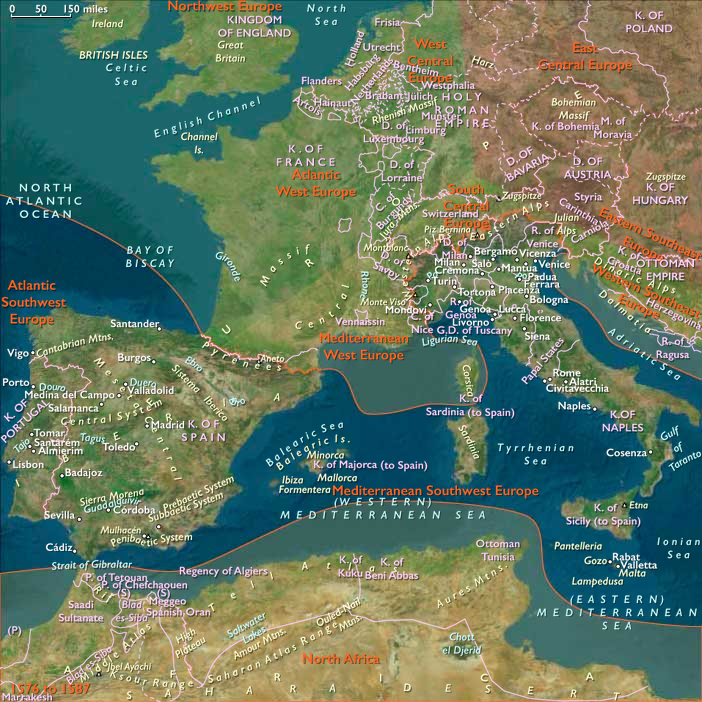
By June 1580, the succession crisis erupted into open conflict, leading to the Iberian Union under Philip II and sixty years of Spanish rule (1580–1640).
Conclusion: The Fall of the Aviz Dynasty and Portugal’s Fate
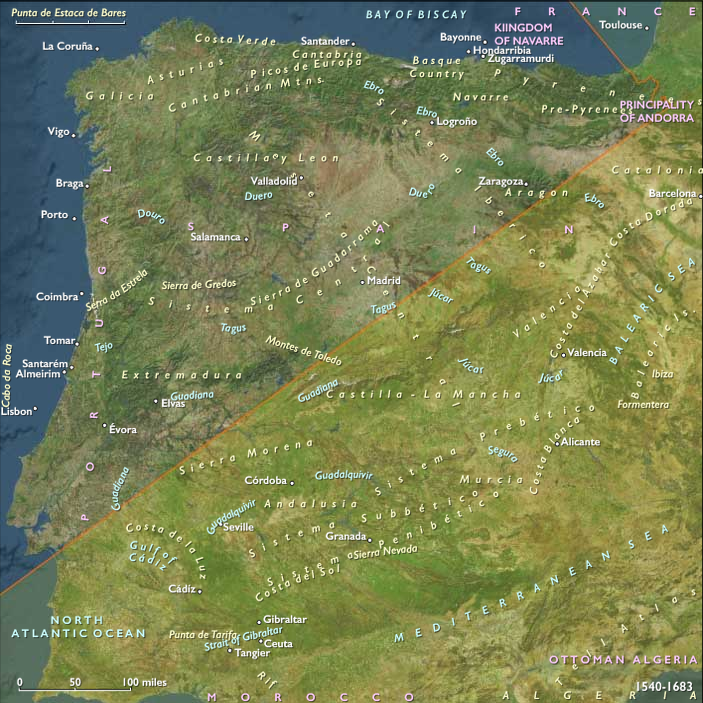
With no clear and universally accepted Portuguese heir, Philip II of Spain successfully claimed the throne, leading to the Iberian Union (1580–1640). Although Portugal remained administratively separate, it was effectively under Spanish control. However, the succession crisis and foreign rule fueled long-term resentment, setting the stage for Portugal’s eventual Restoration War (1640–1668) and its return to independence under the House of Braganza.
Locations
People
Groups
Topics
Commodoties
Subjects
Regions
Subregions
Related Events
Showing 10 events out of 18 total
Years: 1580 - 1580
January
Locations
People
Groups
Topics
Commodoties
Subjects
Regions
Subregions