
King Henry IV, forcibly prosecuting his policy …
Years: 1073 - 1073
June
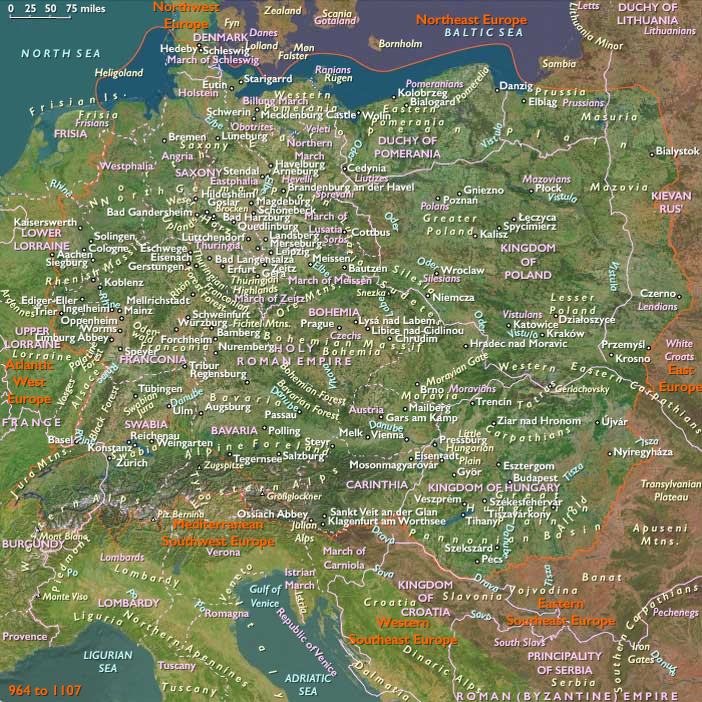
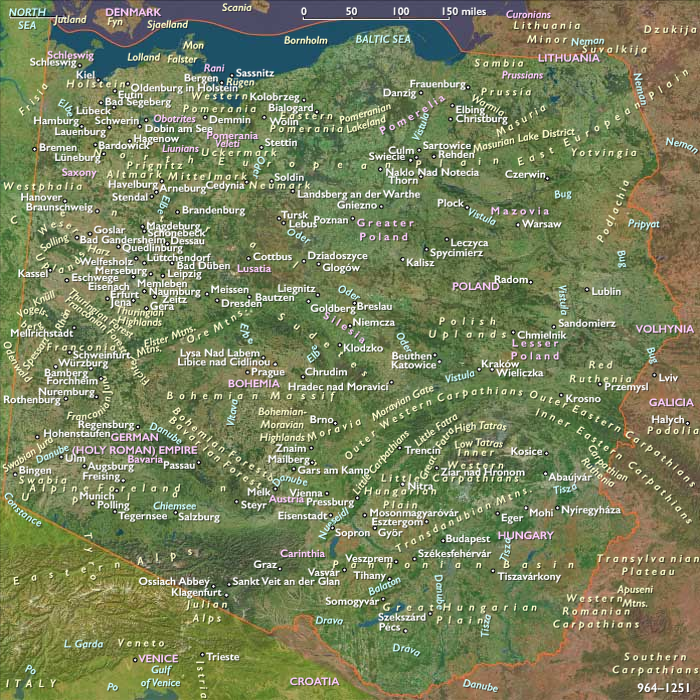
King Henry IV, forcibly prosecuting his policy of recovering imperial estates lost in north central Germany during his minority, exacerbates the normal tension between king and vassals.
Like his father, Emperor Henry III, Henry desires to set Goslar as the fixed capital of the German Kingdom.
Undercurrents of discord between the Salian royal family and the Saxons had already existed under Henry's father.
This may have been primarily due to his Rhenish Franconian origin as well as his numerous stays in the Imperial Palace of Goslar, which were associated with a disproportionately high economic burden on the surrounding population.
With the accession of Henry IV in 1065 this conflict has intensified, as Henry makes demands on numerous Imperial domains (Reichsgüter) in the center of the Saxon heartland around the Harz mountains—especially the silver mines of Rammelsberg.
To secure these estates, he has initiated a castle building program, erecting numerous fortresses along the range, the most prominent being the Harzburg.
This is perceived as a threat by the Saxons.
In addition, these castles are staffed with ministeriales of Swabian origin, who frequently plunder the Saxon population to make up for their lack of income.
Attempts to restore the rights over the Harz forests are not received well by the Saxon freedmen, and efforts to extend the crownlands in general as well as the increased demands laid upon the fisc are opposed.
The Saxon count Otto of Nordheim, Duke of Bavaria since 1061, had been accused in 1070 by the ministerialis Egeno I of Konradsburg of planning an assault on the king's life.
Otto had been deposed and banned, but had nevertheless gained support from the son of the Billung duke Ordulf of Saxony, the young Magnus.
King Henry IV had both captured and arrested.
While Otto has been pardoned, Magnus remains in custody at the Harzburg and is not released even after his father's death in 1072, as he shows no intention to renounce the Saxon ducal dignity.
This heightens tensions between the Imperial court and the Saxons; Magnus' subsequent release in exchange for seventy Swabians captured in Lüneburg does little to encourage a thaw in relations.
In anger, the king has rejected several Saxon petitions for redress.
According to the chronicler Lambert of Hersfeld, the Saxon princes had come to the Imperial Palace of Goslar on June 29, 1073 in order to point to these abuses and demand improvements.
Henry IV refuses to enter discussions and several bishops and princes organize a resistance.
Several castles are besieged, and Henry, along with the imperial insignia, flees from the large, advancing Saxon army to …
Locations
People
Groups
Topics
Commodoties
Subjects
Regions
Subregions
Years: 1073 - 1073
June
Locations
People
Groups
Topics
Commodoties
Subjects
Regions
Subregions