
Filters:
Saltykov plunders the city and prepares for …
Years: 1759 - 1759
August
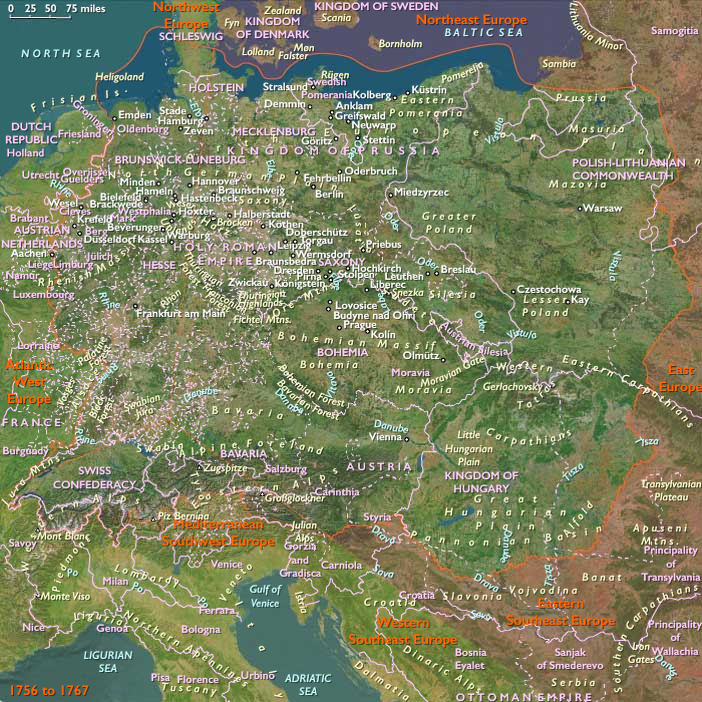
Saltykov plunders the city and prepares for Frederick's assault from the west, while the Prussians reach Reitwein, some twenty-eight kilometers (seventeen miles) north of Frankfurt on August 10, and build pontoon bridges during the night.
Frederick crosses the Oder in the night and the next morning, and moves southward toward Kunersdorf; the Prussians establish a staging area near Göritz (also spelled Gohritz on the old maps), about nine and a half kilometers (six miles) north-northeast of Kunersdorf late on August 11 with about fifty thousand men; of these, two thousand are deemed unfit for service and stay behind to guard the baggage.
Frederick conducts a perfunctory reconnaissance of his enemy's position, accompanied by a forest ranger and an officer who had previously been stationed in Frankfurt.
He also consults a peasant who, though garrulous, is uninformed about military needs: the peasant tells the King that a natural obstacle between the Red Grange (a large farmstead between Kunersdorf and Frankfurt's outer city) and Kunersdorf is impassable; what the peasant does not know is that the Russians have been there long enough to construct a causeway linking these two sections.
Looking to the east through his telescope, Frederick sees some wooded hills, called the Reppen Forest, and he believes he can use them to screen an advance, much like he had done at Leuthen.
He does not send scouts to reconnoiter the land or question locals about the ground in the forest.
Furthermore, through his glass he can see that the Russians are facing west and north, and their fortifications are stronger on the west.
He decides that all the Allies are facing northwest and that the forest is readily passable.
After his perfunctory reconnaissance, Frederick returns to his camp to develop his battle plan.
He plans to direct a diversionary force, commanded by Finck, to the Hühner Fliess, to demonstrate in front of what he believes to be the main Russian line.
He will march with his main army to the southeast of the Allied position, circling around Kunersdorf, screened by the Reppen Forest.
This way, he thinks, he will surprise his enemy, forcing the Allied army to reverse fronts, which is a complicated maneuver for even the best trained troops.
Frederick can then employ his much feared oblique battle order, feinting with his left flank as he does so.
Ideally, this will allow him to roll up the Allied line from the Mühlberg.
Frederick crosses the Oder in the night and the next morning, and moves southward toward Kunersdorf; the Prussians establish a staging area near Göritz (also spelled Gohritz on the old maps), about nine and a half kilometers (six miles) north-northeast of Kunersdorf late on August 11 with about fifty thousand men; of these, two thousand are deemed unfit for service and stay behind to guard the baggage.
Frederick conducts a perfunctory reconnaissance of his enemy's position, accompanied by a forest ranger and an officer who had previously been stationed in Frankfurt.
He also consults a peasant who, though garrulous, is uninformed about military needs: the peasant tells the King that a natural obstacle between the Red Grange (a large farmstead between Kunersdorf and Frankfurt's outer city) and Kunersdorf is impassable; what the peasant does not know is that the Russians have been there long enough to construct a causeway linking these two sections.
Looking to the east through his telescope, Frederick sees some wooded hills, called the Reppen Forest, and he believes he can use them to screen an advance, much like he had done at Leuthen.
He does not send scouts to reconnoiter the land or question locals about the ground in the forest.
Furthermore, through his glass he can see that the Russians are facing west and north, and their fortifications are stronger on the west.
He decides that all the Allies are facing northwest and that the forest is readily passable.
After his perfunctory reconnaissance, Frederick returns to his camp to develop his battle plan.
He plans to direct a diversionary force, commanded by Finck, to the Hühner Fliess, to demonstrate in front of what he believes to be the main Russian line.
He will march with his main army to the southeast of the Allied position, circling around Kunersdorf, screened by the Reppen Forest.
This way, he thinks, he will surprise his enemy, forcing the Allied army to reverse fronts, which is a complicated maneuver for even the best trained troops.
Frederick can then employ his much feared oblique battle order, feinting with his left flank as he does so.
Ideally, this will allow him to roll up the Allied line from the Mühlberg.
Locations
People
- Carl Heinrich von Wedel
- Count Leopold Joseph von Daun
- Ernst Gideon Laudon
- Frederick the Great
- Maria Theresa
- Prince Henry of Prussia (1726–1802)
- Pyotr Saltykov
Groups
Topics
Subjects
Regions
Subregions
Years: 1759 - 1759
August
Locations
People
- Carl Heinrich von Wedel
- Count Leopold Joseph von Daun
- Ernst Gideon Laudon
- Frederick the Great
- Maria Theresa
- Prince Henry of Prussia (1726–1802)
- Pyotr Saltykov
Groups
Topics
Subjects
Regions
Subregions