King Constantine II of Scotland retires and …
Years: 943 - 943
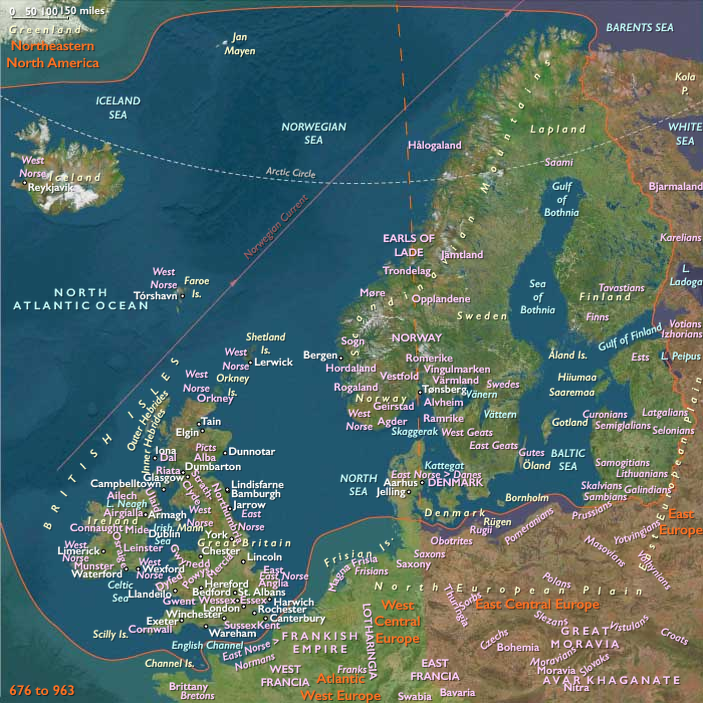
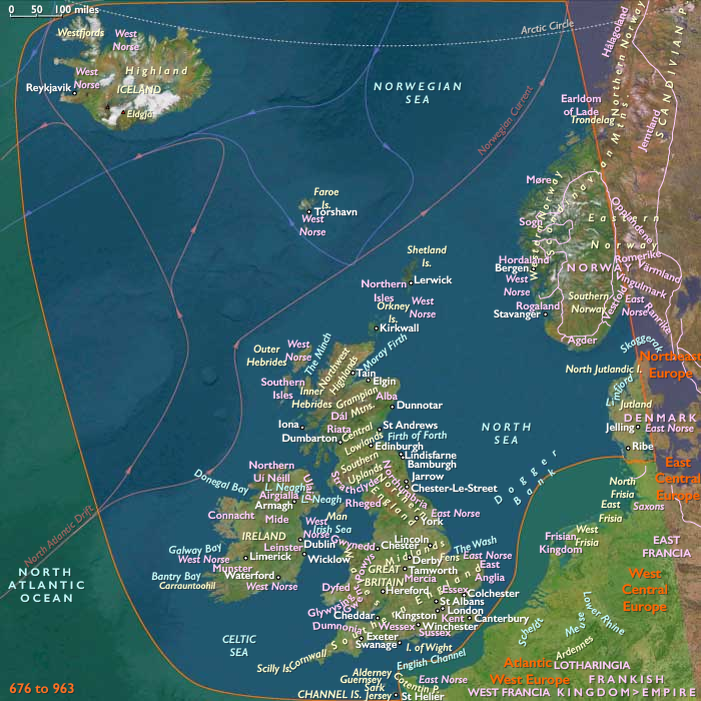
King Constantine II of Scotland retires and becomes a monk, and is succeeded by his cousin Malcolm I of Scotland.
Locations
People
Groups
Subjects
Regions
Subregions
Related Events
Filter results
Showing 10 events out of 53015 total
The relationship between the Liao and the Later Jin had soured after the death of Shi Jingtang in 942 and the elevation to the throne of Shi Chonggui, also known as Emperor Chudi of Later Jin.
The new emperor surrounds himself with anti-Khitan advisers, and in 943 he expels the Liao envoy from the Jin capital of Kaifeng and seizes the property owned by Khitan merchants in the city.
The second large-scale campaign by the Rus' in the Caspian region is dated to 943, when Igor is the supreme leader of the Rus', according to the Primary Chronicle.
During the 943 expedition, the Rus' row up the Kura River, deep into the Caucasus, defeat the forces of Marzuban bin Muhammad, and capture Bardha'a, the capital of Arran.
The Rus' allow the local people to retain their religion in exchange for recognition of their overlordship; it is possible that the Rus' intended to settle permanently here.
According to ibn Miskawaih, the local people broke the peace by stone-throwing and other abuse directed against the Rus', who then demanded that the inhabitants evacuate the city.
This ultimatum is rejected, and the Rus' begin killing people and holding many for ransom.
The slaughter is briefly interrupted for negotiations, which soon break down.
The Rus' stay in Bardha'a for several months, using it as a base for plundering the adjacent areas, and amass substantial spoils.
The city is saved only by an outbreak of dysentery among the Rus'.
Encouraged by the epidemic, the Muslims approach the city.
The Rus', their chief riding on a donkey, make an unsuccessful sally after which they lose seven hundred warriors, but evade encirclement and retreat to the Bardha'a fortress, where they are besieged by the Muslims.
Exhausted by the disease and the siege, the Rus' "left by night the fortress in which they had established their quarters, carrying on their backs all they could of their treasure, gems, and fine raiment, boys and girls as they wanted, and made for the Kura River, where the ships in which they had issued from their home were in readiness with their crews, and three hundred Russes whom they had been supporting with portions of their booty."
(Vernadsky, George (1959).
The Origins of Russia.
Oxford, Clarendon Press).
The Muslims then exhume from the Rus' graves the weapons that had been buried beside the warriors.
George Vernadsky proposed that Oleg of Novgorod was the donkey-riding chief of the Rus' who attacked Bardha'a.
Vernadsky identified Oleg with Helgu, a figure mentioned in the Schechter Letter.
According to that document, Helgu went to Persia by boat and died there after a failed attack on Constantinople in 941.
On the other hand, Lev Gumilev, drawing on the name of the Rus' leader (as recorded in Arabian sources), hypothesizes that this leader was Sveneld, a Varangian chieftain whose wealth was noted in the Primary Chronicle under 945.
Dunstan, an English monk in his mid-thirties who had served at the royal court before joining the monastery at Glastonbury, becomes abbot here in about 943, and institutes a thorough reform of the monastery.
The Image of Edessa, according to Christian tradition, is a holy relic consisting of a square or rectangle of cloth upon which a miraculous image of the face of Jesus was imprinted—the first icon ("image").
In Eastern Orthodoxy, and often in English, the image is known as the Mandylion.
According to the legend, King Abgar of Edessa wrote to Jesus, asking him to come cure him of an illness.
Abgar received a reply letter from Jesus, declining the invitation, but promising a future visit by one of his disciples.
This legend was first recorded in the early fourth century by Eusebius of Caesarea, who said that he had transcribed and translated the actual letter in the Syriac chancery documents of the king of Edessa, but who makes no mention of an image.
Instead, the apostle "Thaddaeus" is said to have come to Edessa, bearing the words of Jesus, by the virtues of which the king was miraculously healed.
The report of an image, which accrued to the legendarium of Abgar, first appears in the Syriac work, the Doctrine of Addai: according to it, the messenger, here called Ananias, was also a painter, and he painted the portrait, which was brought back to Edessa and conserved in the royal palace.
The first record of the existence of a physical image in the ancient city of Edessa (now Urfa) was in Evagrius Scholasticus, writing about 593, who reports a portrait of Christ, of divine origin, which effected the miraculous aid in the defense of Edessa against the Persians in 544.
John Kourkouas had invaded northern Mesopotamia in 943, and besieges Edessa in 944.
As the price for his withdrawal, Kourkouas obtains from its inhabitants one of Constantinople's most prized relics, the mandylion, the holy towel allegedly sent by Jesus Christ to King Abgar V of Edessa.
This is the final great achievement of Romanos's reign.
Romanos concludes a treaty with Prince Igor of Kiev in 944.
This crisis having passed, Kourkouas is free to return to the eastern frontier.
It has sometimes been suggested that a marriage alliance might bring together the Eastern and Western parts of the empire and so provide for a united defense against the common enemy in Sicily—the Arabs.
In 944, Constantine's five-year-old son is married to a daughter of Hugh of Provence, the Carolingian claimant to Italy.
Constantine also keeps up diplomatic contact with Otto I, the Saxon king of Germany.
Romanos' later reign has been marked by the old emperor's heightened interest in divine judgment and his increasing sense of guilt for his role in the usurpation of the throne from Constantine VII.
On the death of Christopher, by far his most competent son, in 931, Romanos had not advanced his younger sons in precedence over Constantine VII.
Fearing that Romanos will allow Constantine VII to succeed him instead of them, his younger sons Stephen and Constantine, impatient to succeed to power, arrest their father in December 944, carry him off to the Prince's Islands and compel him to become a monk.
The Lekapenos brothers threaten the position of Constantine VII, and the people of Constantinople, fearing only that the Porphyrogenitus emperor might be included in the purge accompanying the seizure of power, riot until Constantine appears at a window of the palace.
This show of loyalty emboldens him to banish Romanus' sons on January 27, 945.
Stephen and Constantine are likewise stripped of their imperial rank and sent into exile to their father.
Having never exercised executive authority, Constantine remains primarily devoted to his scholarly pursuits and relegates his authority to bureaucrats and generals, as well as to his energetic wife Helena Lekapene, the daughter of Emperor Romanos I and his wife Theodora.
Romanos II is a son of Emperor Constantine VII and Helena Lekapene.
Named after his maternal grandfather, Romanos had been married, as a child, to Bertha, the illegitimate daughter of Hugh of Arles, King of Italy, who changes her name to Eudokia after her marriage.
Constantine crowns his son Romanos co-emperor on April 6, 945.
John Kourkouas, although considered by some of his contemporaries "a second Trajan or Belisarius," is dismissed after the fall of the Lekapenoi in 945.
Nevertheless, his campaigns in the East have paved the way for the even more dramatic reconquests in the middle and the second half of the tenth century.
Constantine, now thirty-nine, will rule alone from this point forward.
He appoints to the highest army commands four members of the Phokas family, which had been in disgrace under the Lekapenoi, but takes no further reprisals, except for an incidental remark, in De ceremoniis, that Romanus Lecapenus was neither an aristocrat nor a cultured man.
That he does not depart from the admiral's basic policy-at home, maintaining a delicate balance among civil and military officers, landed aristocrats, and peasant soldiers; abroad, friendship with the Rus, peace with the Bulgarians, a limited commitment in Italy, and a resolute offensive against the Muslims—may be ascribed to statesmanship as well as to timidity.
The policy continues to be effective.
The Chersonese Greeks had alert the emperor about the approaching Kievans, who fled in 944/945.
This time, Constantinople hastens to buy peace and concludes a treaty with Kievan Rus'.
Its text is quoted in full in the Primary Chronicle.
The Emperor had sent gifts and offered tribute in lieu of war, and the Rus’ had accepted.
Envoys are sent between the Rus’, Constantinople, and the Bulgarians in 945, and a peace treaty is completed.
The agreement again focused on trade, but this time with terms less favorable to the Rus’, including stringent regulations on the conduct of Rus’ merchants in Cherson and Constantinople and specific punishments for violations of the law.
Constantinople may have been motivated to enter the treaty out of concern of a prolonged alliance of the Rus', Pechenegs, and Bulgarians against them, though the more favorable terms further suggest a shift in power.

The Hamdanids had captured Aleppo and …
…Homs and have occupied northern Syria following the death of ibn-Ra'iq in 942; a shaky truce ends the civil war in 944.
'Ali, one of three sons of Buyeh, of Daylamite origin, had been appointed governor of Karaj about 930 by the Daylamite leader Mardaviz ibn Ziyar.
'Ali had seized Isfahan and Fars, while …
…his brothers, Hasan and Ahmad, took Jibal, Khuzestan, and Kerman.