King Cenwalh of Wessex, driven from his …
Years: 645 - 645
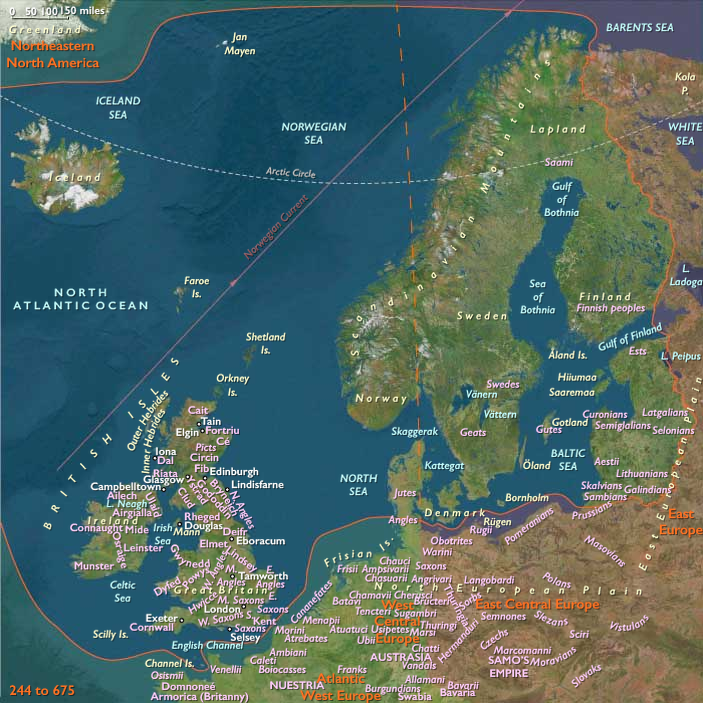
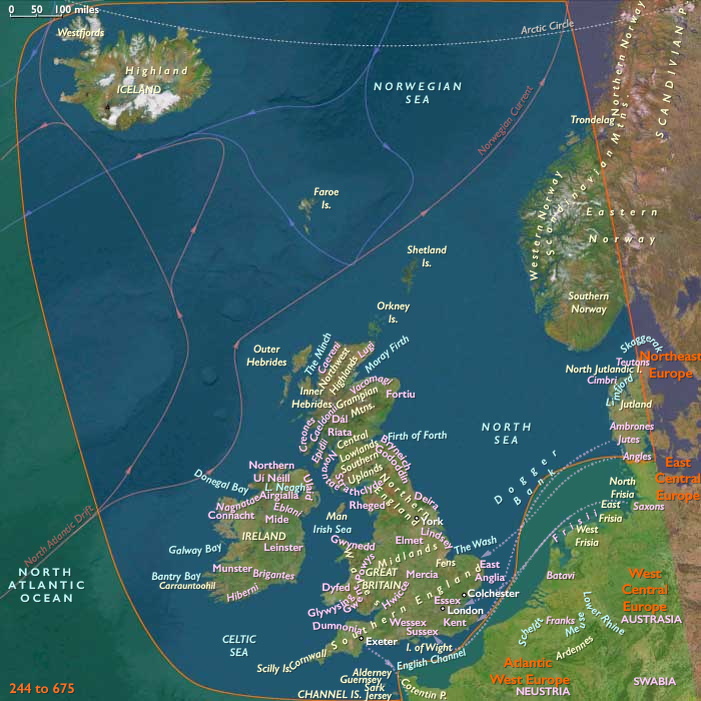
King Cenwalh of Wessex, driven from his kingdom by his brother-in-law, king Penda of Mercia, according to Bede, flees to the court of king Anna of East Anglia, and is baptized while in exile.
Penda overruns Wessex.
Locations
People
Groups
- Saxons
- Anglo-Saxons
- Christianity, Chalcedonian
- Wessex, English Kingdom of
- Mercia, Kingdom of
- Britain, Medieval
Topics
Subjects
Regions
Subregions
Related Events
Filter results
Showing 10 events out of 56478 total
The ambitious Emperor Taizong of Tang leads an army of sixty thousand men across the Liao River into the northern Korean kingdom of Goguryeo in spring, 645.
Tang forces under Li Shiji heads southeast, toward the Yalu River, and put the strategic fortress city of Anshi under siege.
Taizong is unable to capture the fortress, which is defended by Yang Manchun.
Food supplies running low and winter coming on, he withdraws his forces, with the main Goguryan army still intact, and returns to China.
Chinese monk Xuanzang returns from India, traveling through the Khyber Pass and passing through Kashgar, Khotan, and Dunhuang on his way back to China.
He arrives in the capital, Chang'an, on the seventh day of the first month of 645, and a great procession celebrates his return.
Xuanzang was greeted with much honor but he refuses all high civil appointments offered by the still-reigning emperor, Emperor Taizong of Tang.
Instead, he retires to a monastery and, with the emperor's support, he sets up a large translation bureau in Chang'an, drawing students and collaborators from all over East Asia.
Having brought from India six hundred and fifty-seven basic Buddhist texts in Sanskrit, he ultimately systematizes and translates seventy-five of the texts, publishing them as Datang xiyouji.
He is credited with the translation of some 1,330 fascicles of scriptures into Chinese.
His strongest personal interest in Buddhism is in the field of Yoacara, or Consciousness-only.
The force of his own study, translation and commentary of the texts of these traditions initiates the development of the Faxiang school in East Asia.
Although the school itself does not thrive for a long time, its theories regarding perception, consciousness, karma, rebirth, etc., will find their way into the doctrines of other more successful schools.
Peace between Muslim Egypt and Christian Makuria only really materializes in 645 upon the succession of Abdullah Ibn Sa'ad.
This peace will last until the Second Battle of Dongola, the outcome of which in 652 will result in one of the longest peace treaties in recorded history.
Constantinople makes several attempts to retake Alexandria.
None of these are successful for a sustained period of time, but imperial forces in 645 are able to briefly regain control of the city, when Uthman dismisses Amr as military governor of Alexandria.
Constans, taking advantage of the power vacuum, dispatches a fleet to besiege the city, successfully at first, as Alexandria revolts from Arab rule at the appearance of three hundred ships of the imperial fleet, whose forces recapture the city.
Arab chroniclers tell of a massive fleet and army sent by Constantinople with the goal of retaking Alexandria.
The imperial forces are led by a lower ranking imperial official named Manuel.
After entering the city without facing much resistance, the imperial forces are able to regain control of both Alexandria and the surrounding Egyptian countryside.
Rothari’s quick conquests have left Constantinople with only the Ravennan marshes in northern Italy.
The exarch of Ravenna, Plato, tries to regain some territory by invading the southern Po Valley, but his army is defeated by Rothari on the banks of the Scultenna (the Panaro) near Modena, with the loss of eight thousand men, in 645.
However, …
…Plato recaptures Oderzo in the same year.
Greek theologian Maximus (later called the Confessor), in his many writings on ascetical, doctrinal, exegetical, and liturgical subjects, argues that through Christ, the Incarnate Word, humans had received the power to practice virtue, which he interprets as a combination of ascetic self-denial with active charity.
Monothelitism has evoked a hostile reception among the churches of North Africa and Italy.
The Exarchate of Africa is this time n internal turmoil due to the conflict between the mainly Orthodox Chalcedonian population and the supporters of Monotheletism, the attempt at compromise between Chalcedonianism and Monophysitism devised and promoted by Heraclius in 638.
In Africa, the latter is mostly advocated by refugees from Egypt.
In an effort to lessen the tensions, in July 645 Gregory the Patrician, Exarch of Africa,hosts a theological dispute in his capital, Carthage, between the Chalcedonian Maximus the Confessor and the Monothelite former Patriarch of Constantinople, Pyrrhus.
Gregory helps to bring about a reconciliation between the two, and Pyrrhus re-embraces the Chalcedonian position.
Over the next few months, several local synods in Africa proceed to condemn Monotheletism as heresy.
Gwynedd and much of Wales is in the grasp of famine.
Would-be king Cadwaladr Fendigaid flees to Brittany.
Civil war continues in his kingdom.
Prince Naka no Ōe, the son of Emperor Jomei, plays a crucial role in ending the near-total control the Soga clan have over the imperial family.
From 644, seeing the Soga continue to gain power, he conspires with Nakatomi no Kamatari and Soga no Kurayamada no Ishikawa no Maro to assassinate Soga no Iruka in what has come to be known as the Isshi Incident.
The assassination of Iruka takes place on July 10, 645, during a court ceremony at which memorials from the Three Kingdoms of Korea are being read to Empress Kōgyoku by Ishikawa no Maro.
Prince Naka no Ōe has made elaborate preparations, including closing the palace gates, bribing several palace guards, hiding a spear in the hall where the ceremony is to take place and ordering four armed men to attack Iruka.
However, when it becomes clear that the four men are too frightened to carry out the orders, Naka no Ōe rushes Iruka himself and cuts open his head and shoulder.
Iruka is not killed immediately, but protests his innocence and pleads for an investigation.
Prince Naka no Ōe pleads his case before Empress Kōgyoku, and when she retires to consider the matter, the four guards finally rush Iruka again and complete the killing.
Shortly afterwards, Iruka's father Soga no Emishi kills himself by setting fire to his residence.
The conflagration destroys the manuscript copy of the Tennōki and many other Imperial treasures which had been taken for safekeeping by the Soga, but Fune no Fubitoesaka quickly grabs the burning Kokki from the flames.
Later, he is said to have presented it to Naka no Ōe; but no known extant copies of the work remain.
The violence actually unfolded in Kōgyoku's presence.
The Empress responds to this shock by determining to renounce the throne.
Japanese society during the Asuka period is sensitive to issues of "pollution," both spiritual and personal.
Deaths—especially a violent killing that, conducted in close physical proximity to the Empress, is considered to be among the worst possible acts of pollution—would warrant days of seclusion in an uncertain process attempting to redress what is been construed as a kind of profanity.
Although Kōgyoku wants to abdicate immediately in favor of Naka no Ōe, Nakatomi no Kamatari insists that throne should pass instead to his older brother, Furuhito no Ōe, or to his maternal uncle (Kōgyoku's brother) Prince Karu.
Furuhito no Ōe resolves the impasse by declaring his intention to renounce any claim to the throne by taking the tonsure of a Buddhist monk.
This same day—traditionally said to be July 12, 645—Furuhito no Ōe shaves off his hair at Hōkō-ji, in the open air between the Hall of Buddha and the pagoda.
At this point, Kōgyoku does abdicate in favor of her brother, who shortly thereafter accedes to the throne as Emperor Kōtoku (645-654).
Following the Isshi Incident, Iruka's adherents disperse largely without a fight, and Naka no Ōe is named heir apparent.
He also marries the daughter of his ally Soga no Kurayamada, thus ensuring that a significant portion of the Soga clan's power is on his side.

Years: 645 - 645
Locations
People
Groups
- Saxons
- Anglo-Saxons
- Christianity, Chalcedonian
- Wessex, English Kingdom of
- Mercia, Kingdom of
- Britain, Medieval