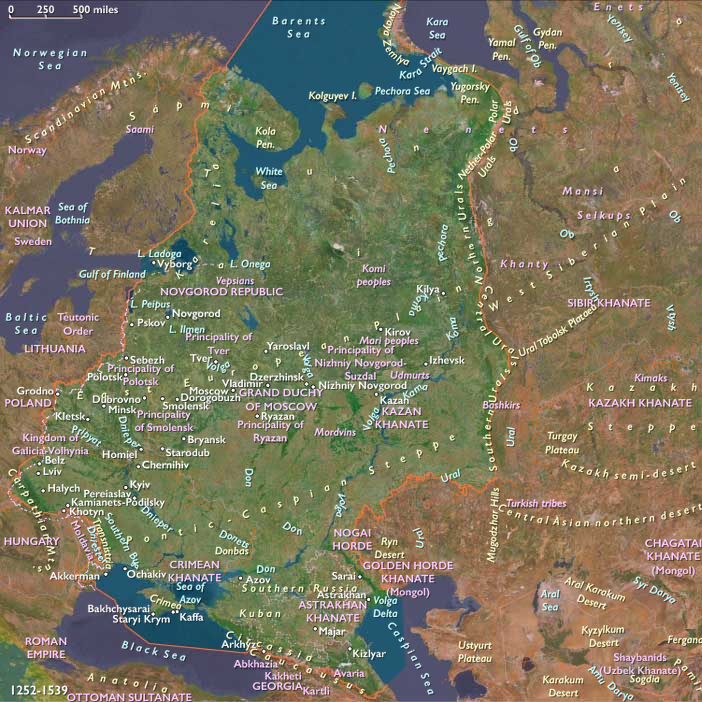
King Casimir III initiates Poland’s eastward expansion …
Years: 1349 - 1349
King Casimir III initiates Poland’s eastward expansion beyond ethnically Polish lands by the 1349 acquisition of the duchy of Galich-Vladimir (later to be known as Galicia), originally to secure a barrier against Tatar invasion.
Locations
People
Groups
- Tatars
- Golden Horde, Khanate of the (Mongol Khanate)
- Galicia–Volhynia, Kingdom of
- Poland of the later Piasts, Kingdom of
Subjects
Regions
Subregions
Related Events
Filter results
Showing 10 events out of 44228 total
Bulgaria, having lost its Macedonian lands to Dushan's Serbian empire, which has become the dominant Balkan power, appears to be on the point of disintegration into feudal states when the invasions of the Ottoman Turks begin.
The crumbling Bulgarian empire divides in the late 1350s into two kingdoms, one based in the imperial capital of Veliko Türnovo, …
…and the other in Vidin along the Danube in the far northwest.
The Black Death has meanwhile reached Hungary.
The first wave of the epidemic ends in June, but it returns in September, killing Louis the Great's wife Margaret.
Louis also falls ill, but survives the plague.
Although the Black Death is less devastating in the sparsely populated Hungary than in other parts of Europe, there are regions which become depopulated in 1349 and the demand for work force will increase in the subsequent years.
Louis, who had signed a truce for eight years with Venice on August 5, had sent new troops to Naples under the command of Stephen Lackfi, Voivode of Transylvania, in late 1349.
Lackfi had reoccupied Capua, Aversa and other forts that had been lost to Joanna I, but a mutiny among his German mercenaries had forced him to return to Hungary.
Bohemia has remained untouched by the plague.
Charles IV, as King of Germany and King of Bohemia from 1346, had initially worked to secure his power base.
Prague has become his capital, and he is rebuilding the city on the model of Paris, establishing the New Town of Prague (Nové Město).
Charles inspires the establishment of the first university east of the Rhine, later called Charles University.
He had asked this of his friend and ally, Pope Clement VI, who on January 26, 1347, had issued the bull establishing a university in Prague, modeled on the University of Paris, with the full (four) number of faculties, that is including theological.
On April 7, 1348 Charles, the king of Bohemia, had given to the established university privileges and immunities from the secular power in a Golden Bull and on January 14, 1349, he repeats this as the King of the Romans.
Most Czech sources since the nineteenth century—encyclopedias, general histories, materials of the University itself—prefer to give 1348 as the year of the founding of the university, rather than 1347 or 1349.
This was caused by an anticlerical shift in the nineteenth century, shared by both Czechs and Germans.
The university is actually opened in 1349.
The university is sectioned into parts called nations: the Bohemian, Bavarian, Polish and Saxon.
The Bohemian nation includes Bohemians, Moravians, southern Slavs, and Hungarians; the Bavarian include Austrians, Swabians, natives of Franconia and of the Rhine provinces; the Polish include Silesians, Poles, Russians; the Saxon includes inhabitants of the Margravate of Meissen, Thuringia, Upper and Lower Saxony, Denmark, and Sweden.
Ethnically Czech students make up sixteen to twenty percent of all students.
Archbishop Arnošt of Pardubice takes an active part in the foundation by obliging the clergy to contribute and became a chancellor of the university (i.e., director or manager).
Charles University will serve as a training ground for bureaucrats and lawyers, and Prague will soon emerge as the intellectual and cultural center of Central Europe.

The Persecution of Jews During the Black Death (1348–1351)
As the Black Death ravaged Europe between 1347 and 1351, it was accompanied by a wave of violent persecution against Jewish communities, fueled by false accusations that Jews had deliberately spread the plague. These attacks occurred throughout Spain, Italy, France, the Low Countries, and the Germanic lands, leading to massacres, forced conversions, and expulsions.
Scale of the Persecution
- Of the approximately 363 Jewish communities in Europe at the time, Jews faced violent attacks in nearly half.
- Many Jews lived in overcrowded, walled Jewish quarters, where they suffered from the plague at similar rates as their Christian neighbors.
- Nevertheless, conspiracy theories spread rapidly, blaming Jews for poisoning wells, contaminating the air, or plotting against Christians.
Massacres and Expulsions
- In 1348–1349, massacres of Jews took place across Western and Central Europe, including:
- Barcelona and other Spanish cities
- Toulouse, Avignon, and other French towns
- Brussels and various towns in the Low Countries
- Cologne, Frankfurt, Mainz, and other German cities
- Basel and Strasbourg (where entire Jewish communities were burned alive).
- Some rulers, such as Pope Clement VI, attempted to protect Jewish communities, issuing a papal bull condemning the accusations as false, but local authorities and mobs often ignored or defied his orders.
Heinrich Graetz’s Historical Perspective
- The 19th-century Jewish historian Heinrich Graetz, in History of the Jews (1894), described the widespread belief that Jews had poisoned wells to spread the plague, stating:
- “The suspicion arose that the Jews had poisoned the brooks and wells, and even the air, in order to annihilate the Christians of every country at one blow.”
- This false accusation, combined with existing antisemitic prejudice and economic tensions, led to one of the most devastating waves of persecution in Jewish medieval history.
Long-Term Consequences
- Many Jewish communities were annihilated, and survivors fled to Eastern Europe, particularly to Poland and Lithuania, where they were granted relative protection under more tolerant rulers.
- The massacres further entrenched antisemitic policies in many European states, reinforcing Jewish segregation, economic restrictions, and future expulsions.
- The social and economic losses caused by these persecutions weakened urban economies, as Jews had played key roles in finance, trade, and medicine.
The persecution of Jews during the Black Death remains one of the darkest episodes of medieval Europe, showcasing how fear, ignorance, and long-standing prejudices fueled mass violence and scapegoating in times of crisis.
With this financial incentive to kill Jews, the attacks only intensify.
A Romanian voivode named Dragos, having crossed the Carpathians and settled with other Romanians on the plain between the mountains and the Black Sea, is joined in 1349 by a Transylvanian voivode named Bogdan, according to a second legend of the Romanian principalities' origins.
Bogdan revolts against his feudal Hungarian overlord and settles on the Moldova River, from which Moldavia derives its name.
Years: 1349 - 1349
Locations
People
Groups
- Tatars
- Golden Horde, Khanate of the (Mongol Khanate)
- Galicia–Volhynia, Kingdom of
- Poland of the later Piasts, Kingdom of