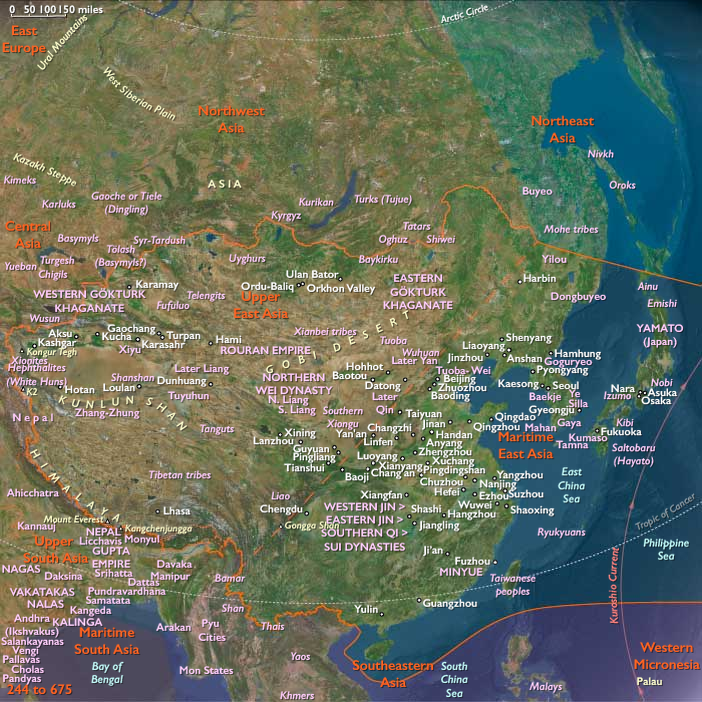
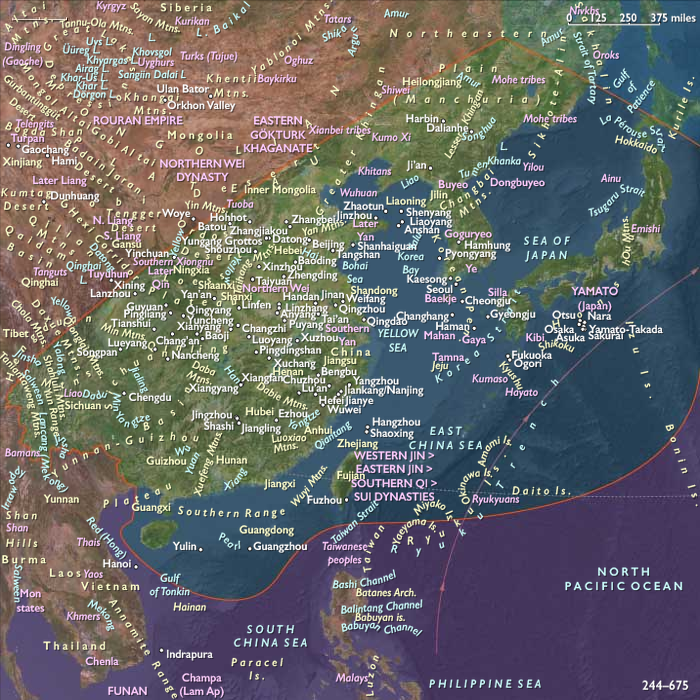
King Asin of Baekje attacks Silla in …
Years: 403 - 403
June
King Asin of Baekje attacks Silla in 403, whence many of his subjects had fled in 399 to avoid conscription.
Locations
People
Groups
Topics
Subjects
Regions
Subregions
Related Events
Filter results
Showing 10 events out of 59238 total
Murong Chao's father Murong Na was the Prince of Beihai during Former Yan, being a son of Murong Huang (Prince Wenming) and a younger brother of Murong Jun (Emperor Jingzhao).
After Former Yan's destruction by Former Qin in 370, the Former Qin emperor Fu Jiān initially made Murong Na a prefetcure governor, but later Murong Na was relieved from that post and relocated, along with his mother Lady Gongsun and Lady Duan to be with his younger brother Murong De, who was the governor of Zhangye Prefecture (roughly modern Zhangye, Gansu).
(Murong Na and Murong De had the same mother.)
Later, when Murong Na's brothers Murong De and Murong Chui rebelled against Former Qin in 384, with Murong Chui establishing Later Yan and becoming its emperor, Fu Chang, the new governor of Zhangye, arrested and executed Murong Na and all sons of Murong De and Murong Na.
At that time, Lady Duan was not executed because she was pregnant, but she was imprisoned to await execution after she gave birth.
However, the jailer Huyan Ping was a former subordinate of Murong De's, and he took Lady Gongsun and Lady Duan and escaped to the lands of the Qiang tribes, where Lady Duan gave birth to Murong Chao.
After Lady Gongsun died in 394, Huyan Ping took Lady Duan and Murong Chao to Later Liang.
Later, after Later Liang surrenders to Later Qin in 403, Huyan Ping, Lady Duan, and Murong Chao are among the populace of the Later Liang capital Guzang (in modern Wuwei, Gansu) forcibly relocated to …
…the Later Qin capital, Chang'an.
Here, Huyan Ping dies, and Lady Duan has Murong Chao take Huyan Ping's daughter as his wife.
Epiphanius had gone to Constantinople at Theophilus’ request, but when he realized that Theophilus was merely using him for his own purposes, he had left the capital, dying on his return in 403.
The Christian revival of Celtic art, which borrows heavily from late Roman provincial and contemporary Anglo-Saxon designs, is rapidly transmitted to Ireland.
The Scots of Ireland from about 395 had begun attacking Roman Britain from Strathclyde south to Wales, devastating coastal settlements and carrying off thousands of captives into slavery.
According to later tradition, during one of his many raids on Britain, Niall of the Nine Hostages, high king at Meath, captured the future Saint Patrick, aged sixteen, and brought him in bondage to Ireland, where he serves as a swineherd.
Patrick will succeed in escaping to Britain many years later, but he will eventually return to Ireland and play an important early role in the conversion of the Irish to Christianity.
The fifth and youngest son of Eochaid Mugmedon, an Irish High King, and Cairenn Chasdubh (curly black), the enslaved daughter of Sachell Balb (Sachell the stammerer), a British king, Niall is the eponymous ancestor, through his sons Conall Gulban, Endae, Eogan, Coirpre, Lóegaire, Maine of Tethba, Conall Cremthainne and Fiachu Fiachrach, of the Northern and Southern Uí Néill dynasties, some of whom will hold power in Ulster until their defeat in the Nine Years War in 1603. (In January 2006, scientists suggested that Niall may have been the most fecund male in Irish history, and second only to Genghis Khan worldwide.)
There are various versions of how Niall gained his epithet, the oldest being that he had taken a hostage from each of the nine túatha or petty kingdoms of the Airgialla.
The later, better known story is that he had taken a hostage from each of the five provinces of Ireland (Ulster, Connacht, Leinster, Munster and Meath), and one each from the Scots, Saxons, Britons, and Franks (or one each from Dál Riata, Caledonia, Strathclyde and Northumbria).
Irish sources describe Niall's expeditions to Britain and France, and his reign, as given in the Irish Annals, which is roughly contemporaneous with the foundation of Dál Riata in Scotland by Irish migrants and the raids by "Scots" on late Roman and sub-Roman Britain.
Alaric is allowed to escape after another defeat before Verona in June, though his army is in bad condition.
He had not "penetrated to the city", but his invasion of Italy has produced important results.
It had caused the imperial residence to be transferred from Milan to Ravenna, and will soon necessitate the withdrawal of Legio XX Valeria Victrix from Britain.
Stilicho, having engaged Alaric successfully and pursued him northward, is probably capable of massacring the barbarians with his superior numbers, but instead develops a treaty with Alaric designed to aid the former's ambitions in invading and controlling the Eastern Roman empire.
Alaric withdraws to Illyricum, where the Western court again gives him office, though only as comes and only over Dalmatia and Pannonia Secunda rather than the whole of Illyricum.
Stilicho probably supposes that this pact will allow him to put Italian government into order and recruit fresh troops.
John Chrysostom, as patriarch of Constantinople, has proven himself a courageous and faithful administrator, implementing a series of reforms in his diocese.
John’s asceticism is at odds with the luxurious tone of the age, and he finds himself incapable of subservience to the emperor Arcadius and his domineering wife, Eudoxia who, although an earnest Christian, quarrels bitterly with the patriarch.
Tactless and idealistic to the point of bigotry, the patriarch repeatedly denounces Arcadius' court for immorality and frivolity.
At this time Chrysostom delivers a sermon against the vain luxury of women.
It is reported to the empress as though Chrysostom had been referring to her personally, which only embitters her more against the Patriarch.
Theophilus, Patriarch of Alexandria, at last appears at Constantinople in June, 403, not alone, as he had been commanded, but with twenty-nine of his suffragan bishops, and, as Palladius tells us, with a good deal of money and all sorts of gifts.
He takes his lodgings in one of the imperial palaces, and holds conferences with all the adversaries of Chrysostom.
Then he retires with his suffragans and seven other bishops to a villa near Constantinople, called Epi Dryn.
A long list of unfounded accusations is drawn up against Chrysostom, whose powerful enemies unite to condemn and depose him at the illegal Synod of the Oaks.
The synod now consists of forty-two archbishops and bishops, many of whom are Syrian and Egyptian bishops inimical to him brought by Theophilus.
The synod, assembled to judge Theophilus in accordance with the orders of the emperor, now summons Chrysostom to present himself and apologize.
Severian, Bishop of Gabala in Syria, whom Chrysostom had previously ordered to leave Constantinople because of his involvement in a plot against the patriarch, serves as prosecutor.
Chrysostom naturally refuses to recognize the legality of a synod in which his open enemies are judges.
After the third summons, Chrysostom, with the consent of the emperor, is declared to be deposed.
In order to avoid useless bloodshed, he surrenders himself on the third day to the soldiers who await him, but the threats of the excited people, and a sudden accident in the imperial palace, frighten the empress, who, fearing some punishment from heaven for Chrysostom's exile, immediately orders his recall.
After some hesitation, Chrysostom reenters the capital amid the great rejoicing of the people.
Theophilus and his party save themselves by fleeing from Constantinople.

Emperor Honorius and Stilicho, in what is to be the last victory celebrated in Rome, are honored with a triumphal march for the victories against the Goths.
Chinese Buddhist theologian Huiyuan had in 402 organized a group of monks and lay people into a Mahayana sect known as Pure Land Buddhism, the Pure Land being the western paradise of the Buddha Amitabha.
According to this belief, the cosmos contains many Pure Lands, in each of which dwells one Buddha.
He founds a monastery on Lushan in Jiangxi province and writes the text On Why Monks Do Not Bow Down Before Kings in 404.
In his book he argues that although the Buddhist clergy should remain independent and undisturbed by politics, the Buddhist laymen nonetheless make good subjects under monarchs, due to their fear of retribution of karma and desire to be reborn in paradise.
Gwanggaeto of Goguryeo attacks Liáoníng in 404 and takes the entire Liaodong Peninsula.
Murong Chao, apprehensive that his true identity will be discovered, becomes a beggar and pretends to be insane.
However, on one occasion, the brother of Later Qin's emperor Yao Xing, Yao Shao, the Duke of Dongping, sees him, and thinks that this is not truly an insane person—because he looks healthy and strong physically.
He informs Yao Xing of this and suggests that Yao Xing give Murong Chao a minor official position to secure him.
Yao Xing summons Murong Chao to an audience with him, but Murong Chao continues the charade and intentionally gives wrong answers or no answers at all when Yao Xing asks him questions.
Yao Xing is unconvinced that Yao Shao is correct, and sends Murong Chao away.