Kilkenny, located in the valley of the …
Years: 1293 - 1293
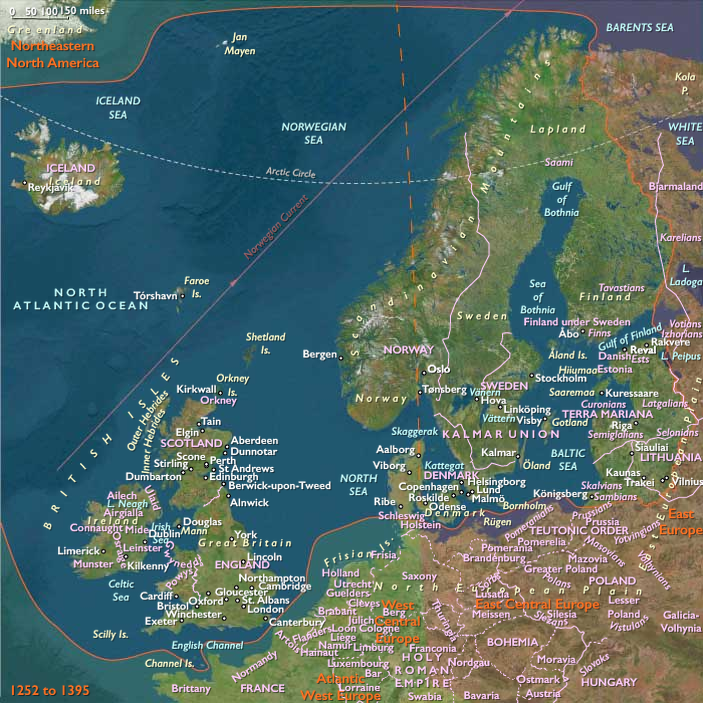
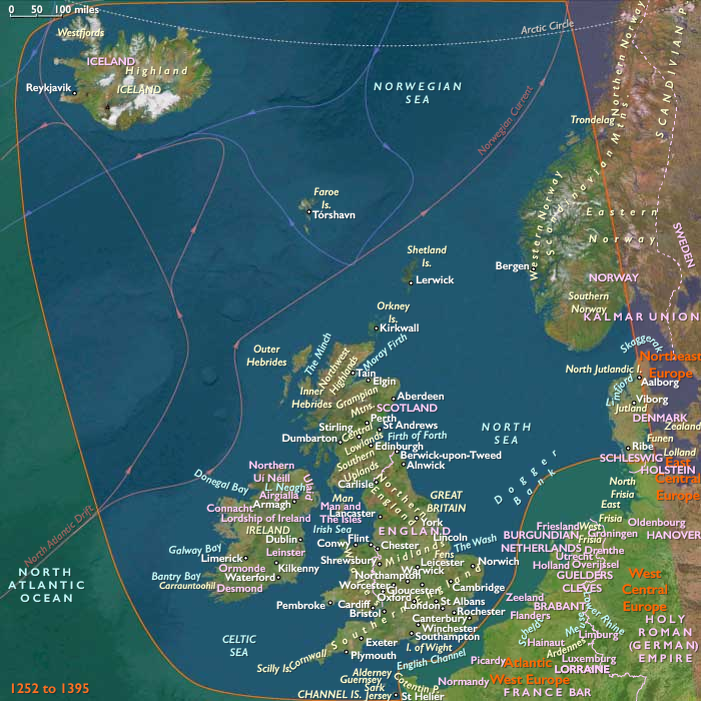
Kilkenny, located in the valley of the River Nore has been divided, since Norman times, into Englishtown and Irishtown, with much strife between the two.
An Anglo-Norman parliament is held there from 1293.
Locations
Groups
- Irish people
- Anglo-Normans
- England, (Plantagenet, Angevin) Kingdom of
- Ireland, (English) Lordship of
Subjects
Regions
Subregions
Related Events
Filter results
Showing 10 events out of 45262 total
The Khan has sent a massive one-thousand-ship ship expedition that arrives off the coast of Java in 1293.
Raden Wijaya, Kertanegara's son in law and supreme commander, himself a descendant of the kingdom’s founder Ken Anrok, after a brief exile in the favor of the Regent (Bupati) Arya Wiraraja of Madura, allies himself with the Mongols against Jayakatwang and, once Jayakatwang is destroyed and the invaders are feasting in victory, turns and forces his Mongol allies to withdraw from the isle after he launches a surprise attack.
The huge Mongol Army has to withdraw in confusion as they are in hostile land and it is the last opportunity for the monsoon that will allow them to depart for home, otherwise, they would have had to wait for another six months anchored off hostile territory.
Wijaya, or Vijaya, now establishes a state in eastern Java (to be known eventually as the Majapahit Empire), which is to become one of the greatest empires to arise from within the area covered by the modern territory of Indonesia.
The exact date used as the birth of the Majapahit kingdom is the day of his coronation, the fifteenth of Kartika month in the year 1215 using the Javanese çaka calendar, which equates to November 10, 1293.
During his coronation he is given the formal name Kertarajasa Jayawardhana.
King Kertarajasa takes all four daughters of Kertanegara as his wives, his first wife and prime queen consort Tribhuwaneswari, and her sisters; Prajnaparamita, Narendraduhita, and Gayatri Rajapatni the youngest.
He also takes a Sumatran Malay Dharmasraya princess named Dara Petak as his wife.
An earthquake in Kamakura, Japan, kills an estimated thirty thousand on May 26, 1293.
Marshal Torkel, as Torkel Knutsson has come to be known, leads the so-called third Swedish crusade against Novgorod following an attack on Tavastland in by the Republic of Novgorod in 1292, and in 1293 conquers parts of Karelia, where he founds the stronghold of Vyborg.
A settlement at Wittenberg, an inland harbor port situated on the Elbe River between Berlin and Leipzig, and the eventual residence of the electors of Saxony, was first mentioned in 1180 as a small village founded by Flemish colonists under the rule of the House of Ascania.
In 1260, this village became the residence of the dukes of Saxe-Wittenberg, and in 1293 the settlement is granted its town charter as a freestanding town.
Because of its central location, Wittenberg will develop into an important trade center during the following several centuries.
Al-Ashraf Khalil, accompanied by Ibn al-Salus, Baydara and other Emirs in December 1293, goes to Turug in northern Egypt on a bird-hunting expedition.
He sends Ibn Al-Salus to the nearby city of Alexandria to bring materials and to collect the taxes.
Arriving at Alexandria, Ibn Al-Salus discovers that the deputies of Baydara had already taken everything.
On receiving a message from Ibn Al-Salus with this news, Al-Ashraf summons Baydara to his Dihlis and insults and threatens him in the presence of other Emirs.
The distressed Baydar leaves the Dihlis and calls Lajin, Qara Sunqur and other Emirs and together they decide to kill the Sultan.
The Sultan while walking on December 14 with his friend Emir Shihab ad-Din Ahmad is attacked and assassinated by Baydara and his followers.
The Emirs who strike the Sultan after Baydara are Hosam ad-Din Lajin and Bahadir Ras Nubah followed by other Emirs.
After the assassination of Al-Ashraf Khalil, Baydara and his followers go to the Dihliz and proclaim Baydara the new Sultan, but Baydara is soon arrested by the Sultani Mamluks and Emirs.
Baydara is killed by the Sultani Emirs led by Kitbugha and Baibars al-Jashnikir and his head is sent to Cairo.
Ibn al-Salus is arrested in Alexandria and is sent to Cairo, where he is mistreated and at last beaten to death.
The Emirs who were involved in the assassination of Al-Ashraf Khalil are severely punished and executed.
Lajin and Qara Sunqur flee and disappear.
After the death of Al-Ashraf Khalil, the Emirs decide to install his nine-year-old brother Al-Nasir Muhammad as the new Sultan, with Kitbugha as vice-Sultan and al-Shaja'i as the new Vizier, but the death of Al-Ashraf Khalil is concealed for sometime.

Dante Alighieri, born to a middle-class Florentine family with some pretensions to ancient nobility, was nine years old in 1275, when he encountered eight-year-old Beatrice Portinari and developed an intensely spiritual devotion to her.
Dante has received a good education both in the classics and in scholastic Christian literature, also studying painting and music.
Having begun, at a very early age, to write poetry—largely love lyrics (canzoni) in the style of Guido Guinizelli and Guido Cavalcanti—he had encountered Beatrice for a second time in 1283 and, despite his own marriage, in 1285, to Gemma Donati (which produces several children) and Beatrice's to Simon de'Bardi, has remained spiritually devoted to Beatrice.
In the political wars between the pro-papal Guelphs and the Empire-aligned Ghibellines, Dante, a Guelph, had fought in 1289 with his fellow Florentines against the Ghibellines at the Battle of Campaldino.
Following the death, on June 8, 1290, of twenty-four-year-old Beatrice, he had composed, in her honor, his first book, La vita nuova (“The New Life”).
Completed in 1293, the work embodies the progression of his courtly love for her in the love poetry contained within.
Arnolfo combines architecture and sculpture in another giant canopy, this time for Santa Cecilia in Trastevere, Rome, executed in 1293.
Cimabue frescoes parts of the Basilica of San Francesco in Assisi in the late 1280s and early 1290s with depictions of the Virgin, Christ, angels, the evangelists, and the Apocalypse, subjects reflecting the preaching of Saint Francis, who is entombed here.
Cimabue’s painterly exploration of real appearances and human feelings is instrumental in transforming Italian painting from its mannered Byzantine roots to a new, naturalistic assertiveness.
Most Jewish communities in the Kingdom of Naples, the cradle of Ashkenazic culture in southern Italy, have been destroyed by 1293, accompanied by the conversions of many Jews.
A Studium Generale (as Universities are known at this time) in Alcala de Henares is founded by the Archbishop of Toledo, Gonzalo Garcia Gudiel, under a Royal Charter granted by King Sancho IV of Castile on May 20, 1293.
This is the nucleus of today’s Complutense University of Madrid.
One of its alumni, Cardinal Cisneros, will make extensive purchases of land and order the construction of many buildings, in what will become the first university campus ex-novo in history: the Civitas Dei, or city of God, named after the work of Agustine of Hippo.
Years: 1293 - 1293
Locations
Groups
- Irish people
- Anglo-Normans
- England, (Plantagenet, Angevin) Kingdom of
- Ireland, (English) Lordship of