
Historians have debated the long-term influence of …
Years: 1252 - 1395
Historians have debated the long-term influence of Mongol rule on Russian society.
The Mongols have been blamed for the destruction of Kievan Rus', the breakup of the "Russian" nationality into three components, and the introduction of the concept of "oriental despotism" into Russia, but most historians agree that Kievan Rus' was not a homogeneous political, cultural, or ethnic entity and that the Mongols merely accelerated a fragmentation that had begun before the invasion.
Historians also credit the Mongol regime with an important role in the development of Muscovy as a state.
Under Mongol occupation, for example, Muscovy develops its postal road network, census, fiscal system, and military organization.
Kievan Rus' also leaves a powerful legacy.
The leader of the Rurik Dynasty has united a large territory inhabited by East Slavs into an important, albeit unstable, state.
After Vladimir accepts Eastern Orthodoxy, Kievan Rus' comes together under a church structure and develops a Byzantine-Slavic synthesis in culture, statecraft, and the arts.
On the northeastern periphery of Kievan Rus', those traditions are adapted to form the Russian autocratic state.
Locations
Groups
- Lithuanians (Eastern Balts)
- Slavs, East
- Rus' people
- Novgorod, Principality of
- Rurik dynasty
- Kievan Rus', or Kiev, Great Principality of
- Poles (West Slavs)
- Christians, Roman Catholic
- Christians, Eastern Orthodox
- Mongols
- Novgorod Republic
- Vladimir-Suzdal, Great Principality of
- Galicia–Volhynia, Principality of
- Mongol Empire
- Golden Horde, Khanate of the (Mongol Khanate)
- Galicia–Volhynia, Kingdom of
- Galicia–Volhynia, Kingdom of
- Roman Empire, Eastern: Palaiologan dynasty
- Belarusians (East Slavs)
- Russians (East Slavs)
- Ukrainians (East Slavs)
- Poland of the later Piasts, Kingdom of
- Lithuania, Grand Duchy of
- Poland of the Jagiellonians, Kingdom of
- Lithuania, Grand Duchy of
Topics
Commodoties
Subjects
Regions
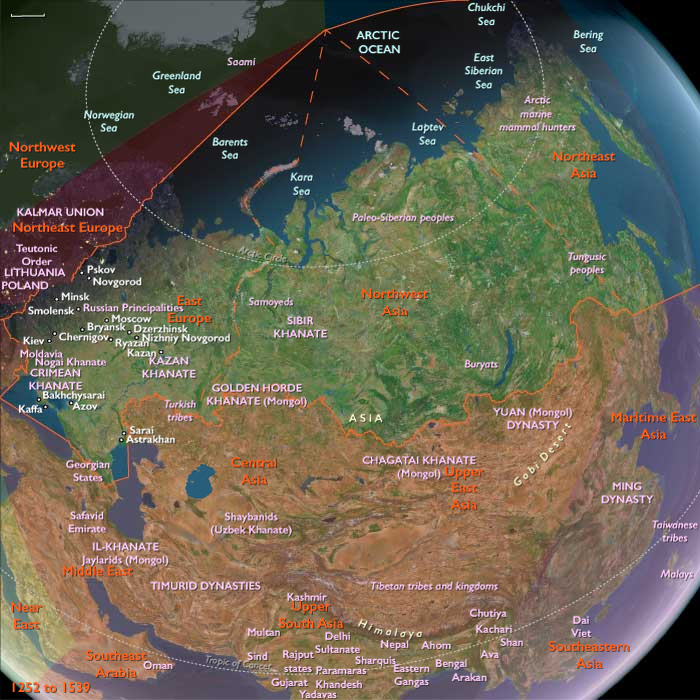
Subregions
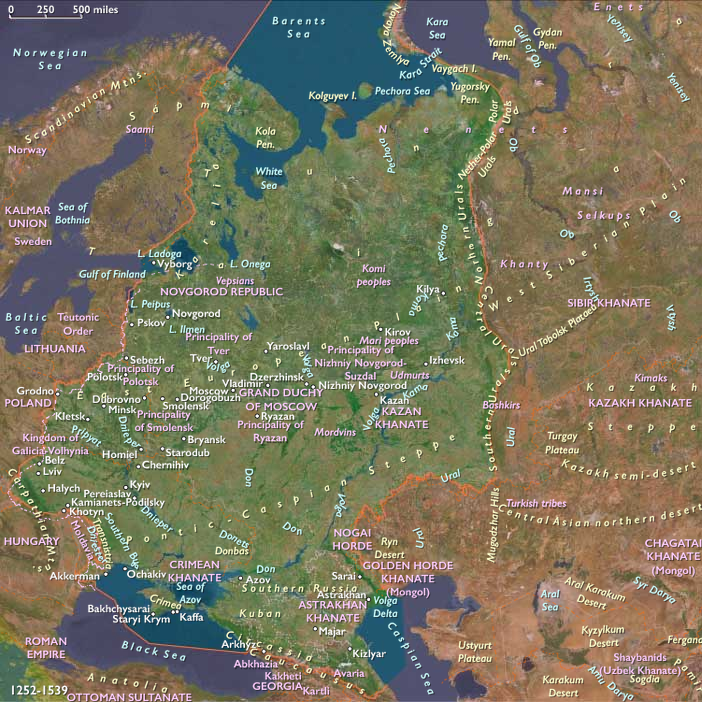
Years: 1252 - 1395
Locations
Groups
- Lithuanians (Eastern Balts)
- Slavs, East
- Rus' people
- Novgorod, Principality of
- Rurik dynasty
- Kievan Rus', or Kiev, Great Principality of
- Poles (West Slavs)
- Christians, Roman Catholic
- Christians, Eastern Orthodox
- Mongols
- Novgorod Republic
- Vladimir-Suzdal, Great Principality of
- Galicia–Volhynia, Principality of
- Mongol Empire
- Golden Horde, Khanate of the (Mongol Khanate)
- Galicia–Volhynia, Kingdom of
- Galicia–Volhynia, Kingdom of
- Roman Empire, Eastern: Palaiologan dynasty
- Belarusians (East Slavs)
- Russians (East Slavs)
- Ukrainians (East Slavs)
- Poland of the later Piasts, Kingdom of
- Lithuania, Grand Duchy of
- Poland of the Jagiellonians, Kingdom of
- Lithuania, Grand Duchy of
Topics
Commodoties
Subjects
Regions
Subregions